- Finance Ministry blocks Estadão's request for the files behind MP 1394
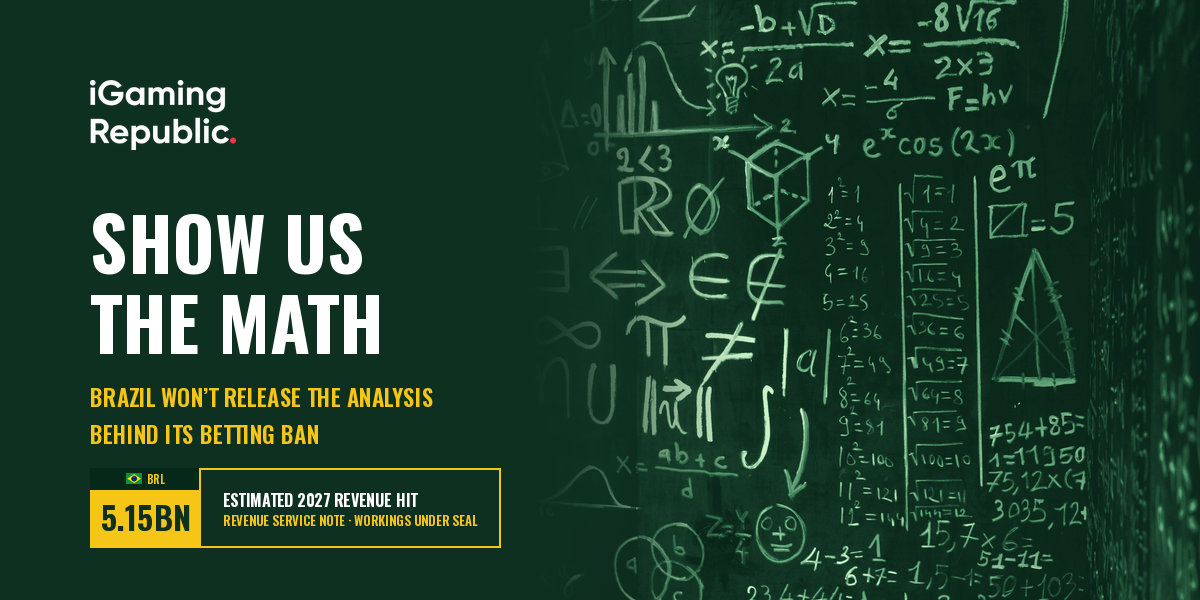
- A Revenue Service note estimates a BRL5.15bn revenue reduction in 2027
- ANJL and IBJR want the industry to see the calculations
In this story4 sections
Brazil's government won't release the analysis behind its ban on fixed-odds betting and online games. The Ministry of Finance has sealed the preparatory files for Provisional Measure 1,394/2026.
It turned down a freedom of information request from newspaper Estadão shortly after President Luiz Inácio Lula da Silva signed the measure on September 25.
Add iGaming Republic as a preferred source on GoogleSee more of our stories in Google’s Top Stories.Secrecy spreads across ministries
The ministry says the files were drafted by the Office of the Attorney General of the National Treasury (PGFN). On that basis, it classes them as legal advice protected by attorney confidentiality, according to Estadão's reporting, as cited by Gazeta do Povo.
The Ministry of Finance said in its response to Estadão:
“This (functional) protection extends to the technical documents that supported the drafting of the legal opinions.”
That means the seal also covers records the PGFN did not prepare. The ministry describes the MP as temporary because Congress has yet to vote on it. It also acknowledges that the measure “produces immediate legal effects upon publication.”
The ministry treated a similar request differently in May. At that time, Estadão obtained the preparatory files for the so-called “MP das blusinhas”, including PGFN legal opinions. The ministry now says the PGFN assesses access to legal opinions “on a case-by-case basis”.
Other departments have taken the same route. On October 29, the presidential Chief of Staff's office, the Casa Civil, rejected a request from BBC News Brasil, citing attorney-client privilege. The office told the broadcaster that professional secrecy covers legal advice produced by public attorneys.
Bruno Morassutti, co-founder of transparency group Fiquem Sabendo, told BBC News Brasil the reasoning could create permanent secrecy. Unlike a fixed classification, the Casa Civil's justification sets no date for the information's release.
The Ministry of Justice has classified the documents used to draft the MP as restricted for five years, Gazeta do Povo reports. The order was signed on September 24 by Victor Oliveira Fernandes, the ministry's Secretary of Digital Rights. He argued that disclosure would put public safety and financial stability at risk.
This is the Finance Ministry's second transparency dispute with the sector this year. In June, it dropped a 100-year seal on betting licensing files after Estadão reported it. Finance Minister Dario Durigan then pledged to publish around 25,000 documents through a dedicated task force.
Little analysis behind ban
Responses obtained by Brazilian media suggest the measure went ahead with little formal impact analysis. Estadão reported that Lula settled on the ban on September 23 at the Palácio da Alvorada, in a meeting that included Durigan and Chief of Staff Miriam Belchior.
On the eve of the MP's publication, the Secretariat of Prizes and Betting (SPA) told BNLData it had not identified studies on the impact of a ban. The Planning Ministry later told the outlet it held no data or documents evaluating any change to betting policy.
The Ministry of Sport found no record of formal consultation before the measure was issued. It has since told BNLData it took part in interministerial meetings on betting coordinated by the Casa Civil.
Lula made the ban a central issue in his re-election campaign, linking it to household debt and public health. His own administration had built the licensing regime that the MP dismantled.
The commercial impact is already visible. Licensed sites went offline on October 6, leaving BRL1.33bn still owed to around 26.5 million bettors. The ANJL counted more than 3,500 direct jobs lost in under two weeks. Authorizations for 85 operators, covering 188 brands, expired on October 25.
BRL5.15bn tax hole questioned
One preparatory document has reached the public. A Federal Revenue Service technical note, dated the day Lula announced the ban, estimates revenue reductions of BRL5.15bn (about $870m) in 2027 and BRL5.33bn in 2028. The note has been cited in litigation before the Supreme Federal Court (STF).
The government projects a further BRL1.54bn loss for the rest of 2026, Times Brasil reports. Citing O Globo, the outlet says a BRL1.9bn reserve could absorb part of that hit. With lost supervisory fees, the total nears BRL12.3bn by 2028.
Planning Minister Bruno Moretti has said the calculations come from technical notes the government produced to support the ban. Those notes are the same kind of material now under seal.
For context, Revenue Service data show operators paid around BRL10bn in 2025 and roughly BRL7.3bn in the first half of 2026. Licensed operators generated BRL20.28bn in gross gaming revenue in the first six months of this year.
The National Association of Games and Lotteries (ANJL) told Estadão that the methodology behind the estimate is unknown. It suspects the economic team shaped the numbers to make the ban look viable, and called the secrecy “no coincidence”.
The ANJL said:
“It raises the question of who benefits from this lack of transparency.”
The association argues that bettors have been left exposed to the illegal market since late September.
The Brazilian Institute of Responsible Gaming (IBJR) says the BRL5.15bn reduction alone would absorb roughly half of the fiscal cushion the government projected for its 2027 target.
The IBJR said:
“A decision of this magnitude demands a complete, verifiable, and technically sound accounting.”
The institute wants the government to publish its supporting calculations and the adjustments it plans for the 2027 budget bill.
Congress and STF deadlines
The sealed files matter because the MP is still before Congress and the STF. Congress extended it for a second 60-day term from November 24, and lawmakers have pushed back with amendments. The clock pauses over the December 23 to February 1 recess, which sets a voting deadline of March 4, 2027.
On November 17, the government withdrew urgency on its criminal betting bill, PL 5.477/2026, to prioritize a fiscal package. It plans to restore urgency before the recess.
At the STF, Justice Luiz Fux held a ten-hour hearing on November 3 without issuing a ruling or setting a decision date.
On November 20, ANSEJA filed a 35-page petition in ADI 8024. It asks the court to strike down the MP, reinstate authorizations for at least 180 days or allow a 180-day assisted closure. It also seeks about BRL1.6bn in proportional license fee refunds.
ANSEJA's case relies on government data that the Attorney General's Office filed in the proceedings. The data show tens of thousands of illegal betting offers identified since the ban.