Ten-hour hearing ends with Brazil’s betting ban intact

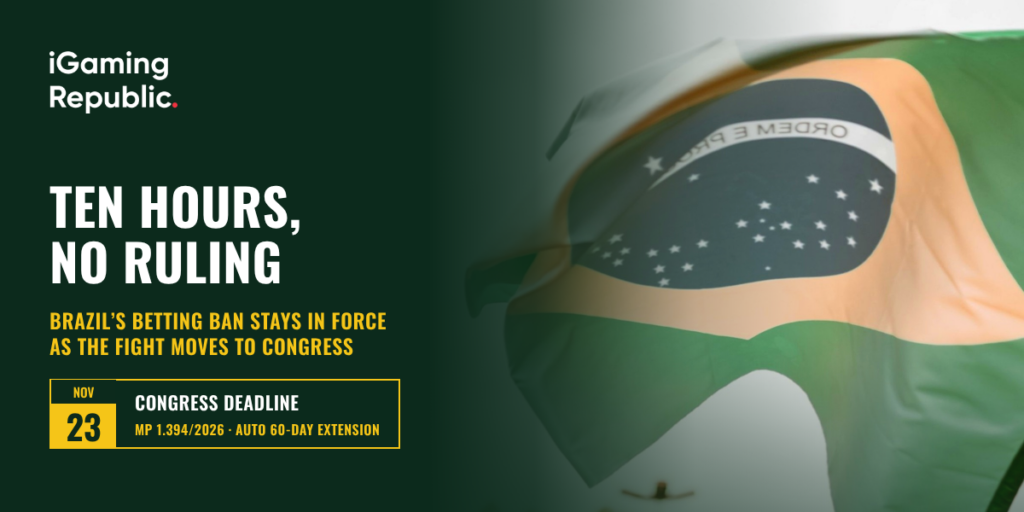
- Brazil’s Supreme Court hears ten hours of argument on the betting ban but makes no decision.
- Justice Luiz Fux says he believes bets should be banned, though ten colleagues will also rule.
- Congress has until November 23 to vote, with an automatic 60-day extension if it does not.
Brazil’s betting ban is still in force after the Supreme Federal Court (STF) spent ten hours hearing arguments for and against it on Tuesday, November 3.
Justice Luiz Fux, who is leading the case, took no decision and set no date for a ruling.
Where things stand
President Luiz Inácio Lula da Silva signed Provisional Measure 1.394/2026 on September 25. It bans fixed-odds betting and online casinos, cancels existing licenses and prohibits betting advertising.
Licensed sites went dark soon after. The industry’s main legal challenge is ADI 8027, filed by the National Association of Games and Lotteries (ANJL). Three other constitutional challenges target the same measure.
Tuesday’s session was not a trial. Fux called it to gather information before the court decides, and he said so repeatedly. It ran from 10am to 8pm in Brasília, Migalhas reported.
The judge’s leanings
Operators hoping for a sympathetic ear will not have found one. Fux said he has the “perception that bets should be banned”, SBT News reported.
He also made clear that he does not decide alone. Fux said his ten colleagues on the court will judge the case, and that he needs to bring them the new arguments raised since the ban.
Those arguments are the ones the industry is leaning on: legal certainty, contracts signed in good faith and whether the measure meets the constitutional tests of relevance and urgency.
Fux pushed back against criticism that he had only invited companies and football clubs. The STF already held two days of hearings on betting’s harms in November 2024.
Luiz Fux, Justice of the Supreme Federal Court, said:
“In a judge’s car, reason goes in the front seat and passion in the back. If they swap, the car will crash.”
Brasília isn’t budging
The government sent its heaviest hitters. The Ministries of Justice, Health and Finance and the Attorney General’s Office (AGU) all defended the ban.
Jorge Messias, head of the AGU, said the old framework failed to protect consumers. Citing preliminary Finance Ministry data, he said licensed operators took BRL620bn in bets in 2025 and generated BRL36.9bn in revenue.
Jorge Messias, head of the Attorney General’s Office, said:
“Recognising this effort does not oblige us to close our eyes to its limitations. Reviewing a policy in light of its results is the responsibility of the State.”
Messias also cited a Datafolha poll showing 78% of Brazilians support the ban. He asked Fux to consider a further hearing with civil society groups, which could add another step before any ruling.
The Finance Ministry’s Rodrigo Toneto put the money moving from families to the sector at about BRL62bn. The government says enforcement is now easier: the Justice Ministry requested the takedown of 36,905 illegal sites between September 25 and October 29.
A compromise on paper
The industry’s ask is simple: pause the ban, then fix the rules. The Brazilian Institute for Responsible Gaming (IBJR) asked Fux for an injunction until Congress votes or the court rules.
Celso Mori, representative of the Brazilian Institute for Responsible Gaming, said:
“The country, through its Congress, opted for regulated gambling. But it didn’t happen overnight. It was after years of legislative processes.
“Now, suddenly, you change that orientation. Now you want clandestine and irregular gambling.”
ANJL argued for tighter enforcement, not prohibition. It also challenged the loss of the BRL30m that operators paid for five-year licenses.
The most practical proposal came from the Economic Regulation Laboratory at the State University of Rio de Janeiro (UERJ). If betting returns, it wants eight mandatory conditions.
These include a spending cap per taxpayer ID, a ban on credit-funded bets, limits for people on the welfare register and independent funding for treatment.
If the ban stays, UERJ suggested a 180 to 360-day transition so contracts, systems and self-exclusion tools can wind down properly.
Football counts the cost
The football clubs made the commercial damage concrete. Flamengo said it faces a loss of about BRL430m a year, with more than 1,200 employees affected, Correio Braziliense reported.
Flávio Willeman, general vice-president at Flamengo, said:
“Flamengo took on financial obligations to athletes and employees based on these contracts. Flamengo believed that Brazil had regulated betting.”
Fluminense put its own hit at BRL200m. Its representative said betting brought in around BRL1bn of the BRL3bn in commercial revenue earned by Série A clubs in 2025.
Several clubs complained about the ten-day deadline to remove sponsorships. The Brazilian Football Confederation (CBF) asked for a transition lasting until the 2030 World Cup.
Grêmio went further and floated a split. It proposed keeping the ban on online casinos and allowing sports betting under strict rules. The Brazilian Paralympic Committee also drew a line between the two products.
Two routes back
The court has no deadline. Any ruling Fux drafts still needs the backing of his colleagues, and the AGU’s call for another hearing could slow things further.
Congress may move first. The measure enters urgency mode on November 9, which blocks other votes in whichever house holds it, BNLData reported. Its first 60-day period ends on November 23 and extends automatically for 60 more days. Lawmakers have tabled 99 amendments, and Lula has since won re-election.
With the rapporteur leaning toward a ban, a quick injunction looks unlikely. Lawmakers are the more realistic audience for the industry’s case.
If a door reopens, it will probably lead to a smaller market than before. The sports-only idea from Grêmio and the Paralympic Committee, plus UERJ’s caps and credit ban, show where a deal could land.
Suppliers with heavy online casino exposure in Brazil have the most to lose under that kind of compromise.
About the author
Bianca Máthe
Bianca Máthe is Publisher of iGaming Republic. She spent close to a decade on the supplier side of iGaming, working across the sector's core verticals: platform and player-engagement technology and crypto payments. That mix gave her a working knowledge of how operators, suppliers and payment providers actually run. In 2025 she started a media project, bringing that operational grounding to her editorial work. Her output includes interviews with high-profile iGaming executives, original reports, and in-depth features covering licensing, M&A, and the operators and suppliers shaping the sector. Based in Malta, she spends much of her time getting closer to emerging sectors like prediction markets, tracking how they're developing before the rest of the industry catches up.
Do you have a story worth sharing?
Send it over to our editors!