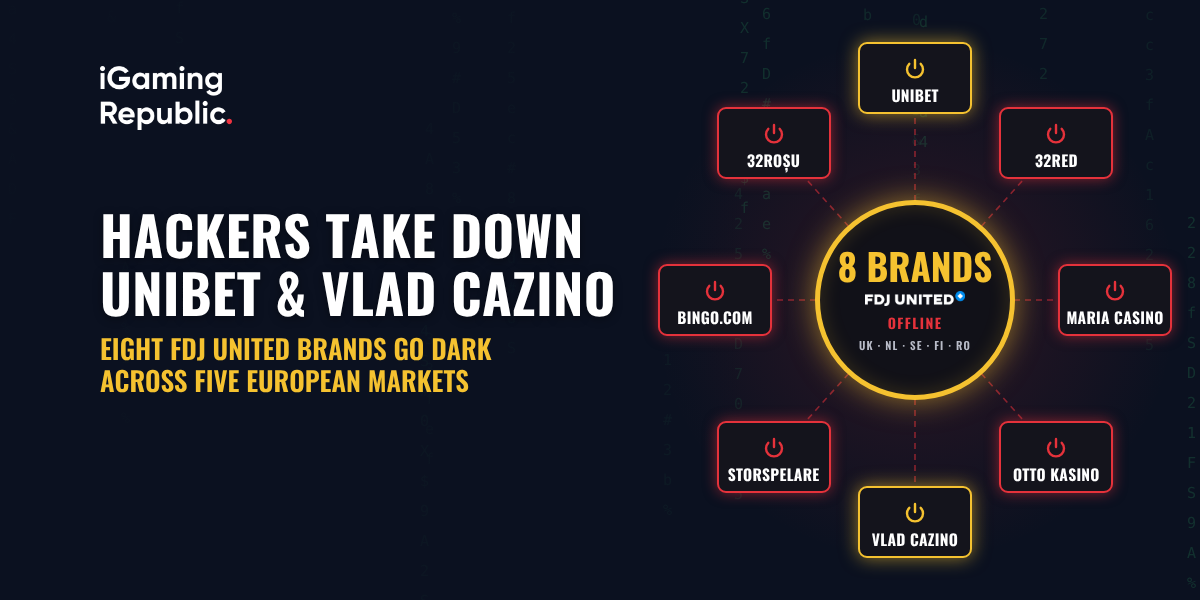
- Unibet, Vlad Cazino and six sister brands go offline after a cyberattack
- Dutch players lost access from Thursday night, for more than 22 hours
- FDJ United has not said whether player data or funds were affected
In this story5 sections
Unibet said it was back online on Friday evening, roughly a day after a cyberattack knocked it, Vlad Cazino and other FDJ United brands offline in five markets. Three days after the attack began, the group has not said whether player data or funds were affected.
A day offline
The first problems showed up in the Netherlands. Outage tracker Storingvandaag logged reports about Unibet.nl from 21:15 CET on Thursday 19 November until midnight, and again shortly before 06:00 on Friday.
Add iGaming Republic as a preferred source on GoogleSee more of our stories in Google’s Top Stories.Players saw a short “important notice” on the site and in the apps. It said work was under way, with no reason given and no return time.
Unibet confirmed the cause at 11:58 GMT on Friday in a post on X.
Unibet said on X:
“Following a cyberattack we’ve temporarily taken Unibet offline as a safety precaution. Our team is working to restore access safely. Thank you for your patience — we’ll share further updates as soon as we can.”
FDJ United has made one on-the-record comment, to Dutch trade site CasinoNieuws.nl. A spokesperson said Unibet’s Dutch platform had been hit by a cyberattack.
According to the spokesperson, the group shut off access as soon as it spotted the incident, following its internal procedures. It had taken steps to stop further attacks and apologised to customers.
Unibet said it was back at 18:39 GMT on Friday, in a second X post.
Unibet said on X:
“We’re pleased to let you know that Unibet is back online following the recent disruption, and you can now place bets and play as usual. Thank you for your patience while we worked to restore access safely. We’re glad to have you back.”
Going by the first outage reports, Dutch players were locked out for more than 22 hours. Some replies to the post asked why there was no bonus to make up for it.
Which brands were hit
Most of the affected brands came from Kindred Group. FDJ completed its takeover of Kindred in October 2024.
Besides Unibet, Maria Casino, 32Red, Otto Kasino, Storspelare, Bingo.com and Vlad Cazino were taken offline. Unibet went down in the UK, the Netherlands and Sweden. FDJ United has not given a restoration time for each sister brand.
In Romania, Unibet, Vlad Cazino and 32Roșu, the group’s three locally licensed brands, could not be accessed on 20 November. All three are licensed by ONJN, the national regulator.
Finland was hit too. Unibet does not yet hold a Finnish licence. The new regulator has named its first 12 licensees, and 50 operators applied in the first round.
In the UK, the brands sit under Platinum Gaming Limited. The company operates unibet.co.uk and uk.bingo.com, and it also runs 32Red.
Platinum Gaming was fined £10m by the UK Gambling Commission last year over anti-money laundering and social responsibility failings. In the Netherlands, Unibet’s operator Optdeck Service Limited was fined €4m over player protection.
What FDJ has not said
FDJ United has not said whether personal data, payment data or player accounts were exposed. It has also not named the attackers or explained how they got in.
There may also be a legal deadline. The GDPR gives a company 72 hours to notify its data protection authority once it becomes aware of a personal data breach. If player data was affected and FDJ United knew on Thursday night, that deadline would have expired over the weekend.
Other operators have said more about their incidents. On 13 November, GGPoker told players that unauthorised access at a third-party service provider may have exposed email addresses, dates of birth, balances and loyalty levels. It also said it had reported the incident to data protection and gambling regulators and to law enforcement.
Gambling businesses have been hit regularly this year. Crypto casino Gamdom went offline after a hot wallet breach in October, and attackers now want a $15m ransom for its player database. In September, hackers stole $7m from Duelbits.
Suppliers are targets too. Bragg Gaming said its August hack was limited to internal systems. Sweden’s ATG disclosed a breach with its first-quarter results, and Shuffle warned users after customer data leaked through a third-party provider.
Third-party code is another weak point. Malicious JavaScript planted in Optimizely Web showed up on websites linked to 178 organisations, including HSBC, the BBC and Zoom.
Regulators have not escaped from attacks. Curaçao is replacing its licensing portal after a months-long attack. The Malta Gaming Authority confirmed a system breach in March, after which a hacker made claims about its systems.
Pressure on online
The attack hit FDJ United’s weakest division. On 21 October, the group adjusted its 2026 targets to a low single-digit fall in GGR and a mid single-digit fall in revenue. Third-quarter revenue had fallen 8.1% to €794m.
Online betting and gaming revenue fell 8.2% to €619m in the first nine months, after €34m of additional taxation. In the third quarter alone, the drop was 10.2%.
Tax pressure showed earlier in the year too, in the first quarter and the first half. The UK’s higher Remote Gaming Duty was one of the drivers.
The group plans to run most markets on a single sports platform by the end of 2027. This outage hit its main online brands while that platform is still being built.
FDJ United is also dealing with brand abuse online. Last week it took Meta to court over fake ads that copied its branding. It counted 226 new illicit posts on Facebook and Instagram in just four days in May.
Questions for FDJ
Regulators in the UK, the Netherlands, Sweden, Romania and Finland will want to know which systems the attackers reached and whether player data left the business.
Affiliates may have lost a day of revenue from these brands. They will also want to know whether tracking data was exposed.
Investors have their own questions. FDJ United trades on Euronext Paris and adjusted its guidance a month ago. So far, its only account of the attack is one statement to a Dutch trade site.