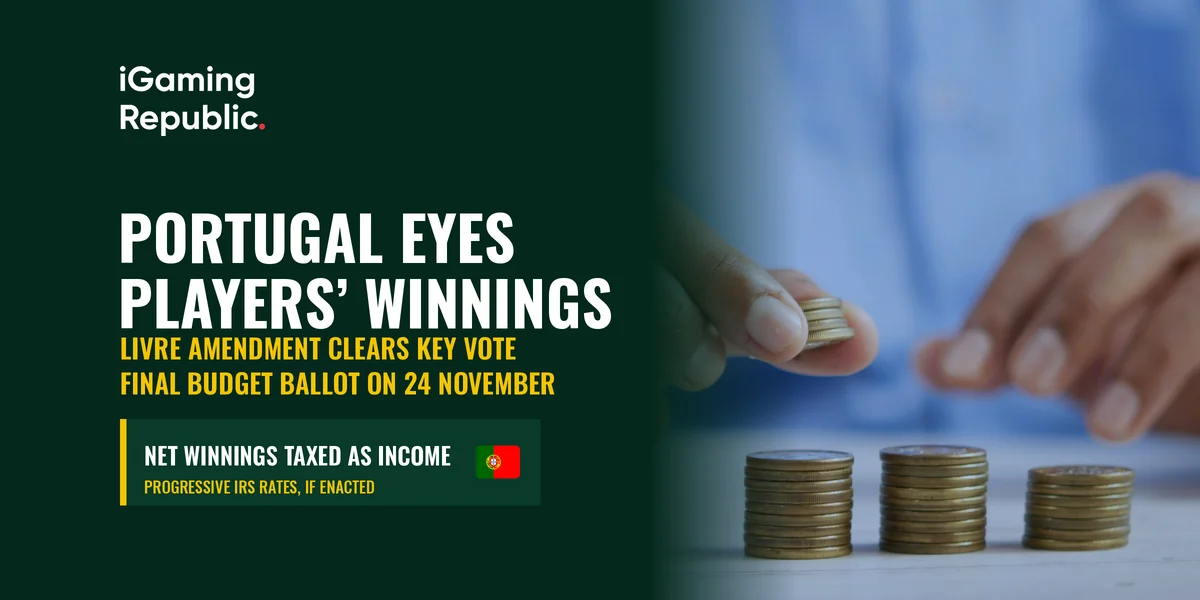
- Livre amendment to Portugal’s 2027 State Budget clears the detailed vote on 19 November
- Net annual online winnings would be taxed as Category G income at progressive IRS rates
- The full budget faces its final global vote in parliament on 24 November
In this story6 sections
Portuguese players are a step closer to paying income tax on what they win online. Parliament has approved a Livre amendment at the detailed stage of the 2027 State Budget that would tax net annual gambling and betting gains as personal income.
The amendment only survives if the budget passes its final global vote on 24 November.
Add iGaming Republic as a preferred source on GoogleSee more of our stories in Google’s Top Stories.Government benches on board
The proposal from left-wing party Livre cleared the detailed vote on Thursday 19 November, according to Lusa reporting carried by Diário de Notícias. Only Iniciativa Liberal (IL) voted against it.
Chega, the largest opposition party, abstained. Every other parliamentary group voted in favour, including the governing Social Democratic Party (PSD) and the Socialist Party (PS).
That is a sharp change from last year. The online gambling proposals Livre tabled a year earlier were rejected at the same stage. This time, the government benches backed it.
Prizes minus stakes
Under the amendment, a player’s positive net annual balance from online games and bets would become Category G income. That is the IRS category for capital gains and other increases in wealth. The balance would be aggregated with salary and other earnings and taxed at progressive IRS rates, just like employment income.
Livre’s proposed rule is that what counts is the year’s result across every account a player holds: prizes received minus amounts staked. In practice, losses on one licensed site would offset wins on another.
The industry would carry the reporting burden. Licensed operators would be required to report each player’s figures to the customer and to the Tax and Customs Authority (AT), so the income could flow into the automatic IRS return.
Livre presents the change as tax fairness. Anyone making a net gain from online gambling should pay under the same rules as people living on wages, pensions, savings or investments. The party points to Spain, which already counts net gambling gains as part of the general personal income tax base. Spain has also launched a cross-operator deposit cap, which becomes binding in March 2027.
The amendment as reported by Lusa sets no start date or exemption threshold. Both could still be settled in the final legislation and its implementing rules.
Data nobody holds
The obvious question is how much money this would raise. Last year, nobody could say.
Livre’s 2026 version would have taxed annual net gains above €500. Portugal’s parliamentary budget office, UTAO, said it could not estimate the budget impact because there was no data at all on players’ net winnings, ECO reported.
The gaps were basic. Online gambling winnings are not subject to IRS today, and the AT told UTAO it held no relevant information as a result. The regulator, SRIJ, receives daily reports of prizes paid but does not work out net gains per player.
UTAO was also missing a second figure: the income bracket each player was in before any winnings were added. Under progressive rates, the same win costs a high earner more than a low earner, so any revenue estimate needs both.
The sums involved are large. Operators paid €335m in Special Online Gambling Tax (IEJO) in 2024, on gross revenue of €1.1bn, with 4.7 million registered players. Quarterly online gaming revenue has kept climbing since then.
UTAO’s own fix was a mandatory reporting mechanism for players’ net gains, mainly to the AT. The 2027 amendment builds that requirement into the tax itself.
Livre’s long game
The tax is one part of a wider campaign. In September 2026, Livre called an urgent parliamentary debate on online gambling, a format the government must attend.
Spokesperson Isabel Mendes Lopes called the issue a major public health problem. The party cited €23bn wagered online in 2025, 4.9 million player registrations and 413,000 self-exclusion requests.
Besides the IRS proposal, the package called for:
- a ban on influencer advertising
- tobacco-style risk warnings
- a single self-exclusion covering all licensed platforms
- an end to betting bonuses
Economy Minister Manuel Castro Almeida said over the summer that the government plans new legislation. What it will contain is not yet known.
The offshore question
Operators care less about the principle than about how it would work. They want clarity on how net winnings would be calculated across multiple licensed platforms. It is also important to know what reporting and compliance duties operators would carry.
Industry voices also questioned what the tax would do to player behaviour and to the licensed market’s competitiveness. Some players could move to unlicensed sites outside the tax and regulatory framework.
UTAO raised the same risk last year. It flagged possible migration to unlicensed platforms in a young, growing market. It accepted the tax could deter some gambling, but doubted it would curb problem gambling, because a yearly IRS bill sends a weaker signal than a cost felt on each bet.
The last parliamentary hurdle
Parliament holds the final global vote on the whole budget at 15:00 on Tuesday. If it passes, the President must still promulgate the law. The detail then moves to the Finance Ministry and the AT, which is where operators will focus.
Two choices will decide the impact. A threshold, if one comes back, decides whether casual players are caught or only big winners. The start date decides how long licensees have to build player-level net reporting, something SRIJ does not run today.
If enacted, the measure would put Portugal among the European markets that tax players as well as operators. Greece has held firm on its online casino winnings tax. Finland has eased its rules on slot winnings. Lithuania is moving the other way on operator tax with a progressive gambling tax.
The real test is whether a tax on players can raise revenue without weakening a licensed market that Portugal has spent a decade building.