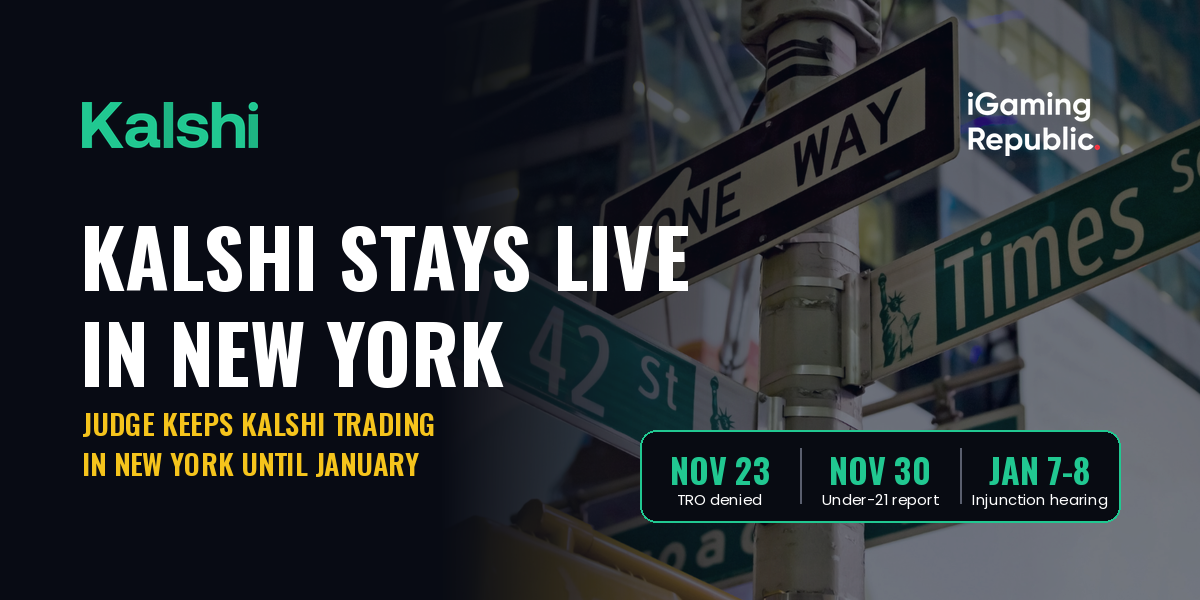
- Justice Melissa Crane rejects New York’s TRO request against Kalshi on November 23
- Kalshi and the state must report on under-21 safeguards by November 30
- A preliminary injunction hearing is expected on January 7 or 8, 2027
In this story6 sections
Kalshi can keep offering event contracts in New York after Justice Melissa Crane of the New York County Supreme Court rejected Attorney General Letitia James’s request for a temporary restraining order on Monday, November 23.
Crane ruled from the bench at a virtual hearing. She did not decide whether Kalshi is breaking state gambling law, so the case goes on.
Add iGaming Republic as a preferred source on GoogleSee more of our stories in Google’s Top Stories.Not on day one
New York wanted Crane to stop KalshiEX LLC offering contracts on sports, culture, elections and other events until it holds a state gambling license. Kalshi had not yet filed its full written defense.
Crane told Assistant Attorney General Brent Tomer that this was too much to ask at the first hearing.
Melissa Crane, Justice, New York County Supreme Court, said:
“You’re really seeking the ultimate relief in the case upfront without me even hearing from the defense.”
Timing was a second problem. Kalshi has been live in New York for more than a year, so an emergency order would not be protecting an existing position.
“It doesn’t preserve the status quo because the status quo has been going on for over a year.”
The Manhattan problem
Kalshi is headquartered in New York. The state’s proposed order covered unlicensed gambling “within or from New York.”
Kalshi attorney Grant Mainland said a shutdown would be “a recipe for chaos” for traders. Kalshi’s lawyers warned that the wording could close its CFTC-regulated exchange “not only in the state but nationwide.”
Tomer said the state was “not seeking to shut down Kalshi entirely.” He called the hit to gambling tax revenue “pretty obvious”. He did not give figures.
Licensed operators will pay attention to that point. New York taxes mobile sportsbook gross gaming revenue at 51%. The state argues that Kalshi pays no state gambling tax on comparable products.
Kalshi says it has 1.5 million customers across its platform. A petition funded by the company had more than 326,000 supporters by Monday afternoon.
Old enough to trade
Kalshi accepts users from age 18. New York’s licensed sportsbooks cannot take bets from anyone under 21.
Crane said she was “very concerned” about the risks to younger users. She asked whether Kalshi would pause sports and culture contracts for 18 to 20-year-olds in New York.
Mainland said the company was “open to engaging” on the issue. Kalshi’s lawyers said they could look at a compromise for that age group.
Both sides must report back by November 30.
Kalshi has accepted restrictions before. It agreed to a geofencing deadline in Nevada.
Back from federal court
The case started in October 2025, when the New York State Gaming Commission sent Kalshi a cease-and-desist order. Kalshi’s federal challenge to that order failed.
James sued in state court on July 31, alleging that Kalshi runs an unlicensed gambling business. Kalshi moved the case to federal court within hours. US District Judge Vernon Broderick sent it back on November 19.
The CFTC also tried to intervene. A federal judge rejected its emergency bid to block New York’s case. James has since sued Coinbase and Gemini over their prediction market products.
In a November 20 letter, the state accused Kalshi of “needlessly delaying this expedited proceeding.”
Kalshi spokesperson Elisabeth Diana said the company wants a workable path forward with the state.
Split at the top
Crane also raised the US Supreme Court. She said its eventual ruling “ultimately will bind me” and asked whether it would be prudent to wait.
The appeals courts are divided. The Third Circuit sided with Kalshi. The Fourth, Sixth and Ninth Circuits declined to block state enforcement, which means they accepted that states can regulate prediction markets. The Fourth Circuit’s ruling against Kalshi in Maryland came on November 17.
New Jersey has asked the Supreme Court to hear the case. The justices have not agreed to take it. The CFTC has also sued ten states to defend its authority over event contracts.
What January decides
Under a proposed schedule, opposition papers are due on December 4 and replies on December 11. Crane offered January 7 or 8 for an in-person preliminary injunction hearing.
A deal on under-21 access could take away one of the state’s main arguments for immediate restrictions. The licensing dispute would still be open. New York wants Kalshi licensed like any sportsbook. Kalshi says the CFTC is the only regulator it needs.
A New York ruling that Kalshi needs a state license would come in the company’s home state. It would also give other regulators a precedent from the largest online sports betting market in the US.