Brazil’s ban takes Betano off Flamengo’s books
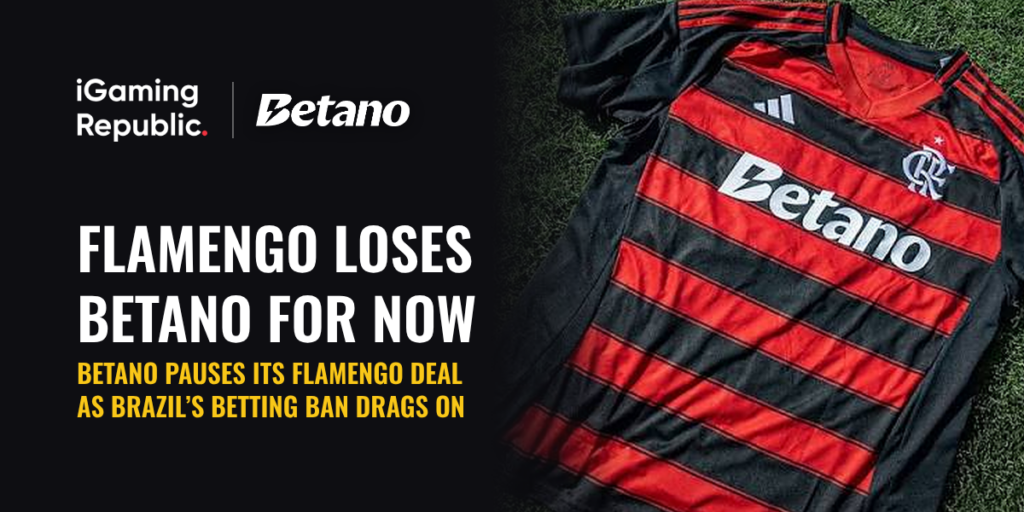
- Betano suspends its Flamengo master sponsorship until March 31, 2027, citing Brazil’s betting ban.
- The deal guaranteed BRL220m (US$42m) a season and could reach BRL268.5m (US$52m) with bonuses.
- Flamengo removes betting income from its 2027 budget and projects a BRL90m (US$17m) deficit.
Kaizen Gaming’s Betano has suspended its master sponsorship of Flamengo, Brazil’s most valuable shirt deal. The operator announced the move on Tuesday, November 17.
It cited the lack of a decision on Provisional Measure (MP) 1.394/2026, which banned online sports betting and casino games in Brazil.
Paid, but invisible
Betano kept funding the deal for weeks after the ban hit, local sources reported. Licensed sites went offline in early October, leaving BRL1.33bn (US$256m) in player balances stranded. Since then, Betano has been unable to show its logo on Flamengo’s kit or use any of the commercial rights it bought.
In its statement, Betano said it held on to the sponsorship for as long as possible. It pointed to Flamengo’s football and Olympic programs, as well as jobs and social projects linked to the deal.
The suspension runs until March 31, 2027. It ends sooner if the MP is revoked, suspended or lapses. Betano says it remains committed to Brazil and is keeping its local staff until lawmakers decide.
Flamengo is not Betano’s only Brazilian property on hold. The operator holds the naming rights to the national league, the Brasileirão. The CBF has since removed Betano from its Brasileirão and Copa do Brasil profiles.
Outside Brazil, Kaizen Gaming is still signing big deals. In October, Betano returned as an official sponsor of UEFA EURO 2028.
Flamengo’s budget hole
Flamengo signed with Betano in 2025, a few days after ending its partnership with Pixbet. The deal ran to the end of 2028. It guaranteed BRL220m (US$42m) a season, with bonuses and investments that could lift the annual total to BRL268.5m (US$52m).
The club confirmed the suspension in its 2027 budget, presented to its board this week. It forecasts BRL1.535bn (US$295m) in revenue next year, with betting income removed entirely.
Higher amortization and depreciation costs push the club further into the red. Flamengo now projects an accounting deficit of BRL90m (about US$17m) for 2027.
The two sides are still negotiating the financial terms. Flamengo had already received the full 2026 payment and must return the share covering the rest of the year, either in cash or services.
The ban also landed mid-cycle for merchandise. Flamengo already had 400,000 units of its 2027 kit ready.
Logo off, slogan on
The relationship had been under strain for weeks. On October 8, Flamengo played Santos with “Proibir não é proteger” (Banning is not protecting) in the shirt space reserved for Betano.
The slogan came from a manifesto by trade bodies ANJL and IBJR. Flamengo and Fluminense wore it again in their derby on October 11.
Betano also blocked a one-off streaming sponsorship Flamengo had lined up for its Copa Libertadores semi-final against Estudiantes. The Betano contract was still active and paid, so the club could not sell the space elsewhere.
Flamengo has led the club response to the ban. In late September it asked to join the Supreme Federal Court (STF) case as amicus curiae. In November it was one of the football clubs that argued against the measure at the court’s public hearing.
Other clubs exposed
In a statement, Flamengo said betting brands spent about BRL1.14bn (about US$219m) on direct sponsorship of Brazil’s 20 largest clubs in 2025. It estimates total direct and indirect losses for Brazilian football at around BRL2.5bn (about US$481m) a year.
Around two-thirds of Série A clubs carried betting sponsors before the ban. Santos’ deal with Novibet, worth up to BRL85m (about US$16m), is suspended. Superbet is also expected to end its deals with Fluminense and São Paulo.
Vitória expects to lose about US$8.8m in 2027 after 7K Bet ended its deal early. Corinthians could be next. Its renewed deal with Esportes da Sorte is worth up to BRL200m (about US$38m) a year through 2029.
The pressure on club budgets started before the ban. Earlier this year, operators were already cutting Série A shirt deals after a tax overhaul. Since then, the ban has cost the industry 3,500 jobs, and Flutter has booked a US$873m Brazil write-down.
Decided in March
The courts have not offered clubs a way out. Justice Luiz Fux is overseeing the constitutional challenges. At the November 3 hearing, he said betting should be banned.
On November 8, Fux froze every lower-court case in Brazil that challenges MP 1.394, at the request of the Prosecutor General’s Office. The freeze holds until the full STF rules. It followed a ten-hour hearing that ended without a decision.
That leaves Congress. On November 11, lawmakers extended the measure by 60 days, so the ban now runs into early March. At that point, the joint committee that must review it had still not been installed. If Congress does not approve the MP by the deadline, it loses effect.
Betano’s March 31 cut-off falls a few weeks after that date. If the MP lapses or is overturned, the suspension ends and the sponsorship can resume.
In the meantime, Flamengo needs a new main shirt sponsor, and betting brands cannot bid. Folha reported that Fatal Model, a local adult escort and content platform, offered more than BRL100m (about US$19m) for the shirt space at Flamengo and Corinthians.
That offer is well below what Betano was paying. If the ban holds, it is the clearest early price signal for Brazil’s top shirts in a market without bookmakers.
Do you have a story worth sharing?
Send it over to our editors!