3,500 betting jobs vanish ahead of Brazil’s election

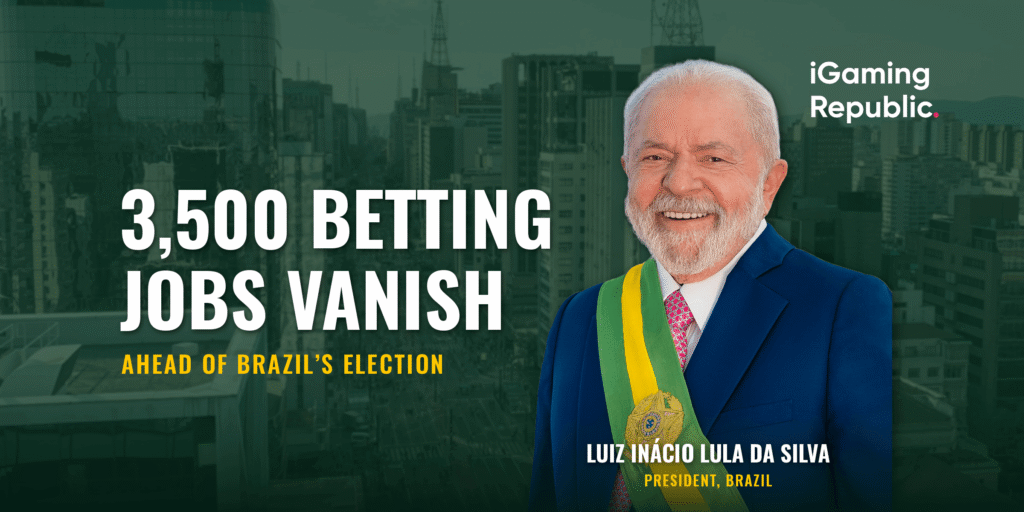
- ANJL data shows more than 3,500 betting jobs lost since Provisional Measure 1,394/2026
- Flávio Bolsonaro attacks the ban but still backs an online casino prohibition
- Stake’s suspended injunction leaves the industry’s hopes with the STF
Brazil’s prohibition on fixed-odds betting under Provisional Measure 1,394/2026 has cost more than 3,500 direct jobs in under two weeks.
The National Association of Games and Lotteries (ANJL) published the figure on October 7. With the October 25 presidential runoff approaching, the ban is now a campaign issue, and Stake’s suspended injunction shows how little room licensees have left.
The jobs bill
The ANJL survey draws on data supplied by operators and is still partial. It counts more than 3,500 dismissals since President Luiz Inácio Lula da Silva signed the measure on September 25, Poder360 reported.
The ANJL puts that at 23% of the sector’s workforce, which implies roughly 15,000 direct jobs. A further 4,167 employees have been placed on collective vacation, so about half the licensed workforce has either lost their jobs or stopped working.
The association expects dismissals to reach 5,600 within 90 days. Its legal adviser Bernardo Freire told Poder360 that direct losses could reach 10,000 to 15,000 in a short time. The ANJL says the damage also extends to the suppliers and service providers around operators.
The state is losing too. Licensed operators paid BRL9.95bn in federal taxes in 2025, according to Receita Federal data cited by Poder360. Separately, 83 companies paid one-off fees totaling BRL2.55bn for 85 five-year authorizations, which terminate on October 25 without compensation.
Bolsonaro’s split ticket
That date is also polling day. Senator Flávio Bolsonaro led Lula by 47.03% to 45.16% in the October 4 first round, and he is now framing the ban as a self-inflicted wound. Speaking in Brasília on October 7, the Liberal Party (PL) candidate said it had hurt operators, football clubs and the wider business community.
Flávio Bolsonaro, Liberal Party presidential candidate, told reporters:
“He attacked legal certainty, he attacked the clubs, various companies.”
His pitch to the industry is selective. He argues the government took licensing fees from companies that paid heavily to enter the regulated market, then shut them down. Enforcement, in his view, belongs with the black market.
Bolsonaro added:
“Illegal bets have to be truly banned; they are not supervised by the current government.”
Operators should not read that as a rescue plan. Bolsonaro has said he would prohibit online casinos if elected, and has signaled support only for licensed sports betting. He also declined to say how he would vote on the measure in Congress.
Neither side has a clean record. Online betting was legalized under Law 13,756/2018, but the regulatory deadline lapsed under Jair Bolsonaro, Flávio’s father. Lula’s government delivered Law 14,790/2023, which opened the licensed market on January 1, 2025.
Stake’s short reprieve
Stake was among the first licensees to challenge the measure in court. On October 8, Judge Cristiane Farias Rodrigues dos Santos of São Paulo’s 9th Federal Civil Court granted Stake Brazil a partial injunction to keep trading until October 25.
The reprieve lasted a day. On October 9, Luis Antonio Johonsom Di Salvo, president of the Federal Regional Court of the 3rd Region (TRF-3), suspended the injunction at the request of the Attorney General’s Office (AGU). He held that exempting one operator would create unequal treatment, with every rival still blocked.
Di Salvo did not rule on the merits or on the measure’s constitutionality. His decision still sets a high bar for any single-operator exemption for as long as the measure remains in force.
Stake now faces the same position as every other licensee, having paid the standard BRL30m fee for an authorization that runs to December 2029 on paper.
Fux holds the key
That leaves the Supreme Federal Court (STF). In an October 6 petition, the ANJL and the Brazilian Institute of Responsible Gaming (IBJR) asked Justice Luiz Fux to suspend the measure until a new public hearing is held.
The AGU requested that hearing itself, but opposes any suspension in the meantime. The associations argue that if the government wants more evidence, the market under review should be preserved until that evidence is in. As a fallback, they want licensed operators to keep trading until December 31, with the measure’s deadlines restarting on January 1, 2027.
Their filing also cites government data showing 10,435 illegal websites referred for blocking between September 25 and October 1. The associations argue that removing licensed operators only pushes players offshore faster.
The next president takes office on January 5, 2027, inside that transition window. The 120-day clock on provisional measures pauses during the congressional recess, so lawmakers may not settle the issue until 2027.
A Bolsonaro win would not reopen the market overnight. The AGU represents the federal government, however, and its position could change under a new administration. The open question is how much of the licensed supply chain is still standing by then.
About the author
Bianca Máthe
Bianca Máthe is Publisher of iGaming Republic. She spent close to a decade on the supplier side of iGaming, working across the sector's core verticals: platform and player-engagement technology and crypto payments. That mix gave her a working knowledge of how operators, suppliers and payment providers actually run. In 2025 she started a media project, bringing that operational grounding to her editorial work. Her output includes interviews with high-profile iGaming executives, original reports, and in-depth features covering licensing, M&A, and the operators and suppliers shaping the sector. Based in Malta, she spends much of her time getting closer to emerging sectors like prediction markets, tracking how they're developing before the rest of the industry catches up.
Do you have a story worth sharing?
Send it over to our editors!