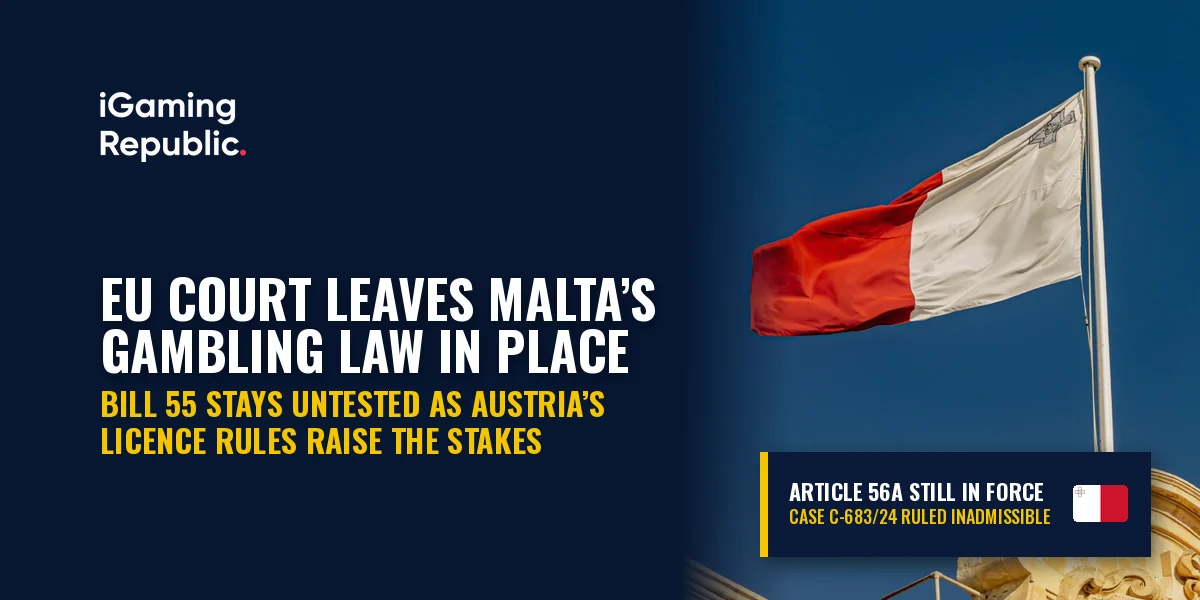
- CJEU rules Austrian Bill 55 referral inadmissible in Case C-683/24
- Court says the underlying dispute is a negligence claim under Austrian law
- Article 56A stays in force as the Commission's infringement case continues
In this story7 sections
The Court of Justice of the European Union (CJEU) will not rule on whether Malta's Bill 55 breaches EU law. On 19 November, it declared a referral from Vienna's Commercial Court inadmissible. Malta-licensed operators keep the protection Article 56A gives them against foreign refund judgments in Malta.
A row over legal advice
Spielerschutz Sigma Prozessfinanzierungs finances lawsuits brought by Austrian players against Malta-licensed operators. Its argument is that those operators offered games in Austria without the licence Austrian law requires. According to the CJEU, it has won numerous refund judgments and is trying to enforce them in Malta.
Add iGaming Republic as a preferred source on GoogleSee more of our stories in Google’s Top Stories.When Malta passed Bill 55 in June 2023, the funder asked German law firm Geissler Heilbock Hopf Ferox Legal what it meant for the business. The firm said the amendment was “manifestly in conflict with EU law” and would not be applied by Maltese courts.
Spielerschutz Sigma kept funding claims on that advice. A Maltese court then refused to recognise one of its Austrian judgments, citing the amendment. The funder sued the firm in Vienna for the cost of the opinion and for losses on the cases it funded afterwards.
Why Luxembourg passed
The Handelsgericht Wien asked the CJEU whether Bill 55 is compatible with the Brussels I bis Regulation, the EU's rulebook on recognising judgments across borders.
The court declined to answer. It only takes questions that a national court needs answered to decide the case in front of it. In this case, it found that answering them was not necessary to resolve the dispute.
The real question in Vienna is whether the lawyers were negligent. Under Austrian law, that depends on whether their advice was reasonably defensible given the case law and legal writing available at the time. Nobody needs to decide whether Malta's law is valid to answer it.
Jacques René Zammit, press officer at the CJEU, confirmed to iGaming Business that the judgment does not address Bill 55's compatibility:
“In this case, it did not go into that, no.”
Emiliou's view, unanswered
On 23 April 2026, Advocate General Nicholas Emiliou also found the referral inadmissible. He then gave his view on the substance as well.
Emiliou said Article 56A was manifestly incompatible with EU rules on recognising judgments. Public policy, he argued, cannot be used to refuse a judgment just because a foreign court may have applied EU law wrongly.
He also pointed out that EU countries do not have to recognise each other's gambling licences. A Maltese licence is generally valid only in Malta and in countries that choose to accept it. Advocate General opinions are not binding, and the court did not consider his reasoning.
Malta's courts apply it
Article 56A of Malta's Gaming Act tells Maltese courts to refuse recognition and enforcement of a foreign judgment on public policy grounds when three conditions are met. The claim must target a Malta-licensed operator. It must rely on the service being illegal in another member state. The service must have been lawful in Malta.
Maltese judges have used it. On 27 February 2025, the First Hall of the Civil Court refused recognition and enforcement of Austrian judgments against TSG Interactive and European Lotto and Betting. It relied on the public policy ground in Article 45(1)(a) of the same regulation.
In January 2026, the same court turned down an Austrian order for Betway to repay more than €83,000 to a player.
For MGA licensees facing claims from Austrian and German players, that means a win in an Austrian court has been hard to collect on in Malta.
Rulings tilt towards players
EU case law has gone against Malta's position in key areas this year. On 15 January, the CJEU ruled in Wunner, a case brought against the directors of Titanium Brace Marketing, a Malta-licensed operator now in liquidation.
The court held that a player's loss is deemed to occur in the country where the player lives. Under the EU's Rome II rules, that generally means Austrian law applies to such tort claims, unless the case is manifestly more closely connected with another country.
In April, in Case C-440/23, a Maltese court asked about Germany's former ban on online casino games. The CJEU said member states can ban those games even when the operator holds a licence elsewhere. It added that EU law does not, in principle, prevent such contracts being treated as void, or players suing to recover lost stakes.
Not every national court has gone the same way. In July, the Dutch Supreme Court rejected blanket refund claims. It ruled that contracts made before October 2021 are not void simply because the operator lacked a Dutch licence.
Brussels keeps the file
The European Commission opened infringement proceedings against Malta with a letter of formal notice on 18 June 2025. It argues that Malta uses the public policy exception far more widely than EU law allows.
The Malta Gaming Authority (MGA) rejects that reading. It says the article “does not impose a blanket ban on enforcing European judgments against Maltese-licensed gaming companies”.
Zammit told iGaming Business that other cases pending before the court could still produce a ruling on Bill 55.
Austria's licence condition
Austria could bring the issue to a head sooner. Its draft reform would replace the online monopoly with a multi-licence market, with new concessions from October 2027.
Under the draft bill the Finance Ministry published in June, licences would only go to operators whose home jurisdiction enforces Austrian civil judgments. Operators active in Austria without a licence would also have to stop from 1 January 2027 and settle outstanding player claims before entry.
Malta filed a detailed opinion on Austria's notified draft on 4 November, iGaming Business reported. That pushed the EU standstill period from 5 November to 7 December. The report did not say which provisions Malta objected to.
Simon Priglinger-Simader, president of the Austrian Association of Betting and Gaming (OVWG), told iGaming Business:
“We had anticipated a detailed opinion, as we also have concerns about certain provisions of the current Austrian draft law.”
If the rules are adopted as proposed, Malta-licensed operators with plans for Austria face an awkward trade-off. Bill 55 protects their assets in Malta. Under Austria's draft, the same protection could count against them when they apply for a licence.
In the meantime, the Vienna court has to decide Spielerschutz Sigma's claim under Austrian law, with no guidance from Luxembourg.