- US iGaming revenue reaches a record $3.05 billion in Q3 2026, up 13.5%
- Seven iGaming markets account for around 42% of the industry’s Q3 gain
- AGA says growth is the slowest since 2018; Citizens calls it a record low
In this story4 sections
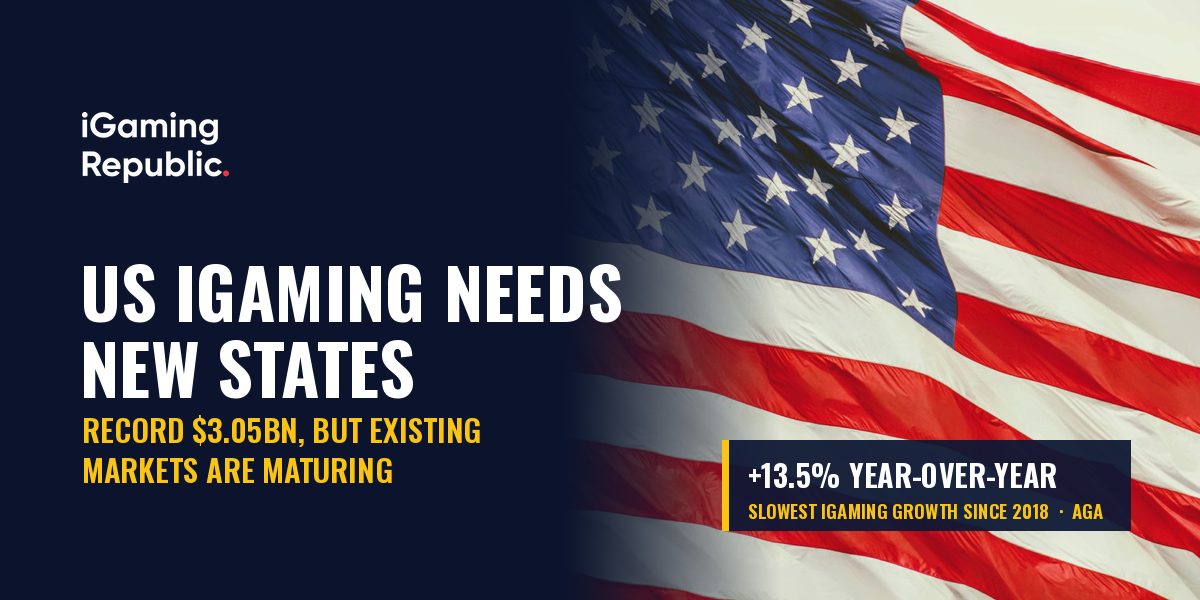
US iGaming revenue reached a record $3.05 billion in the third quarter of 2026, according to American Gaming Association (AGA) data published on November 20.
Growth of 13.5% was the vertical’s slowest in any quarter since 2018, the AGA said, with no new states opening.
Add iGaming Republic as a preferred source on GoogleSee more of our stories in Google’s Top Stories.iGaming outpaces land-based casinos
The wider market also set a record. US commercial gaming revenue hit $19.81 billion in Q3, up 4.6% on last year, according to the AGA’s Q3 2026 tracker. Land-based casinos, sports betting and iGaming all grew, and 29 of the 37 states with complete Q3 data reported higher revenue.
Almost all of the extra money came from two places. Based on the AGA’s figures, traditional casinos added about $384 million year-over-year. iGaming, meaning real-money online casino play, added about $363 million.
That is a striking result. Land-based casinos operate in 27 states and earn more than four times as much. iGaming is live in only seven regulated markets: New Jersey, Pennsylvania, Michigan, West Virginia, Delaware, Connecticut and Rhode Island. Yet those seven produced roughly 42% of the industry’s total Q3 gain.
Land-based casinos still held up well. Traditional casino revenue rose 3.0% to $13.17 billion, with slots bringing in $9.69 billion and table games $2.55 billion.
New York posted the biggest casino gain in the country, adding $167.9 million, up 20.7%. Of that, $129.8 million came from table games at Resorts World New York City.
Sports betting added only about $131 million. Revenue rose 3.8% to $3.58 billion on handle up 8.2% at $38.15 billion, but hold fell 39 basis points to 9.4%.
A new market also flattered the sportsbook total. Missouri began reporting in December 2025 and contributed $53.7 million in Q3. Excluding Missouri, sportsbook revenue grew 2.3%, according to the AGA’s figures.
Big markets slow growth
iGaming is still growing at double-digit rates. The pace has simply fallen quarter after quarter.
In Q3 2024, iGaming revenue rose 30.3%, according to the AGA. Across 2025 it grew 27.6% to $10.74 billion. That was also the year iGaming revenue overtook land-based casino revenue in Pennsylvania and New Jersey for the first time.
This year the slowdown has been steady. iGaming grew 15.7% in July and 12.8% in September, when it brought in $1.02 billion, AGA data shows.
The AGA gave two reasons: existing markets are maturing, and no new state has launched. Without a new market to open, operators have to grow by getting more out of the customers they already have.
Citizens JMP Securities sees the same trend, though its numbers differ. The bank, which compiles its own state data, put Q3 iGaming growth at 12%, down from 19% in Q1 and 16% in Q2. By its own measure, that is the slowest rate on record.
Jordan Bender and Isabelle Slavin, analysts at Citizens JMP Securities, said:
“Growth slowed in 3Q26, as expected, to its slowest rate on record.”
The seven markets are not slowing at the same speed. According to Citizens, Delaware grew fastest in Q3, up 36%, followed by West Virginia at 26%.
Michigan, coming off a record 2025, grew 17%. Connecticut rose 12%. The two oldest large markets grew more slowly, with New Jersey up 10% and Pennsylvania up 7%.
New Jersey and Pennsylvania generate a large share of national iGaming revenue. When they slow, the national growth rate slows with them.
Market share is also moving. Citizens said DraftKings gained about 130 basis points of US iGaming share in Q3, its first quarterly share gain in two years.
Untaxed rivals cost states
States collected $4.42 billion in gaming taxes in Q3, up 5.8%. Year-to-date collections reached $13.63 billion. iGaming tax revenue rose 15.6% in the quarter, faster than iGaming revenue itself.
The AGA argues the total should be higher. It says skill machines, sweepstakes casinos and sports contracts on prediction markets pay no state gaming taxes.
The association keeps a running estimate of what prediction markets cost states. In its Q3 release, it put potential gaming taxes lost to prediction market sports betting at about $1.7 billion since the start of 2025, up from more than $1.56 billion in its August report. The platforms dispute the AGA’s numbers.
States are starting to act. Utah has taken Stake.us to court over its sweepstakes casino, and a New Jersey bill would bring prediction markets under state tax.
The AGA makes the same argument about the wider illegal market. In an analysis published in August 2025, the AGA estimated that unregulated gaming devices, offshore sportsbooks and illegal online casinos generate about $53.9 billion a year. It estimated the cost to states at more than $15 billion in lost tax revenue.
Maine eyes 2027 launch
With growth slowing in the existing markets, the industry needs new states. The next one is Maine, but not soon.
Maine legalized online casinos in January 2026, with licenses reserved for its tribes. It will become the eighth iGaming state once it launches.
Milton Champion, Executive Director of the Maine Gambling Control Unit, has pointed to early 2027 as a realistic launch date. The regulator published its third draft of the online gaming rules on September 30.
Caesars plans to launch three brands in Maine through its partnership with the Wabanaki Nations, pending regulatory approval. Churchill Downs, which owns Oxford Casino, is challenging the tribal-only model in federal court, and the tribes have joined the case.
Maine has moved slowly before. It legalized sports betting in May 2022, but the market did not open until November 2023.
It is also a small state. Until a bigger market opens, operators are mostly competing for the same players in the same seven states.
The AGA’s Q4 figures will show whether September’s 12.8% was the low point or another step down.