$5.26m drain hits 9 Anjouan crypto casinos
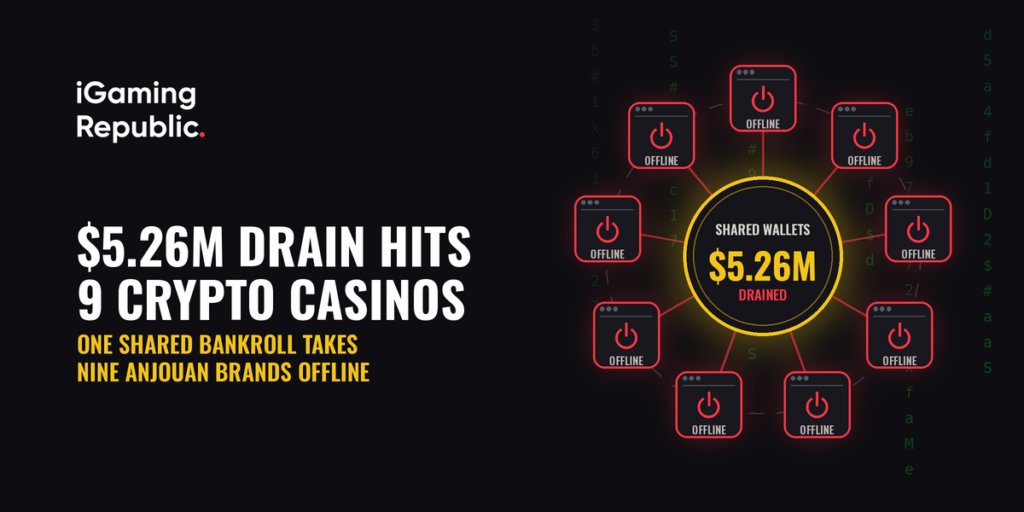
- An attacker takes $5.26m from a shared bankroll and the wallets that funded it.
- Nine sites under one Anjouan licence are offline or in maintenance by 19 November.
- Stable Mint freezes 4.6 million USDSM, but about $657k in USDC escapes the freeze.
Nine crypto casinos sharing one Anjouan licence were offline or in maintenance by 19 November. Two days earlier, an attacker took around $5.26m from their common bankroll and the wallets that funded it.
On-chain evidence published by FairGambling points to DeGaming, a platform provider based in Stockholm and Cyprus. Most of the money is now frozen.
Nine brands, one bankroll
The casinos are run by ONCHAIN Technologies Ltd, which holds a gaming licence from Anjouan. The licensor’s register lists 10 casino domains under that licence. By 19 November, nine of them were offline or showing maintenance pages, including Betmode and LuckyCoin.
The register still shows the licence as valid, even though its listed expiry date was 31 October.
The details come from an on-chain report by FairGambling, a crypto casino analytics platform that tracks money moving through gambling wallets. Its report is the main public account of the incident so far.
How the money moves
Players at a crypto casino deposit digital currency rather than card payments. The money lands in a wallet, which is an address on a public blockchain.
Each wallet is controlled by a private key, a secret code that authorises payments. Whoever holds the key can move the funds. Anyone can look up the balance using trackers.
Operators usually split their funds between two kinds of wallet. A hot wallet stays connected to the casino’s systems so winnings can be paid out instantly. A cold wallet is kept offline and is much harder to reach.
The bankroll is the casino’s pot of money. It covers player wins and proves the house can pay. Many crypto brands publish their bankroll addresses so players can check the balance themselves.
These casinos held their bankroll mostly in USDSM, a stablecoin issued by Stable Mint. A stablecoin is a token designed to stay worth one US dollar. USDSM runs on Etherlink, a blockchain built on the Tezos network.
DeGaming sells a model called Bankroll-as-a-Service. The provider runs the pot and the technology, and individual brands plug into it. That lets a new casino launch without raising its own reserve. It also means many brands can depend on the same wallets and keys.
Two hours on 17 November
FairGambling’s timeline shows the attack took place early on 17 November (UTC). At 05:06, the shared bankroll sent 617,498 USDSM to a wallet that had no activity earlier that morning. Eight minutes later, an older bankroll sent 649,908 USDC to the same address.
At 05:27, an operator key sent the new wallet its first XTZ, the token used to pay network fees on Etherlink. At 05:49, the key that had set up the bankroll contract gave payout rights to a new address.
The main transfer came at 06:01. Six wallets with operator access sent 3.88 million USDSM within seconds of each other. A minute later, the bankroll was still accepting a player’s bet.
Smaller amounts left player deposit and fee wallets over the next hour. At 07:00, the last 219,000 USDSM went to a separate operator wallet, where it has stayed.
The only brand talking
So far, Betmode is the only affected brand to comment. It confirmed the breach in a statement shared with FairGambling but did not name its platform provider.
Betmode said:
“Rest assured that player funds are safe.”
“Unauthorized access was gained to the platform systems, bankroll and player wallets.”
Betmode said its provider froze the attacker’s wallet and has rebuilt the platform with extra security. It expects to be “up and running soon again” but gave no date.
Follow the factory
FairGambling’s case for DeGaming starts with a contract. Both drained bankrolls on Etherlink were created by a contract named DGBankrollFactory.
On 22 October, DeGaming announced it was powering LuckyCoin’s launch with its Bankroll-as-a-Service model and its Glass Vault transparency layer.
A LuckyCoin co-founder said at the launch:
“Their API allows us to customise the entire player experience, from features such as live chat to greater transparency through our publicly visible hot wallet and live bankroll.”
FairGambling also points to Gambid, whose website code names DeGaming as the company handling player balances and withdrawals. The DeGaming link is FairGambling‘s reading of this evidence. Its report carries no comment from DeGaming.
Hiding in plain sight
The shared wallets were visible months before the attack. In May, LuckyCoin posted the now-empty bankroll address on BitcoinTalk as proof of a $3m bankroll. On 11 November, Betmode shared three player payouts on X, and all three were sent from that same address.
Also in May, a BitcoinTalk user claimed that Betmode, Rollchain and Wagmi used the same hot wallet. LuckyCoin’s representative replied that reward and payout wallets are shared across sites on the same licence setup.
Dope, another Etherlink casino, says its wallets were also attacked on 17 November. Its founder says the attack failed and that the attackers’ wallets were frozen through Dope’s Etherlink partnership. FairGambling found no on-chain link between Dope and the wallets in this case.
Why the freeze worked
At 07:43 UTC, Stable Mint blacklisted the receiving wallet. FairGambling says it is the only address ever blacklisted on USDSM’s Etherlink contract. Betmode said its provider arranged the freeze.
Freezing is possible because a stablecoin has a central issuer that can block an address from moving its tokens. Bitcoin and Ether have no issuer, so they can’t be frozen. This is why most of the money stolen in the Duelbits hack was swapped into Ether.
The freeze locked 4.6 million USDSM in place. About 492,542 USDC and 977 XTZ are still in the wallet. That USDC is a bridged version: a copy of the token moved from its home blockchain onto Etherlink. Circle, which issues USDC, does not control the copy, so it can’t be frozen.
At 12:30 UTC, the wallet sent 164,181 USDC through the bridging service LI.FI towards a Tron wallet. LI.FI still lists the transfer as pending, and nothing has arrived on Tron.
FairGambling says a cold wallet linked to the casinos still holds 2 million USDSM. Gambid’s homepage links its “Total bankroll” panel to that address.
Stable Mint has not said whether it will return the frozen tokens. It had not answered FairGambling‘s questions about the freeze when the report was published.
One key, many doors
FairGambling counts Dope as the third crypto casino to go offline after a wallet attack since September. The first two were Duelbits and Gamdom. Gamdom went dark in October, admitted a $3m loss, and then faced a $15m ransom demand over its player database.
The licence gives players little to fall back on. According to The Week, Comoros authorities dispute the legitimacy of the island’s licensing, and the Comoros government has asked the UK for help. Anjouan Gaming has defended its framework publicly.
Curaçao, by contrast, has set minimum crypto controls for licensees that accept digital assets.
Getting the money back now depends mostly on Stable Mint, because stablecoin issuers can reissue frozen tokens to their rightful owners. Buyers of shared-bankroll platforms will want to know who holds the operator keys, and how many other brands rely on those same keys.
Do you have a story worth sharing?
Send it over to our editors!