Brazil’s betting ban goes before the Supreme Court

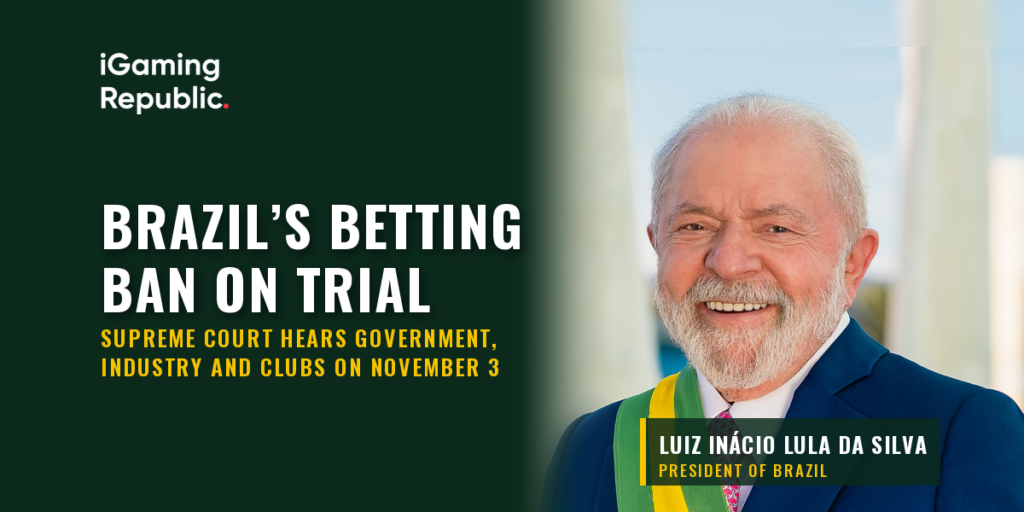
- STF hears government, industry and clubs on November 3 before ruling on MP 1,394 and related betting challenges.
- AGU wants the fixed-odds ban kept in full, ANJL and IBJR seek suspension or a December 31 transition.
- 26 participants include 10 football clubs, the CBF and the Ministry of Finance, but no individual operator.
Brazil’s Supreme Federal Court (STF) will hold a public hearing on November 3 on the decree that shut down the country’s licensed betting market.
It is not a ruling. It is, however, the first time the court will hear both sides before deciding whether operators can return. Licensed sites have been offline since October 6, and every federal betting license expired on October 25.
For operators, suppliers and affiliates with Brazilian exposure, what happens next now depends on two institutions: the STF and Congress.
No ruling yet
The ban came through Provisional Measure (MP) 1,394, signed by President Luiz Inácio Lula da Silva on September 25. An MP works like a presidential decree. It takes effect immediately, but Congress must approve it within a set deadline or it expires.
The industry took its challenge straight to the Supreme Court. The lead case, ADI 8,027, was filed by the National Association of Games and Lotteries (ANJL). An ADI is a constitutional challenge asking the court to strike a law down.
Justice Luiz Fux is the judge in charge of the case. He called the public hearing for 10am on November 3 instead of ruling on whether to suspend the ban. The session works as an evidence day, where interested parties argue their case before the judge decides.
Until Fux or the full court rules otherwise, the ban stays fully in force. Nobody can resume taking bets or advertising in the meantime.
Football takes the stand
The order names 26 participants. Ten clubs will speak: Flamengo, Corinthians, São Paulo, Fluminense, Botafogo, Cruzeiro, Ponte Preta, Vitória, Guarani and Portuguesa. The Brazilian Football Confederation (CBF) joins them.
Clubs have lobbied hard. By early October, 21 clubs had filed submissions backing the challenge, Brazilian outlet BNLData reported.
The government side includes the Attorney General’s Office (AGU), which defends the federal government in court. The Ministry of Finance and the Prosecutor-General of the Republic will speak too.
The list also covers the Brazilian Institute of Responsible Gaming (IBJR), industry and commerce bodies, broadcasters and academics. No individual operator was invited, so the industry’s case rests on its trade associations and the clubs.
Ban versus bridge
The AGU wants the MP kept in full. It also asked for the hearing, alongside ANJL and the amici curiae, the outside parties the court allows to weigh in.
The AGU argued that new evidence since the court’s last betting hearing in November 2024, plus the MP itself, justified a fresh debate, according to the STF.
ANJL and IBJR argue the MP shut down a lawfully regulated market. An MP is only meant for matters that are both relevant and urgent, and they say this one fails that test.
Their main ask is an injunction, a temporary suspension of the ban until Congress or the court gives a final answer. Their fallback is a transition starting on December 31, 2026, letting licensed operators trade through year-end.
Two roads back
The first road runs through the STF. An injunction from Fux could reopen licensed operators before Congress acts, though the full court would then confirm or overturn it. Lower courts offer little. Stake won an exception in São Paulo, but an appeals court shut it within 24 hours.
The second road runs through Congress. The official calendar gives lawmakers until November 23 to vote. From November 9, the MP starts blocking other votes until it is dealt with. The deadline can be extended once by 60 days, with the year-end recess not counted.
Progress is slow. The joint committee that must review the MP has not been set up, and lawmakers have tabled 99 amendments.
Even a lapse would not reopen the market automatically. Steps taken under an MP stay valid unless Congress passes rules on them within 60 days, so expired licenses would not simply revive.
Settlement talk adds a third variable. Folha de S.Paulo has reported that the hearing could open the way to a deal, though that remains unconfirmed. Lula said on October 22 that betting platforms would not return.
The pressure is mounting on both sides. ANJL counts more than 3,500 jobs lost since the ban. Fux’s next step after November 3 will show whether the court route stays open. If it closes, the industry’s fate rests with a Congress yet to start work and a president whose fresh mandate suggests little appetite for retreat.
About the author
Bianca Máthe
Bianca Máthe is Publisher of iGaming Republic. She spent close to a decade on the supplier side of iGaming, working across the sector's core verticals: platform and player-engagement technology and crypto payments. That mix gave her a working knowledge of how operators, suppliers and payment providers actually run. In 2025 she started a media project, bringing that operational grounding to her editorial work. Her output includes interviews with high-profile iGaming executives, original reports, and in-depth features covering licensing, M&A, and the operators and suppliers shaping the sector. Based in Malta, she spends much of her time getting closer to emerging sectors like prediction markets, tracking how they're developing before the rest of the industry catches up.
Do you have a story worth sharing?
Send it over to our editors!