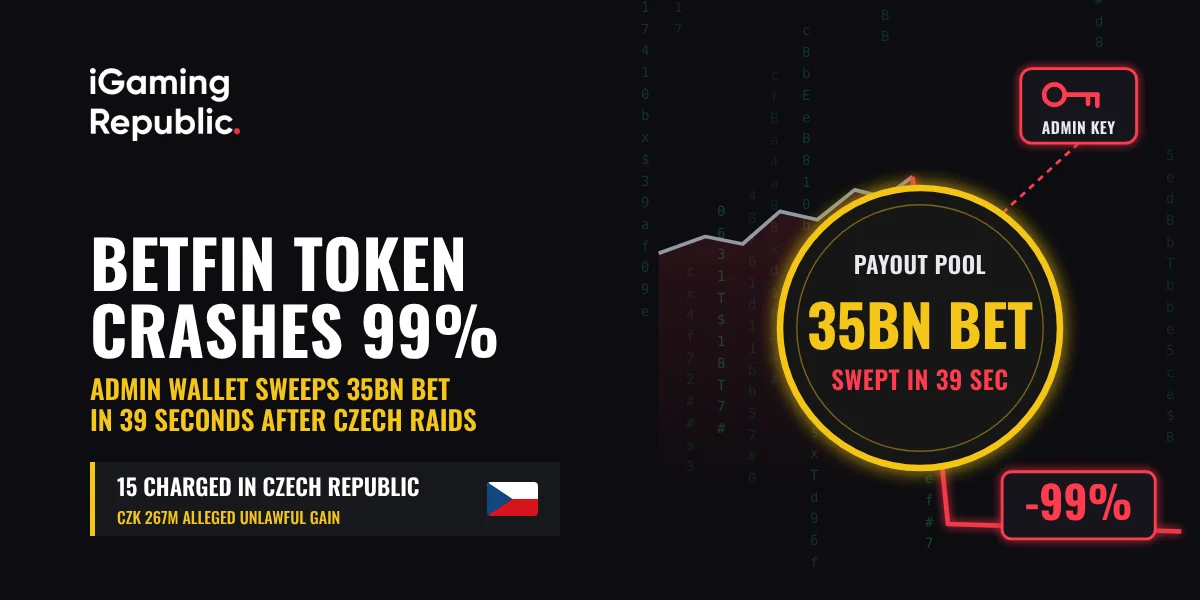
- An admin wallet swept 35 billion BET from Betfin's payout pool on 25 October
- The token lost about 99% in an hour as 48% of the swept tokens were sold
- Czech police and customs have charged 15 people over the unlicensed crypto casino
In this story6 sections
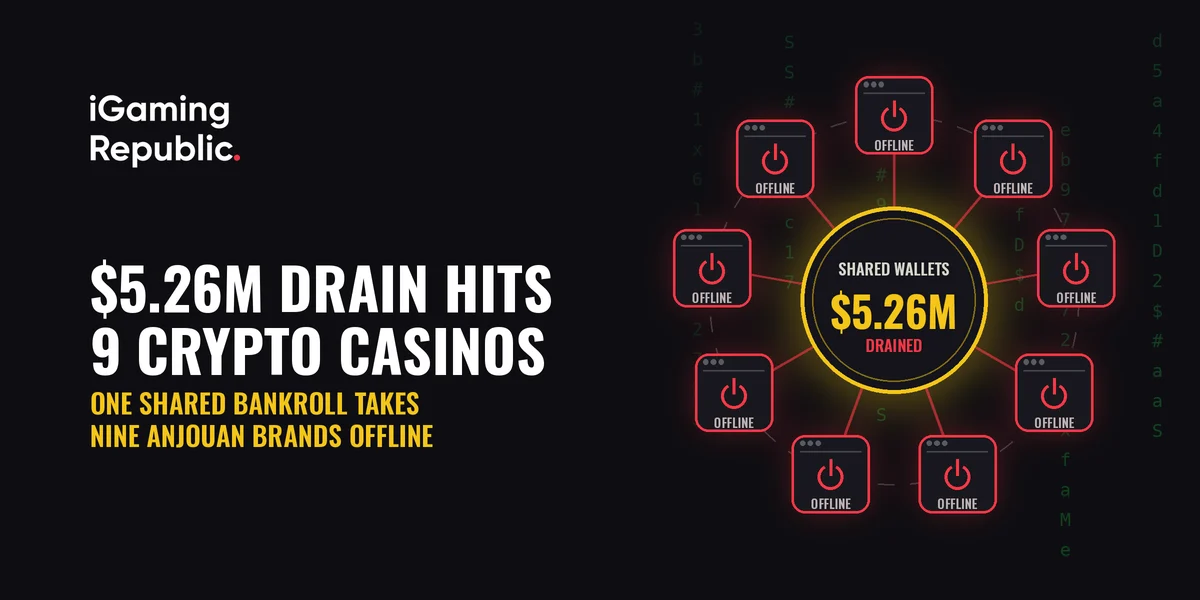
Betfin's BET token lost almost all its value in a single hour on 26 October. Just before midnight UTC on 25 October, an admin wallet linked to the token's deployer emptied the crypto casino's payout pool.
That was less than two weeks after Czech customs and police raided the people behind Betfin. On 19 November, they said they had charged 15 people over the unlicensed operation.
Add iGaming Republic as a preferred source on GoogleSee more of our stories in Google’s Top Stories.Lights out in October
Czech media reported that the raids were part of an operation called "Token". Brno customs officers led it with the National Centre Against Organised Crime (NCOZ). According to the Czech Police, Europol staff took part and nearly 300 customs officers and police were involved.
Officers detained 20 people and searched more than 40 homes and other premises, mostly in the South Moravian Region. Seznam Zprávy reported on 15 October that YouTubers linked to Betfin had been detained.
The casino stopped working almost immediately. Blockchain analytics firm Bitquery found that payouts from Betfin's game contract collapsed at 12:50 UTC on 16 October. The contract made 762 payouts in the 50 minutes before that point and 48 in the hour after.
39 seconds
Betfin's payout pool was an upgradeable contract. In plain terms, one admin key could replace the pool's code and keep its address and tokens.
That key was used late on 25 October. At 23:58:44 UTC, the admin wallet swapped the pool's code. At 23:59:17, the pool sent 35 billion BET to a fresh wallet, which Bitquery calculates as 4.5% of all BET in existence. Six seconds later, at 23:59:23, the original code was back. The altered code ran for 39 seconds in total.
The admin wallet was not a stranger to the project. Bitquery traced its first funding to the BET deployer in late March 2026.
Dumped into thin pools
Three minutes after the transfer, the admin wallet sent the fresh wallet some POL to pay gas fees. Over the next hour, that wallet made six sales and sold 16.7 billion BET, 48% of what it had received, into thin DEX pools.
Liquidity could not absorb the selling. BET fell about 99% in that hour, from roughly $0.00004 to roughly $0.0000004. Its fully diluted value dropped from about $31 million to about $233,000.
The sales raised only about $62,000 in USDT0 and POL. The money was bridged from Polygon to Solana and then to BNB Chain, and ended up as roughly 60,824 USDT.
Smaller sums took other routes. About $3,029 reached an address Bitquery labels as a Bybit deposit address. On 3 November, 349,001 USDT moved on from a wallet where Betfin-linked funds had been mixed with about $293,000 from other wallets. That transfer went into the MetaRouter swap router, a service thousands of wallets use, and Bitquery loses the trail there.
Bitquery does not say who did it. The firm notes that on-chain data shows what keys did, not who controlled them, and it does not name the admin key holder or the owner of the swept BET.
The charge sheet
Police and customs said they had started criminal prosecution against 15 people for participation in an organised criminal group and unauthorised operation of a gambling game. The three alleged organisers are in custody and face up to 13.5 years in prison if convicted.
Police estimate the group's unlawful gain at about CZK 267m, which Bitquery converts to roughly €10.9m. Investigators also seized about CZK 100m in assets, including real estate, motor vehicles, jewellery, cash and cryptocurrencies.
Investigators analysed more than 2.3 million bets placed by about 28,500 players. That player count may overstate real activity: ČTK reported that many player accounts were created by automated programs.
The blockchain record is smaller. Betfin's latest game contract went live at the end of March 2026, and Bitquery counted about 944,000 bets from 20,600 wallets after that. Bitquery notes that the police counted more than 2.3 million bets over a longer period, so the two figures are not directly comparable.
The investigation ran for more than a year. A specialist firm examined Betfin's smart contracts on the Polygon network. Investigators also went through Telegram and Discord channels, online videos and public conferences.
Authorities call it the first case of its kind in the Czech Republic. The High State Prosecutor's Office in Olomouc is supervising the case. Investigators did not name anyone charged.
Selling the duck dream
Betfin was more than an online casino. Players had to buy BET to play, and the token was also promoted as a profitable investment through MLM schemes. Earlier promotional videos promised monthly returns of several percent with no work required.
Holders could also stake BET, locking their tokens for 80 weeks. The promoters branded themselves the "duck nation", with duck masks, duck-themed posts and duck-decorated luxury cars.
The marketing went a long way. Seznam Zprávy reported that promoters once held an event outside a secondary school and handed out money, including to underage students. Customs officers started looking at the case in August 2025, according to ČTK.
The token was in trouble long before the raids. In October 2025, Seznam Zprávy reported that BET had fallen about 80% from its June peak, citing CoinMarketCap data. Customs officers also found a wide gap between the declared value of all tokens in circulation, over CZK 45bn, and actual exchange liquidity of about CZK 11m, ČTK reported.
Code with a keyholder
For anyone building or marketing a "decentralised" casino, the case shows the approach regulators are taking. Czech investigators did not argue about decentralisation in principle. They followed contract permissions, wallet funding and promoter activity back to identifiable people.
The upgradeable pool goes straight to the heart of the case. Investigators say Betfin's claim to be decentralised was false. A payout pool that one key can rewrite in under a minute is hard to describe as ownerless.
The same questions about treasury control are now coming up across offshore crypto gambling, after a string of drains and hot wallet breaches. Prague has already moved to block Polymarket.
Other European authorities are putting crypto into AML planning and threatening influencers with fines for promoting unlicensed gambling.
BET holders are unlikely to recover much. The wallet that sold still holds about 17.5 billion BET, but BET pools have at most about $1,300 in liquidity. Criminal proceedings are ongoing, and police say they cannot share more details at this stage.