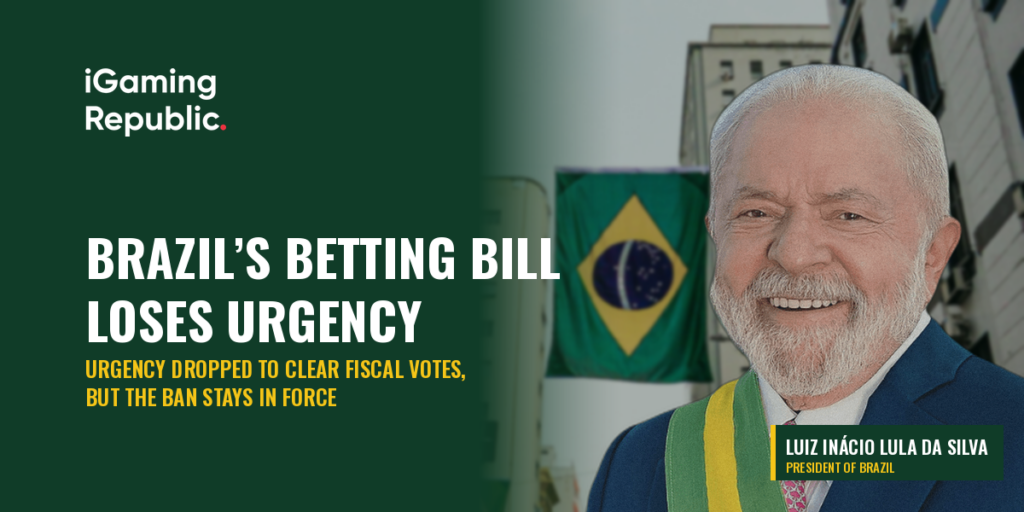
Lula trades betting crime urgency for fiscal votes
- Government withdraws urgency on PL 5.477/2026 after a five-day Chamber agenda block.
- Bill proposes four to six years in prison for operating betting platforms.
- MP 1.394/2026 keeps the ban in force as the government plans to restore urgency.
Brazil’s government has taken the fast track off its bill to criminalize betting. President Luiz Inácio Lula da Silva withdrew constitutional urgency on PL 5.477/2026 on November 17, so the Chamber of Deputies can vote on its fiscal package first.
Five days on hold
Urgency gave the Chamber 45 days to vote. The voting window ran from September 29 to November 12, and from November 13 the bill blocked the floor agenda.
The bill never reached a committee. It was still waiting for Speaker Hugo Motta to send it on when Lula’s Message No. 861/2026 removed the urgency and lifted the block.
The bill has not been archived, and its text is unchanged. It now moves under the Chamber’s priority regime, which carries no 45-day voting deadline.
Its pace now depends on Motta. Without urgency, nothing happens until he sends the text to committee and party leaders agree to put it on the floor.
Fiscal package comes first
The decision followed a meeting with leaders in the Chamber. José Guimarães, minister for institutional relations, confirmed the deal on X and said the betting ban is unaffected.
The government wants two bills through first. One is PLP 299/2026, a fiscal package with new spending controls. The Senate approved its main text on November 12 by 45 votes to 31, with four amendments still to vote before it could move to the Chamber.
The government says the package could improve public accounts by up to R$56.1 billion in 2027. Motta has committed to bringing it to a vote once it arrives from the Senate. Some allied lawmakers have criticized the measures, warning they could squeeze social investment.
The other is PL 4.675/25, which sets competition rules for large digital platforms.
Guimarães said the government will seek to restore urgency on the betting bill once both pass, and wants a vote this year. It has done this before. In June, the government dropped urgency on its 6×1 working-week bill, after Motta complained that it was blocking votes.
Suppliers in the frame
The bill went to Congress on September 25 with Message No. 785/2026, alongside MP 1.394/2026, which ended betting authorizations. The MP shut the market. The bill would make it a crime to keep operating.
It does this in two ways. It adds a chapter of betting crimes to Law 13.756/2018, which governs fixed-odds betting. It also narrows the old gambling misdemeanor in the 1941 Criminal Misdemeanors Law, so the same conduct is not punished twice.
The new chapter creates five offenses. Operating betting platforms carries four to six years in prison, and advertising them carries two to four years.
The bill reaches further than operators. It also covers using personal data to recruit bettors, payment facilitation and supplying platform tools. That brings payment providers and technology suppliers that keep serving the illegal market into scope.
Affiliates are in the frame too. The bill links penalties for advertising and recruiting bettors to how promoters are paid. Finance Ministry rules already require operators to keep written affiliate contracts that set out how affiliates are paid.
Fines would reflect the economic advantage the offender gained. Cases would go to the Federal Police and federal courts.
Article 35-N sets a clear limit. Under the bill’s text, betting operated with a valid Finance Ministry authorization would not be a crime. If the MP falls and licenses return, the offenses would only reach the illegal market.
Racing the recess
Nothing changes on the ground for operators. Congress has extended the MP by 60 days, and the recess pauses the clock, so it now runs into early March. The joint committee that must review it has not yet been installed.
If the MP lapses, the 2023 Betting Law comes back into force. Congress would then have 60 days to pass a decree setting out what happens to the ban’s effects. The Finance Ministry has already said operators that paid R$30 million for licenses are not entitled to a refund.
Criminal penalties could also arrive through the MP itself. Among the 99 amendments filed, Senator Alessandro Vieira (MDB) wants prison terms for running betting sites. Others would bring licenses back.
Congress breaks for recess on December 23. Before then, the government wants the fiscal package approved, urgency restored and a vote on the criminal bill. A cross-party group in the Chamber, “Saúde Não Se Aposta”, is pushing for a faster vote on the MP.
The deadline matters beyond this year. After Lula’s reelection, a new Congress takes office in February. Any vote that slips past the recess would fall to lawmakers who have not yet been sworn in.
The courts are not moving faster. On November 8, Supreme Court Justice Luiz Fux suspended lower-court challenges to the MP nationwide. A ten-hour hearing on November 3 ended without a ruling on the industry’s request to suspend the ban.
The ban is already showing up in results. Flutter booked $873m in Brazil write-downs in its third quarter. For operators, suppliers and affiliates, the MP keeps the market closed, and the prison terms are still being debated in Congress.
Do you have a story worth sharing?
Send it over to our editors!