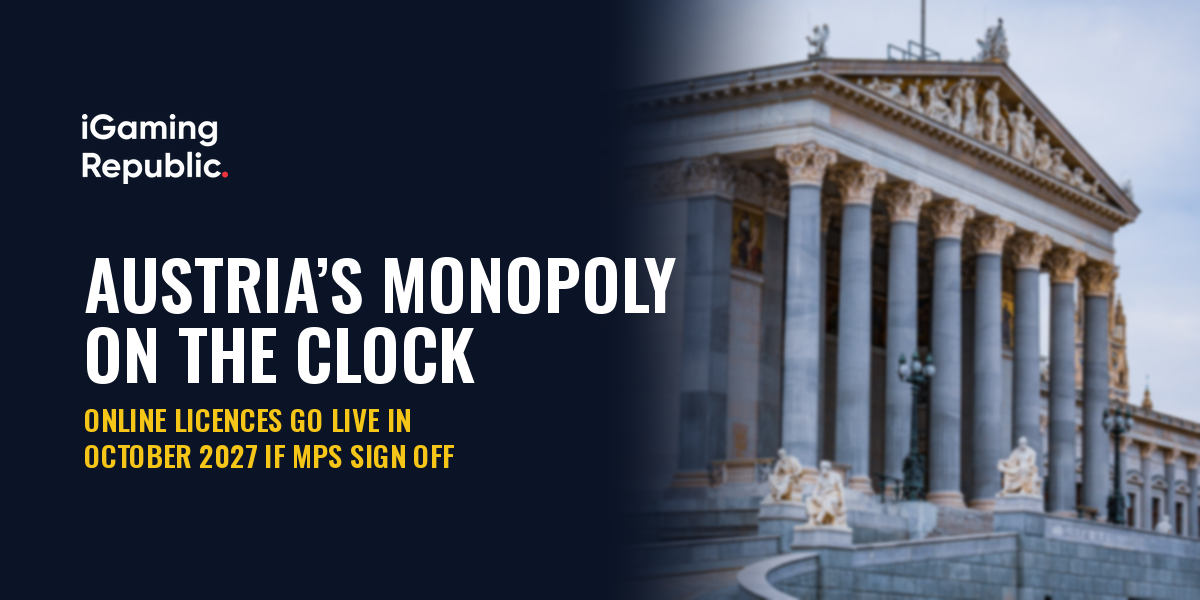
- Austria's Finance Committee approves the Gambling Act reform on 24 November
- New online licences can be granted from 1 January 2027, effective from 1 October
- National Council can vote only after the EU standstill ends on 7 December
In this story4 sections
Austria is a step closer to ending its online gambling monopoly. The parliamentary Finance Committee passed the Gambling Act reform on 24 November, backed by the governing ÖVP, SPÖ and NEOS.
The National Council is expected to vote on it in December.
Add iGaming Republic as a preferred source on GoogleSee more of our stories in Google’s Top Stories.Malta pushes back the final vote
The FPÖ and the Greens voted against, according to the Parliamentary Correspondence. The National Council can vote only once the EU standstill period ends on 7 December.
The Finance Ministry notified the bill to the European Commission in August, starting a three-month standstill due to end on 5 November.
Malta filed a detailed opinion on 4 November, the day before that deadline. This extended the standstill by a month.
Malta has pushed back on Austria before. Its courts have blocked Austrian player claims against Malta-licensed operators, and its protective gaming law survived an EU challenge.
The coalition still plans to pass the law before the end of the year.
Open licensing at lower cost
The committee passed the bill as originally drafted. An amendment comes with the plenary vote, and its key changes are already public.
Online applicants will need €3m in share capital. The June draft set the bar at €10m.
There is no cap on the number of online licences. Any operator that meets the criteria can apply, in line with the coalition's multi-licence plan. Licences can be granted from 1 January 2027 and take effect no earlier than 1 October 2027.
The amendment also extends the lottery concession, due to expire in October 2027, to the end of 2028. Tobacconists that sell lottery tickets get a minimum 7% commission.
Strict entry and player rules
Unlicensed operators must stop serving Austrian players by the end of 2026 to stay eligible. Those that stop later face an 18-month exclusion from licensing. The exclusion rises to 24 months for operators that stop in 2030 or later.
Applicants must also clear tax arrears and pay out player claims backed by final court rulings, across their whole group. The government says around 20,000 players would benefit.
Unlicensed sites will face payment blocking and network blocks, tools that regulators such as Denmark's already use regularly.
A central exclusion register will cover every game type except lotto. Brazil introduced a similar system this year before the ban.
Online deposit limits will apply across operators, not per account. Players will also face a 72-hour wait before they can raise a limit they set themselves. After 90 minutes of continuous play, a break of at least 15 minutes is mandatory.
For gaming machines and virtual slots, the maximum stake is set at €5, a ceiling Germany now applies to online slots. Each game must last at least two seconds.
Channelisation drive meets a tight timeline
win2day, run by Österreichische Lotterien, is currently the only licensed online casino offer in Austria. Suppliers reach Austrian players through it, as RubyPlay has done.
Jan Krainer, SPÖ finance spokesperson, said in a party statement (translated from German):
“This is the biggest reform in decades. The entire online sector currently has one legal provider, which serves perhaps 40% of the market. The rest is grey and black.”
NEOS MP Christoph Pramhofer puts the illegal share higher, at around 71%, a figure CasinoBeats describes as disputed.
The coalition wants to raise channelisation, the share of play that goes through licensed sites. The Nordics show how hard that is.
ÖVP finance spokesperson Andreas Ottenschläger called the timetable “durchaus sportlich”, which means quite ambitious. He has not ruled out reviewing the law in two to three years.
The exclusion register and blocking measures need to work before the first licences take effect. A new body for gambling and player protection will monitor the market, though no start date has been set. The SPÖ says an independent gambling authority and new betting rules will follow next year.
Sports betting remains a matter for the nine Länder for now.
Tipico has already completed its Admiral Austria deal. Operators that keep serving Austrian customers without a licence after 1 January will miss the October 2027 launch.
Finland's market launches in July 2027, so operators will have two new European markets opening within three months of each other.