House Edge: Tomasz Kowalik on AI, consolidation and why the answer is always more gold
House Edge is iGaming Republic’s new interview series for the people shaping casino gaming right now, the product leads, studio heads and game designers whose decisions rarely make it into a press release.
Every guest answers the same set of questions, which means you get something most interviews don’t: a way to compare how different people, at different companies, are actually thinking about the same problems. No PR polish, no pitch deck, just a straight read on where casino is headed, one guest at a time.
For our first edition, we sat down with Tomasz Kowalik, Product Director at Yggdrasil Gaming. He talks about AI rewriting how games get made (not just the art), why he’s betting on a wave of studio consolidation, why he’s betting big on Game in a Box™, and why the best advice he’s ever gotten in this industry still makes him laugh.
Yggdrasil Gaming was founded in 2013, and has grown into one of the industry’s best-known slot studios, with offices across Malta and Poland. The company is known for its HTML5 video slots (titles like Vikings Go Berzerk and Valley of the Gods among its best-known), its GATI interface, which enables development teams to port games to the Yggdrasil platform, and BOOST TOOLS, its in-game tournaments and promotions tool.
More recently, the studio has been putting its weight behind Game in a Box™, an internal production tool now being adopted by external studios too, aimed at pushing Yggdrasil’s output from around two games a month to roughly ten. Yggdrasil has twice won the EGR B2B Award for Best Slots Provider.
iGaming Republic: What’s the most interesting thing you’re seeing happening in the casino game space right now?
Tomasz Kowalik: Maybe I’ll sound a bit obvious here, but for me it’s Artificial Intelligence and how quickly it’s changing almost every part of casino game development.
The obvious area is art, but it goes much further – coding, prototyping, documentation, game design, marketing and even market research. What used to take days or weeks, like building a visual concept or preparing a game design document, can now often be done in hours.
What’s especially interesting is that AI is starting to influence not only how we build games, but also how we decide what games to build. It helps us track trends, analyse competitors and understand what might become relevant next.
We’re following the same direction with Game in a Box™, using technology to make game design and game logic much faster, so teams can spend more time experimenting and less time on repetitive work.
iGR: Name one thing about casino you’d put money on being true in two years.
TK: I’d put money on much more consolidation in online slot development.
Right now, the market is very fragmented. New studios are appearing all the time, while better tooling is making game production cheaper and easier. We’ve seen this pattern in many fast-growing industries: first comes rapid expansion, then consolidation.
“First comes rapid expansion, then consolidation.”
Tomasz Kowalik, Product Director at Yggdrasil Gaming
I think we’re already seeing the early signs of studios operating within larger groups, sharing technology, distribution and production resources. I expect that to accelerate.
The second thing I’d watch is operators producing more of their own content. As making games becomes cheaper and easier, it becomes much more attractive for operators to create games specifically for their own audiences and keep more of the value on their side.
iGR: Where’s the line between innovation and gimmick in casino games?
TK: I’m not sure that line is as clear as it used to be.
With the current pace of AI development, something can look like a gimmick today and become a normal production tool six months later.
Two years ago, few people expected AI to become so useful for game art, visual concepts and design. Today, with the right tools, you can describe how a game should work and generate a playable prototype that is already good enough to validate the idea.
“Sometimes a gimmick is simply an innovation that arrived a little too early.”
Tomasz Kowalik, Product Director at Yggdrasil Gaming
Technology is moving so quickly that it’s becoming harder to say, “This will never work.” The important thing is to stay open to experimentation.
iGR: What’s a common misconception people have about slots?
TK: One of the biggest misconceptions is that slot games are somehow rigged – that the game can decide when to let you win or when to take the money back.
On regulated markets, that simply isn’t how it works. Games go through strict certification, and their results have to follow the approved mathematical model and RNG behavior.
I think the bigger misunderstanding is actually about probability. Players naturally look for patterns. After a long losing streak, it can feel like a win must be coming. After several wins, it can feel like your luck has to run out. But with independent spins, the next spin has the same probability regardless of what happened before.
“The biggest misconception about slots is really a misconception about randomness itself.”
Tomasz Kowalik, Product Director at Yggdrasil Gaming
The mathematics only becomes clearly visible across a huge number of rounds. So in many ways, the biggest misconception about slots is really a misconception about randomness itself.
iGR: What’s a recent project you’re proud of, and what made it work?
TK: I could name a few individual games, like our recent 3 Piggies of Bank, but the project I’m most proud of is definitely Game in a Box™.
We’ve reached the point where it’s no longer an R&D concept – it’s a real production tool. We’ve already released several games with it, and we now have dozens more in production.
What made it work was a huge commitment from the team, some bold decisions, strong R&D and support from across the company and our partners. We put a lot behind it, and that bet paid off.
What’s especially exciting now is that external studios are already learning the tool and starting their first games with it. So it’s becoming more than an internal solution.
It has also reduced production costs, which was one of the key goals from the beginning. The next step is scale: more functionality, more studios using it and increasing our internal production capacity from around two games per month to roughly ten.
iGR: What’s the best piece of advice you’ve been given in this industry?
TK: I’m not sure this is the best advice I’ve ever received, but it’s definitely the one I remember most: more gold (laughs).
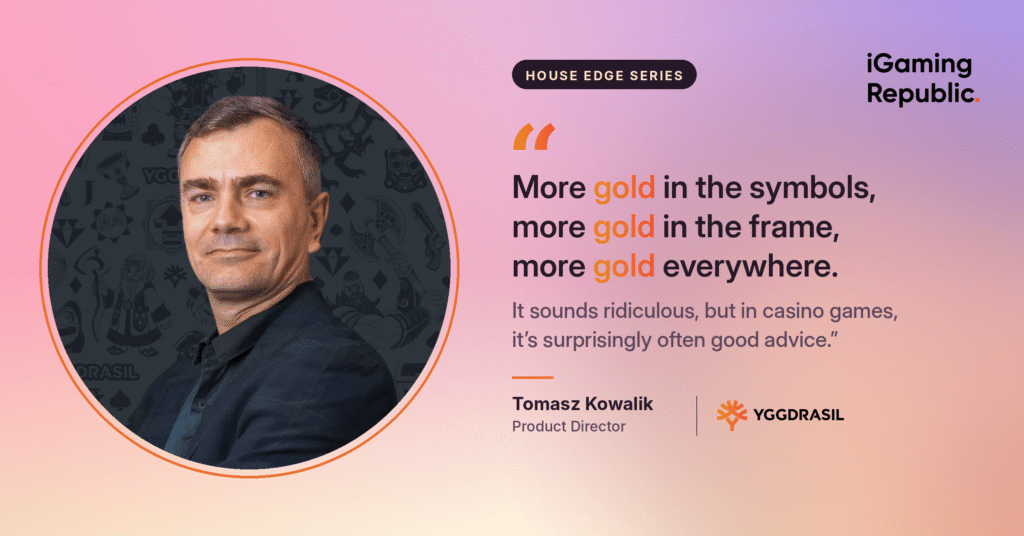
More gold in the symbols, more gold in the frame, more gold everywhere. Make it shiny. Make it rich. It sounds ridiculous, but in casino games, it’s surprisingly often good advice.
“More gold in the symbols, more gold in the frame, more gold everywhere. It sounds ridiculous, but in casino games, it’s surprisingly often good advice.”
Tomasz Kowalik, Product Director at Yggdrasil Gaming
On a more serious note, the best advice is: understand your players and make games for them, not for everyone.
Different markets want different things. A game that works in the UK may not work the same way in Brazil or the Nordics. Younger players may respond better to modern visual language, pop culture or video game references, while traditional slot players may prefer classic mechanics and a more land-based feel.
“Know exactly who you’re building for. And if you’re still not sure – add more gold.”
Tomasz Kowalik, Product Director at Yggdrasil Gaming
So the lesson is simple: know exactly who you’re building for. And if you’re still not sure – add more gold.
About the author
Bianca Máthe
Bianca Máthe is Publisher of iGaming Republic. She spent close to a decade on the supplier side of iGaming, working across the sector's core verticals: platform and player-engagement technology and crypto payments. That mix gave her a working knowledge of how operators, suppliers and payment providers actually run. In 2025 she started a media project, bringing that operational grounding to her editorial work. Her output includes interviews with high-profile iGaming executives, original reports, and in-depth features covering licensing, M&A, and the operators and suppliers shaping the sector. Based in Malta, she spends much of her time getting closer to emerging sectors like prediction markets, tracking how they're developing before the rest of the industry catches up.
Do you have a story worth sharing?
Send it over to our editors!