Louisiana freezes Kalshi, Polymarket event contracts
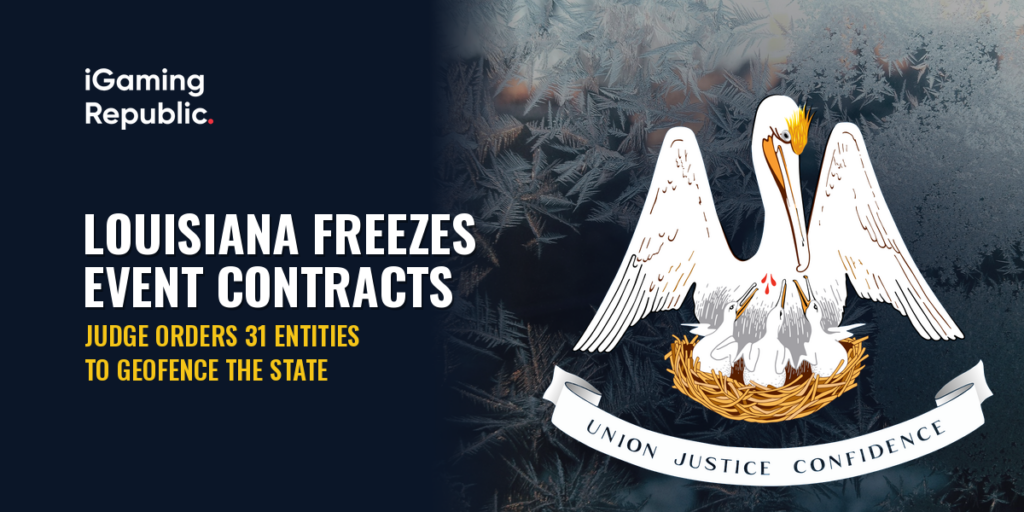
- Judge Jeffrey Johnson signs an ex parte TRO against 31 entities on November 12.
- Operators must geofence Louisiana and halt unlicensed event contracts.
- The CFTC and DOJ sue Louisiana in federal court the next day.
Louisiana has ordered 31 prediction market entities, including Kalshi, Polymarket and Robinhood, to stop offering unlicensed event contracts to people in the state.
Judge Jeffrey Johnson signed the temporary restraining order on November 12, the same day Attorney General Liz Murrill sued the companies.
Signed by mid-afternoon
Murrill announced and filed the civil enforcement action in the 21st Judicial District Court in Tangipahoa Parish on Thursday, November 12. Johnson signed the order at 3:48 pm that day, the Shreveport-Bossier Journal reported.
He issued it ex parte, so the defendants were not heard before it took effect. The order said they had received constructive notice of the case through media and other outlets.
Johnson also required no bond. He found that Louisiana was defending its sovereign interests and those of its citizens.
Murrill said the platforms “have violated our laws with impunity.” She is also seeking a preliminary injunction and civil penalties.
Judge Jeffrey Johnson, 21st Judicial District Court, wrote in the order:
“The equities and the public interest overwhelmingly warrant immediate relief.”
Geofence or stop
The order does not tell the companies to leave Louisiana. It tells them to stop serving Louisiana users without a license.
Defendants may not offer, list, accept, clear, settle or broker event contracts for anyone in the state without a license and permit. They also may not make a market in them.
The definition is wide. It covers any money or value risked on an event with an uncertain outcome, and names sports, elections and awards as examples.
Platforms must geofence the state and stop accepting wagers from residents. They also cannot tell Louisiana customers that their products are lawful, licensed or authorized there.
Exchanges, brokers, crypto
The 31 defendants are corporate and affiliate entities, not 31 separate apps. They span 10 parent operators and 13 brands, and they include clearing and brokerage arms.
The brands range from exchanges Kalshi, Polymarket, Novig and ProphetX to brokers Robinhood and Coinbase. Crypto platforms Crypto.com and Gemini are named too, along with ForecastEx and Underdog.
Several have dealt with a state order before. In October, Ohio’s casino regulator ordered 10 platforms, including Polymarket, Robinhood and Coinbase, to stop offering sports event contracts.
Liz Murrill, Attorney General of Louisiana, said on X:
“It’s not complicated: if you aren’t a licensed gaming operator, you aren’t legal.”
Murrill’s argument is that customers who risk money on a future event are gambling, whatever the product is called. The platforms and the CFTC argue that event contracts on CFTC-regulated venues are swaps under the Commodity Exchange Act, and that state gambling laws are preempted.
The CFTC steps in
On November 13, the Commodity Futures Trading Commission and the United States, through the Department of Justice, sued Louisiana in the Eastern District of Louisiana.
The complaint asks the court to block enforcement of Johnson’s order and to declare the state’s gambling laws preempted. It names the state, Murrill, the Louisiana Gaming Control Board and the State Police gaming enforcement division.
The CFTC says Louisiana is the 12th state it has sued to defend its exclusive jurisdiction. The run began in April, when the agency took three states to court. Days later, a federal judge halted Arizona’s prosecution of Kalshi.
Michael Selig, Chairman of the CFTC, said:
“The state’s eleventh-hour ‘emergency’ lawsuit seeking to shut down the entire prediction market industry is naked lawfare and a cynical political stunt.”
Murrill replied on November 14. She called Selig’s statements “flatly false” and labelled him the “obsequious standard bearer” for Kalshi and prediction markets.
Kalshi saw it coming
Kalshi went to court before the state did. On October 23, it sued Murrill, Governor Jeff Landry and LGCB chair Christopher Hebert in the Western District of Louisiana. Its argument was that state enforcement was about to start.
After Johnson’s order, Kalshi made an emergency filing in federal court. The federal docket also shows the state case was removed to federal court on November 13 as Louisiana State v. Kalshi Inc.
Louisiana has held this position for a year. In December 2025, the LGCB warned licensed sportsbooks that it treats sporting event contracts as illegal gambling. Lawmakers then passed HB 53, which reclassifies illegal gambling offenses as racketeering.
Kalshi’s other legal fights are getting harder too. In October, Utah prosecutors filed 14 criminal counts against the company and co-founders Tarek Mansour and Luana Lopes Lara. Mansour has dismissed the state lawsuits as “faux indignation”.
Appeals courts disagree
Louisiana’s cases take the fight into Fifth Circuit territory for the first time. The circuits that have already ruled reached different answers.
In April, the Third Circuit gave Kalshi its biggest legal win against New Jersey. The Ninth Circuit sided with Nevada on August 28.
On September 25, the Sixth Circuit ruled that Ohio and Tennessee can enforce their gambling laws against Kalshi’s sports contracts. The panel pointed to geofencing as a workable way to comply, which is what Johnson’s order now requires.
New Jersey has asked the US Supreme Court to settle the question. In the meantime, states keep suing. Connecticut and New Mexico have both taken Kalshi to court this year.
Two dates to watch
The federal case comes first. According to the docket, the government’s motion for a restraining order and preliminary injunction is set for submission on November 17 before Judge Anna St. John.
Johnson’s order expires at 3:48 pm on November 22. It can be extended for good cause in increments of up to 10 days, or longer if the defendants consent.
The state had set its injunction hearing for November 30 at 9 am. That would be the defendants’ first scheduled chance to argue against the injunction in the Tangipahoa Parish case. Since the removal, it is unclear whether the hearing will go ahead there.
If the federal court rules for the government, the platforms can reopen to Louisiana users. If it rules for the state, they stay geofenced for as long as the order stands.
Do you have a story worth sharing?
Send it over to our editors!