Ask the Republic: How much AI is too much in CRM?

The economics of iGaming player acquisition have fundamentally changed. With costs through the roof and competition intensifying across every market, operators can no longer rely on aggressive bonusing and broad-reach campaigns to build sustainable revenue.
The answer increasingly lies in smarter, faster, more responsive engagement systems that treat each player as an individual journey rather than a conversion target. AI-driven CRM and gamification have moved from experimental cases to operational necessities, enabling operators to deliver personalized experiences at scale while maintaining the guardrails that protect both players and brands.
But the promise of AI in CRM brings new tensions.
- How do operators accelerate campaign cycles without losing control?
- Where is the line between helpful personalization and intrusive manipulation?
- And how can responsible gaming evolve from a compliance checkbox into an intelligence layer that actively shapes engagement strategy?
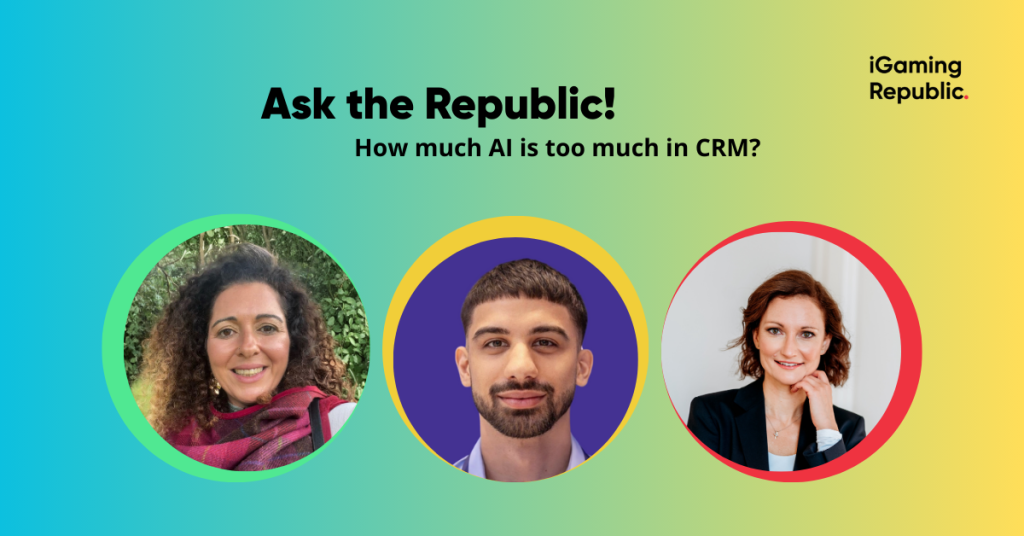
These questions are no longer theoretical. They’re defining how the next generation of operators will compete, retain players, and earn the trust required to operate in increasingly scrutinized markets. To explore this hot topic, we’ve gathered three experts on CRM and customer journeys from across our community.
- Shireen Haddadeen, Founder at Animated Imagination
- Claudia Heiling, COO and Co-Founder at Golden Whale
- Alec Gehlot, Founder at PlaySignal
Let’s dive into this!
iGaming Republic: How can operators use AI within CRM to shorten campaign build, testing, and launch cycles without increasing operational risk?
Claudia Heiling: AI and machine learning allow operators to shift from manually configuring campaigns to systems that adapt automatically to where each player is in their journey. Instead of building static segments and testing them one by one, AI can evaluate player behaviour in real time and match the right promotional message or incentive to the right moment. This drastically reduces the time between idea and execution.
At the same time, risk can be controlled through guardrails and continuous measurement built into the system. The focus should move from “running CRM software” to actually delivering relevant CRM experiences. AI provides the decision quality needed to accelerate execution without sacrificing oversight, consistency, or responsible engagement standards.
Alec Gehlot: It starts with being clear about what AI should and shouldn’t do. AI is great at speeding up the slow parts of CRM, like creating content variations, analysing lots of campaigns, or helping identify which players might be worth targeting. The risk comes when AI starts making or executing decisions without proper oversight. The safest approach is to keep humans accountable for the final call, use AI to support that decision, and constantly test and monitor results so you can step in quickly if something goes wrong.
“The risk comes when AI starts making or executing decisions without proper oversight.”
Alec Gehlot, Founder at PlaySignal
Shireen Haddadeen: By using AI to accelerate insight generation, campaign assembly, and execution, while keeping strategy, risk thresholds, and accountability firmly human-led. AI is most effective when it automates repeatable, reversible tasks such as segmentation analysis, content variation, timing optimization, and real-time orchestration. These high-volume, low-consequence tasks allow operators to move faster without introducing new risk.
Operational risk is contained by designing clear guardrails: predefined eligibility rules, approval checkpoints, and override controls that ensure humans remain responsible for decisions affecting brand, compliance, and player trust. AI can rapidly generate multiple campaign themes, mechanics, or content variations, while human teams retain final sign-off on experience design, tone, and audience fit. This allows teams to explore more creative ideas and test richer experiences without sacrificing coherence or control.
“AI is most effective when it automates repeatable, reversible tasks such as segmentation analysis, content variation, timing optimization, and real-time orchestration.”
Shireen Haddadeen, Founder at Animated Imagination
When AI is treated as an accelerator, not an authority, operators can reduce cycle time while delivering more engaging, entertainment-led player experiences.
iGaming Republic: How can AI be applied ethically across the customer journey, and where should operators draw clear boundaries between effective personalisation and player intrusion?
Claudia Heiling: Ethical AI starts with transparency. Players should understand that personalisation is taking place and why it benefits their experience, whether through more relevant content or better-timed offers.
The second key element is balance. Optimisation systems should never operate in isolation, but alongside responsible gaming frameworks that act as a limiter when necessary. This ensures that engagement strategies support sustainable play rather than purely short-term activity.
Clear boundaries should be drawn around sensitive data use, excessive frequency, and behavioural patterns that indicate risk. When AI is combined with strong RG tools and clear internal policies, personalisation becomes a way to improve player experience responsibly, not a method of pushing engagement beyond what is healthy or appropriate.
“Clear boundaries should be drawn around sensitive data use, excessive frequency, and behavioural patterns that indicate risk.”
Claudia Heiling, COO and Co-Founder at Golden Whale
Shireen Haddadeen: AI can be applied ethically when it is used to understand and support a player’s natural behaviour patterns, rather than to manipulate outcomes. At its best, AI improves relevance, reduces friction, and helps teams recognise early signs of risk or fatigue, enabling timely, human-led interventions.
The boundary is crossed when AI targets moments of weakness instead of respecting a player’s natural rhythm and indicators of healthy versus strained engagement. Because there is no universal definition of “too much” gambling, sustainability must be assessed at an individual level, making personal rhythm-based segmentation far more valuable than industry-average thresholds. With the right segmentation framework as the bedrock, this individual-level approach becomes both practical and scalable.
These boundaries require shared ownership across responsible gaming, compliance, and player advocacy to ensure AI builds long-term trust rather than short-term conversion.
Alec Gehlot: Personalisation works when it reduces thinking for the player. It makes things clearer, more relevant, or easier to navigate. It starts to feel wrong when it reacts to how someone is feeling, especially around loss or frustration. That’s the point where relevance turns into pressure.
For me, the line is simple. If you’d be uncomfortable explaining why a message was sent to a regulator or to the player themselves, then it probably shouldn’t have been sent. Ethical AI isn’t about holding back what the technology can do. It’s about being honest about what we’re trying to achieve with it, and designing for long-term trust rather than short-term engagement.
“If you’d be uncomfortable explaining why a message was sent to a regulator or to the player themselves, then it probably shouldn’t have been sent.”
Alec Gehlot, Founder at PlaySignal
iGaming Republic: What is the most overlooked or underutilised CRM strategy in iGaming today, and why are many operators failing to extract value from it?
Alec Gehlot: The most overlooked CRM strategy in iGaming is using responsible gaming signals as part of everyday CRM decisions, not just as a last-minute safety check. Most CRM journeys focus on what to send next, but rarely stop to ask whether anything should be sent at all in that moment.
A good way to think about it is a car. Many operators treat responsible gaming like the brakes you slam on when something’s already gone wrong. In reality, it should work more like the sensors in the engine, constantly informing how fast you go, when you ease off, or when you change gear. When engagement is optimised on its own and risk is handled later or by a different team, you lose control of the journey. The operators that get real value are the ones that use early behavioural signals to adjust tone, timing, and intensity before things escalate.
Shireen Haddadeen: The most overlooked CRM strategy in iGaming is experience led journey design, particularly during onboarding and early lifecycle stages. Most operators already control the fundamentals such as tone of voice, message sequencing, product exposure, and pacing, but fail to use them intentionally.
Onboarding is typically optimised for speed to revenue rather than speed to confidence, with short term campaigns and incentives replacing the familiarity and clarity that help players understand the product and feel comfortable using it. The result is CRM that drives activity rather than confidence, where players may deposit or bet but never fully grasp the value proposition or how the product fits into their entertainment habits.
This gap exists because CRM teams are often positioned as an execution channel rather than a creative engine. Despite having access to rich behavioural data, they are frequently disconnected from product, design, and brand decisions, which limits their ability to identify friction and shape the experience itself.
“This gap exists because CRM teams are often positioned as an execution channel rather than a creative engine.”
Shireen Haddadeen, Founder at Animated Imagination
Over time, this leads to weaker cross sell, lower lifetime value, and avoidable churn, not because the offers were wrong, but because the journey failed to earn trust. Operators who invest in building confidence early see stronger tenure, more sustainable cross sell, and more resilient long term value, because players who understand the experience are far more likely to stay engaged.
Claudia Heiling: Many operators are still locked into campaign-centric thinking, where success is measured by the performance of individual promotions rather than the overall player journey. This approach made sense when CRM tools were largely manual, but AI now allows us to think differently.
Instead of sending isolated campaigns, operators can build “nudge-focused” journeys that guide players through a more varied and natural experience. These journeys respond continuously to behaviour, adjusting communication, incentives, and timing as the relationship evolves. The missed opportunity lies in failing to connect touchpoints into a cohesive lifecycle strategy. Operators who still treat CRM as a series of one-off pushes often overlook the compounding value of small, well-timed interactions that build trust, loyalty, and long-term engagement.
iGaming Republic: Is there a difference in how legacy sportsbooks and casinos versus new crypto casinos and social platforms approach player engagement, and what can each learn from the other?
Claudia Heiling: Yes, there are clear differences. Legacy operators often have much more experience in compliance, risk management, and long-term customer value, which leads to more structured and sustainable engagement models.
Newer crypto casinos and social platforms, on the other hand, tend to be faster-moving, more experimental, and highly focused on community dynamics and real-time interaction. They often move faster when testing new features, build stronger community interaction, and adapt player experiences quickly based on feedback.
The opportunity lies in combining these strengths. Traditional operators can learn from the agility and community-driven engagement of newer platforms, while crypto and social operators can benefit from the lifecycle thinking, responsible engagement practices, and data discipline that established brands have developed over years in regulated markets.
“Newer crypto casinos and social platforms, on the other hand, tend to be faster-moving, more experimental, and highly focused on community dynamics and real-time interaction.”
Claudia Heiling, COO and Co-Founder at Golden Whale
Alec Gehlot: There’s a clear difference, and both sides are exposed in different ways. Legacy sportsbooks and casinos understand risk and regulation, but they often treat responsible gaming as a brake that slows engagement rather than a signal that should shape it. That makes innovation in player engagement cautious and slow.
Crypto casinos and social platforms move fast and build engagement quickly, but they largely ignore risk signals altogether. Engagement is optimised in the moment, with little thought for long-term player outcomes or regulatory reality. Both approaches break over time. One struggles to stay relevant, the other struggles to stay legitimate. The operators that will win long term are the ones that treat responsible gaming as intelligence, not interference. They use it to guide engagement and build trust that actually lasts.
Shireen Haddadeen: Yes, and the difference is less about technology and more about mindset. Legacy sportsbooks and casinos optimize for scale, reach, and short-term activation. They excel at operating broad funnels and monetizing established behaviours, but engagement is often reduced to frequency, spend, and incentive response, with limited focus on identity, belonging, or narrative beyond campaigns and bonuses.
Crypto casinos and social platforms, by contrast, experiment with community, identity, and alternative value exchange, including tokenized rewards and participation-led mechanics. They design for digitally native audiences and think in terms of participation rather than conversion. However, they frequently overestimate crypto literacy, introduce onboarding friction that excludes casual players, and underestimate the trust signals, regulatory maturity, and responsible gaming frameworks that legacy operators have built.
Legacy operators can learn to design engagement as a coherent experience rather than campaign sequences. Crypto platforms can learn the discipline of accessibility and trust-building at scale. The strongest models will combine experiential, community-led thinking with regulatory credibility and player protection as core design principles, not afterthoughts.
iGaming Republic: Outside of AI and technology platforms, what CRM trends do you expect to shape player engagement strategies in 2026, and how should operators prepare for them today?
Claudia Heiling: As personalisation technology becomes more advanced, the competitive edge will increasingly come from the human side of CRM. Creative quality, tone of voice, brand consistency, and trust-building communication will become more important differentiators.
Players will respond not just to relevance, but to how brands make them feel over time. Operators should invest now in stronger creative processes, better storytelling, and clearer brand positioning, supported by technology that amplifies these efforts. AI can optimise delivery, but meaningful engagement will depend on combining smart automation with thoughtful, human-centred communication strategies.
Shireen Haddadeen: In 2026, the most important CRM shift will be from campaign execution to experience engineering, the disciplined design of player journeys as coherent, testable systems. Tools are no longer the constraint; organisational design, journey clarity, and ownership are.
Operators will increasingly design modular, motivation-led journeys that match entry intent, whether players arrive seeking value, entertainment, community, or competition. This requires creating distinct experiences for paid, affiliate, organic, and SEO traffic rather than funneling everyone through the same onboarding flow. As data capture and attribution improve, source-specific journey design will become a commercial necessity. Competitive advantage will come from how clearly journeys are designed, governed, tested, and scaled.
Retention measurement will shift from generic 30-day benchmarks to cohort-based lifecycle value models that reflect how different player types naturally engage, while operators balance deeper personalisation with increasing privacy requirements. Operators should prepare by restructuring CRM around journey ownership, defining ideal customer profiles by acquisition channel, and treating engagement as a repeatable, commercially driven experience system rather than a campaign function.
“Retention measurement will shift from generic 30-day benchmarks to cohort-based lifecycle value models that reflect how different player types naturally engage.”
Shireen Haddadeen, Founder at Animated Imagination
Alec Gehlot: Engagement in iGaming is entering a new phase. It will no longer be judged only by how well it performs, but by how clearly it can be explained and defended when something goes wrong. That shift pulls responsible gaming out of the background and into the centre of CRM decision making, shaping how operators engage players day to day, not just how they intervene at the end. CRM now has to answer harder questions. Not just how to drive activity, but when to slow down, change tone, or step back altogether. The next generation of operators won’t win by pushing harder, but by proving they deserve to operate.
About the author
Bianca Máthe
Bianca Máthe is Publisher of iGaming Republic. She spent close to a decade on the supplier side of iGaming, working across the sector's core verticals: platform and player-engagement technology and crypto payments. That mix gave her a working knowledge of how operators, suppliers and payment providers actually run. In 2025 she started a media project, bringing that operational grounding to her editorial work. Her output includes interviews with high-profile iGaming executives, original reports, and in-depth features covering licensing, M&A, and the operators and suppliers shaping the sector. Based in Malta, she spends much of her time getting closer to emerging sectors like prediction markets, tracking how they're developing before the rest of the industry catches up.
Do you have a story worth sharing?
Send it over to our editors!