Kalshi’s Trump speech contracts face CFTC review
- CFTC suspends Kalshi’s TRUMPSAY series and Trump nickname market.
- Regulator opens proceeding into whether Kalshi’s certification was false.
- Kalshi complies and has until December 11 to respond.
Kalshi has paused trading in contracts on what President Donald Trump will say in public after the Commodity Futures Trading Commission (CFTC) froze their certification.
The regulator has also opened a proceeding into whether Kalshi’s certification that the contracts complied with federal law was false.
Trump’s words on hold
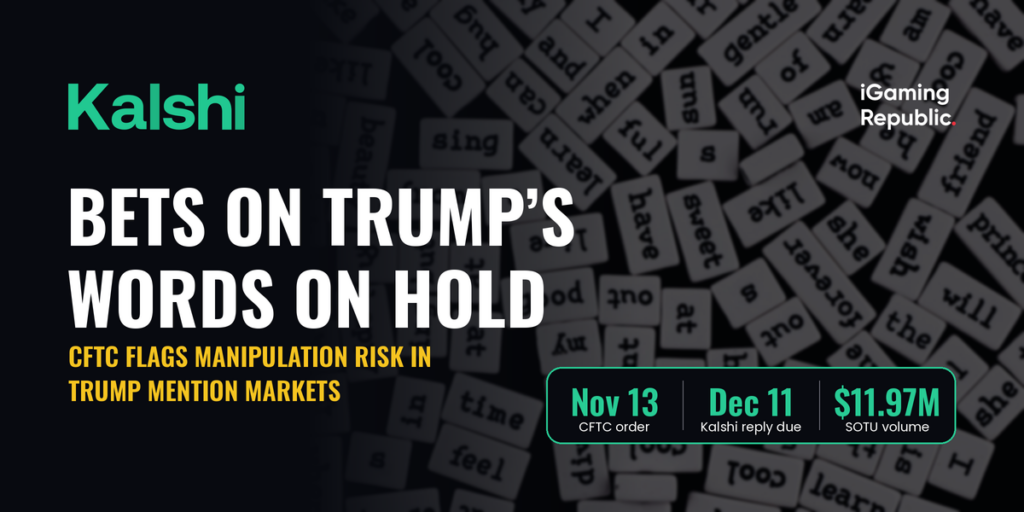
The CFTC issued its order on November 13. It covers Kalshi’s TRUMPSAY contract series and a market asking “What nicknames will Trump say before 2027?”. Both let users take positions on whether Trump would say specified words within a set period.
CNBC reported that other paused contracts covered what Trump would say in November and which countries and companies he would mention before the end of the month.
The order became public on Tuesday, when Kalshi confirmed it was complying. Contracts that had already been determined remain settled. Trading in the unresolved markets is paused, and Kalshi has until December 11 to respond.
These were active, real-money markets. Mention markets on Trump’s 2026 State of the Union address generated $11.97 million across more than 17 million contracts, according to The Washington Sun. Kalshi as a whole traded more than $5 billion in a single day earlier this month.
The September memo
Kalshi is a designated contract market, so it can self-certify new contracts without prior approval. In return, it may list only contracts that are not readily susceptible to manipulation.
On September 22, CFTC staff issued an advisory on mention markets. Staff warned they “may view Mention Markets as presumptively readily susceptible to manipulation and accordingly expect a heightened showing” from any exchange seeking to list them.
The reasoning is that settlement often turns on the conduct of one person or a small group, not on independently generated data.
According to the CFTC, Kalshi listed the nickname market after that advisory and did not update its certification to address the concerns. The order states that “the Commission presumptively believes the certification is false”.
The regulator says this is why it “has determined to institute proceedings for filing a false certification concerning the Contracts”. It also stresses that the order “reflects no final determination that a presidential mention contract can or cannot comply with the act.”
Brooke Nethercott, spokesperson at the CFTC, said:
“The CFTC stayed the certification of these contracts because they may be susceptible to manipulation, which is consistent with the staff advisory the CFTC put out two months ago.”
The mention markets advisory was not the first of its kind. In August, the CFTC told event-contract firms that sportsbook-style odds could mislead traders.
Kalshi pushes back
Kalshi has complied with the order. Dani Lever, spokesperson at Kalshi, said:
“We are complying with the order.”
Chief executive Tarek Mansour was less diplomatic with Axios. Tarek Mansour, CEO of Kalshi, said:
“We disagree with this decision.”
His argument is that Trump’s words can move financial markets, so contracts on them carry economic value. He made a broader version of that case last month in a Wall Street Journal op-ed, describing Kalshi as a market, not a casino.
The exchange also says it relies on real-time surveillance to stop manipulative trading. It has made that case to the regulator before. Arjun Sawai, head of market operations at Kalshi, wrote in a July letter to the CFTC:
“The suggestion that Mentions Markets create ‘new’ manipulation incentives is, on close inspection, overstated.”
Some mention markets are still live. For example, a contract on what Vice President JD Vance might say at an event today on Wednesday. Most of what remains is tied to corporate earnings calls.
Sports-related mention contracts had already gone. The Washington Sun reported that Kalshi stopped listing a significant number of mention markets at the CFTC’s direction, including all sports ones. Kalshi said the markets it dropped had been generating $90 million a month.
When those contracts came down in August, NPR reported that co-founder Luana Lopes Lara had backed mention markets as a way to attract users beyond sports.
Washington state had separately ordered Kalshi to geofence its mentions markets in August.
Insiders in the frame
The CFTC’s caution has a recent backstory. In August, it found that former White House teleprompter operator Gabriel Perez had seen Trump’s prepared speeches about an hour before delivery and bet on specific words.
Perez won on 39 of 43 contracts across 14 mention markets. Kalshi’s own surveillance flagged the trades and referred them to the regulator. He was ordered to repay $107,539 and pay a $65,000 civil penalty, and settled without admitting the findings.
He is not an isolated case. In July, the CFTC ordered former Representative George Santos to pay a $17,500 fine over trades on whether he would attend the 2026 State of the Union. Kalshi also banned him for life and fined him $71,000.
In September, the regulator opened a probe into former Representative Adam Kinzinger over trades on whether he would receive a pardon from Joe Biden. Kinzinger denies having inside information.
Senator Elizabeth Warren has since asked a White House lawyer how a repeat of the Perez case will be prevented. A Senate bill would bar the president, vice president, members of Congress and senior officials from trading event contracts.
Rival Polymarket has tightened its own rules, banning trading by anyone with authority to influence an event’s outcome.
Friend and referee
Bloomberg sees the order as a sign of greater scrutiny for prediction markets after the midterm elections. Those races drew more than $1.4 billion in trading by late October. Kalshi and Polymarket say their favorites won about 98% of races.
Until now, the CFTC has mostly taken a light-touch approach to prediction markets, and it has sued several states that tried to treat them as illegal gambling. In October, a CFTC rule took effect taking licensed sportsbook and casino wagers out of the swap definition.
That fight is still running. A Louisiana judge has just frozen event contracts from 31 prediction market entities, and the CFTC went to court the following day. Kalshi and its co-founders also face criminal counts in Utah.
The political backdrop is shifting as well. Donald Trump Jr. stepped down as a Kalshi adviser last week, less than two weeks after Democrats took control of Congress in the midterms.
Nevada Senator Catherine Cortez Masto had criticized CFTC Chairman Michael Selig for serving the Trump family’s interests. The mention market stay shows the same regulator drawing lines of its own.
Kalshi’s December reply
The order carries no penalty. Kalshi must now show the compliance it originally certified, in light of the September guidance. After reviewing its answer, the Commission will decide whether the certification was false and what further action, if any, is warranted.
The CFTC could lift the stay, allow amended contract terms or continue the proceedings.
The outcome matters beyond the exchanges. Suppliers are building for this market too, with Hacksaw launching a B2B prediction markets platform last month.
A finding that the certification was false could shape how the CFTC assesses similar single-person contracts, including the earnings-call markets that now make up most of Kalshi’s mention book.
Do you have a story worth sharing?
Send it over to our editors!