Ask The Republic: Where do ethics and AI meet in iGaming?

As artificial intelligence accelerates across iGaming, we have a central question to ask our experts: how can the industry unlock its AI potential while protecting transparency, ethics, and the human element?
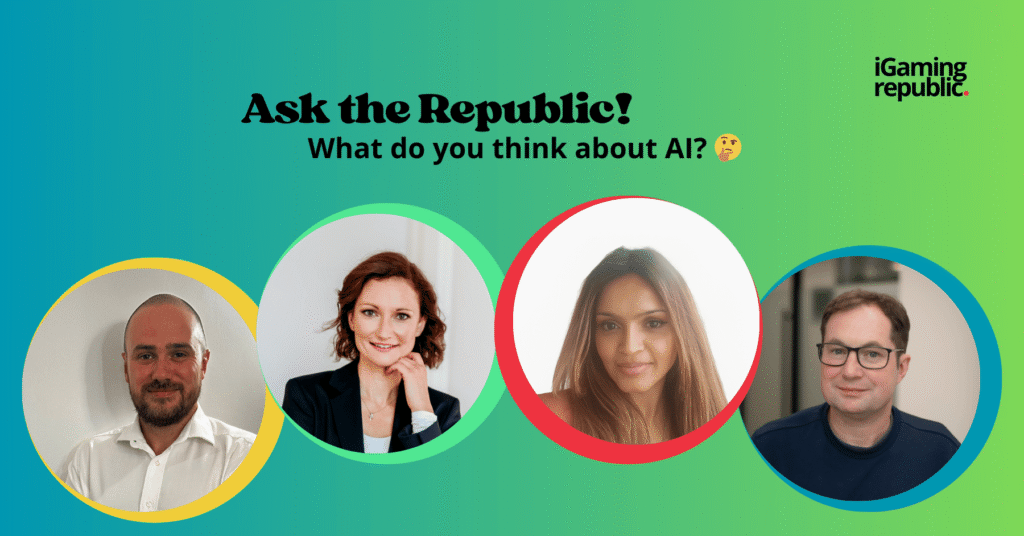
To explore this, 4 industry leaders joined our AI Ethics Roundtable:
- Claudia Heiling, COO and Co-Founder at Golden Whale
- Liam Hoofe, Content Strategist at GameOn
- Dominic Le Garsmeur, Chief Product Officer at Fincore
- Nipa Soni, AI and Data Business Development Manager at Fsas Technologies
Together, we examined the challenges and opportunities shaping AI’s future.
How is AI reshaping modern teams? What do players deserve to know about AI-driven experiences? Can businesses maintain humanity as automation accelerates? Are regulators keeping up, or does the industry need its own ethical standards?
Throughout the discussion, common ideas surfaced:
- AI should elevate human talent rather than replace it;
- transparency is essential for maintaining trust;
- personalisation and player safety represent AI’s most transformative strengths.
Ultimately, the roundtable invites a larger reflection: how do we ensure AI builds not just a more efficient industry, but a safer, more human, and more sustainable one?
Let’s dive in!
iGaming Republic: How has AI integration impacted your workforce, and what steps have you taken to retrain or redeploy affected employees?
Claudia Heiling: We’ve been an AI/ML company before ChatGPT entered the market, so our team has always worked closely with machine learning systems as part of our everyday operations. That said, the pace of change is incredible, and we continually retrain our teams in an effort to achieve our goal of having the most enhanced and automated workflows in the business.
As a result, instead of replacing roles, AI has helped us shift people toward higher-value work. We see AI as a tool that’s great for humans to use, but it shouldn’t replace our team members, who we value highly for their talent and experience. Our philosophy is that we want to use AI to enhance human capability, not to erase it.
Liam Hoofe: While I do not manage the workforce, I have played a role in the implementation of AI in GameOn’s workflow and the development of GO Intel. Speaking from personal experience with AI, I now spend significantly less time gathering information for content and reports, allowing me to devote more time to creative activities.
I think it’s also really important to train your teams how to use AI. There is still resistance towards this technology, but I think that those who don’t embrace it will fall behind. The genie is out of the bottle, and outside of an intense clampdown, it is not going back in. Businesses should find ways to support their teams. Chat with your colleagues, share your experiences with the technology, and find new ways to make everyone’s work-life more efficient.
Dominic Le Garsmeur: So we’re talking about AI as a productivity tool here, not as a gaming system component. Honestly, we don’t see it as a threat to roles, but as something that enhances them. We’re already finding that junior developers, for example, are using AI to bypass the repetitive, rote-learning phases of coding. This allows them to develop architectural and systems thinking much earlier in their careers. Sure, they need to know the basics, and they do, but spending two years re-writing the same database functions isn’t helping anyone.
We’ve started projects both internally and externally using these new technologies so our teams can get familiar with the principles and get their hands dirty quickly. I suppose that’s “retraining”, but retraining with a purpose and a positive impact on our business.
On a broader perspective (and this is going to sound a bit pompous), I honestly believe the fears about job losses are overstated. We’re seeing a classic example of the “Lump of Labour Fallacy,” a concept Henry Hazlitt debunked back in the 1940s. The assumption that there’s a finite amount of work to be done, and that AI will “use it up,” is wrong. Just like the technical advances of the past, AI doesn’t subtract work; it removes the boring stuff and lets us focus on higher-value problems.
The assumption that there’s a finite amount of work to be done, and that AI will “use it up,” is wrong.
Dominic Le Garsmeur, Chief Product Officer at Fincore
Nipa Soni: The way in which we have integrated AI across Fsas Technologies has meant there’s been no need to redeploy employees. And that’s because we’re using AI and tools like our PrivateGPT to make daily tasks easier and more efficient. For example, I use our PrivateGPT to translate documents – as a European company, we have tons of internal resources such as reports and presentations written in different languages.
In the past, I would use Google to translate bits of these documents, but now I can do the entire document and have the key points summarised. Another use case is for tenders – these documents can be lengthy, but by putting them through our PrivateGPT, I can have each summarised to get to the crux of what is required much more quickly.
iGaming Republic: What transparency measures do you provide to players regarding how AI influences their gaming experience?
Claudia Heiling: Transparency is the keyword to use when it comes to building trust with our players. We encourage our operator partners to make it clear when AI plays a role in all regulations we work in, whether it’s in personalisation, recommendations, or game balancing.
We also believe that while AI can be a fast, effective and useful tool for things like customer service, players should always have the option to speak to a human and get the answers they need that way. When players understand what’s happening behind the scenes, they feel more comfortable engaging with the technology.
Liam Hoofe: The debate around AI and transparency is something that I’ve no doubt most companies have had. As I’ve mentioned, there is still considerable resistance towards AI, and some businesses or players are hesitant to be involved with companies using it.
In my opinion, honesty is 100% the best policy. If you’re a company using AI to refine the graphics of your games or help script the dialogue, be upfront with your players about it. Likewise, if you’re a marketing agency or an operator using the technology to streamline your workflow, embrace it.
In my opinion, honesty is 100% the best policy.
Liam Hoofe, Content Strategist at GameOn
Dominic Le Garsmeur: At the moment, we’re working more upstream from players, so we’re not really hitting this issue directly. If AI is improving a human process, such as issuing a reward or recommending a sports bet, then we’re not changing the player’s experience; we’re just getting better at delivering it. We’ve always used algorithms to do this; we’re just swapping a well-crafted Excel model for something that’s better at the same job.
The responsible gaming concerns are exactly the same in both scenarios. It’s hugely important we don’t encourage reckless behaviour and that we meet our regulatory obligations, regardless of how we do the maths in the back end.
As our products evolve, it becomes important to let people know where their experience is being influenced by AI. One example that drives me nuts is when you’re interacting with a chatbot that pretends to be human. You know it’s a bot. It’s encouraging to see this becoming a thing of the past. Most services I’ve dealt with recently make it clear from the start what you’re interacting with. Clear labelling of this kind of thing matters.
Nipa Soni: We use “Explainable AI” both internally and with customers to clearly explain how AI is reaching decisions at each step of any given process, product or solution. This includes how models are trained, questions inputted, prompts and how explanations are arrived at. To me, this is foundational stuff as AI transparency bleeds into other areas, especially AI ethics.
AI isn’t new, but how we’re using it is changing at pace so we need to ensure we’re doing the right thing in terms of how models are being built, trained and developed. And this means data and information need to be accurate so that the outputs generated by AI are accurate, too. Any bias in algorithms could have a catastrophic consequence now and in the future, so it’s mission critical for data to be neutral and all AI outputs sense-checked by qualified and experienced humans.
iGaming Republic: How do you balance the efficiency gains from AI automation with maintaining the human touch within your business?
Claudia Heiling: This should be an iterative process in our view. We’ve built loops between human creativity and machine optimisation, which means that humans set the direction, AI tests and refines it, and then people interpret and guide the next step. This back-and-forth keeps the process efficient, but still very human. AI is great at surfacing insights, but it can’t replace intuition, empathy, or cultural understanding.
This is especially true for how we communicate with our partners. AI will never be able to replace the personal touch wanted and expected in doing business. We see automation as a way to remove friction, not as a replacement for the unique way companies interact with their audiences.
AI will never be able to replace the personal touch wanted and expected in doing business.
Claudia Heiling, COO and Co-Founder at Golden Whale
Liam Hoofe: AI is brilliant at gathering intelligence and identifying patterns and opportunities within data. However, what it lacks is the ability to offer actionable insight, and it certainly doesn’t possess the same industry experience as our team.
Our approach for GO Intel is simple: AI gathers and processes intelligence, and our team interprets it. AI is incredibly skilled at processing news sources, providing regulatory updates, and breaking down data. As a team, we then analyse its findings and provide actionable advice and insights based on our own experiences.
Dominic Le Garsmeur: This goes back to my first point. AI supports us by giving us more time to maintain the very human relationships we have with customers and partners. This industry will always be relationship-driven. The less time we spend digging out old responses to standard RFP questions, the more time we have to talk to customers, understand their real strategic challenges, and work out how we can help. (No one thinks, “Oh no, the human art of copy-pasting is being lost.”)
Nipa Soni: By using humans to train AI models and algorithms. AI can do some truly incredible things, but it needs to be trained by human specialists and with constant sanity checks to ensure the outputs are accurate. If AI models are fed data, content and information that’s false or inaccurate, it will keep spreading that misinformation – we call this an AI hallucination.
This is why data is so important, and why we’re seeing organisations rethink their approach to gathering, cleansing, storing and analysing data so that it’s primed and ready for feeding into their AI models, with many shifting away from the cloud to on-premises. Of course, by having humans train and oversee AI models and algorithms, you create jobs and allow employees to develop and enhance their skill sets.
iGaming Republic: What role should regulators play in defining the ethical use of AI, and are current frameworks sufficient to keep pace with the speed of technological development?
Claudia Heiling: Regulators have a really tough job here. AI moves fast, much faster than most frameworks can evolve. I think their role should be to keep a close eye on developments, understand where the real risks lie, and step in when there’s potential for harm or misuse.
But it shouldn’t be about stifling innovation with rigid rules. Instead, we need collaborative approaches where regulators, technologists, and industry leaders work together. The goal should be flexible principles that encourage responsible experimentation, not just reactive oversight. It’s a partnership, not a policing exercise.
Liam Hoofe: Keeping pace with AI development is going to be a headache for regulators. It’s going to be an extremely difficult balancing act that involves implementing restrictions that keep players and businesses safe, while also not stifling innovation. I think the key to this is ensuring that regulators and governments have personnel in place who understand the technology. You need people who understand the pros and cons of this technology; otherwise, it will lead to problematic regulations.
Dominic Le Garsmeur: Many of the ethical challenges around AI are universal, not specific to gaming. We need government frameworks that strike a balance: protecting consumers without killing off the opportunities AI creates.
In iGaming, regulators need to move from general concern to specific guidance. We don’t want to guess what the rules are. Regulation should focus on the outcome (is the player safe?) rather than the tool (is it AI or Excel?). If the industry and regulators align on that principle, we can innovate safely. We just need to hear more from them.
Nipa Soni: They need to play a central role, and no, current frameworks aren’t really dealing with the rapid advancements we’re seeing within AI. But this is always the case – regulators just need to ensure they’re hanging on to the coat tails of innovation. This is especially important at a time of geopolitical uncertainty, as we’re seeing with international power players such as the US and China.
Take the US, for example. Recent changes to the law mean authorities can access data held in the cloud with providers such as AWS and Azure if they see fit – a move that will be concerning for a large number of organisations. And then you have the AWS outage last month, which affected more than 500 organisations, including HMRC in the UK – this shows how exposed organisations are to issues happening on the other side of the world.
It’s why businesses are increasingly looking to move infrastructure closer to home, and why many are turning to Fsas Technologies as a European infrastructure provider. As such, we are fully compliant with the European Union’s frameworks for AI.
iGaming Republic: How do you see the regulatory landscape evolving around AI use in iGaming? Should there be industry-wide ethical guidelines for AI use?
Claudia Heiling: It’s a bit of a patchwork right now. Some markets are really advanced, others are just starting to think about AI regulation. That unevenness makes it tricky for companies operating globally. I’d love to see the industry agree on a shared ethical baseline – something that focuses on fairness, transparency, and player protection.
We don’t all need identical laws, but an industry-wide code of conduct with players could go a long way in building trust and ensuring that innovation always aligns with responsibility. Ultimately, AI should make the experience better for players, not more complicated for them.
Liam Hoofe: I believe there should be global ethical guidelines and practices in place for the use of AI, not just in iGaming. If we are going to maximise its potential, everyone needs to be on the same page. If one regulator is loosening the shackles and another is imposing restrictions, operators will simply go where they think they can make the most money.
Industry-wide regulation is probably a pipe dream, but if the major regulators can get on the same page, we will see steady, controlled growth that benefits everyone while also ensuring safety.
Dominic Le Garsmeur: It’s similar to the last question, but with a bigger emphasis on collaboration. Right now, regulators are signalling concern but not offering much detailed guidance. That leaves operators and suppliers trying to interpret the rules, which isn’t ideal for anyone. What we’d like to see is a shift towards shared sandboxes. Regulators and industry testing ideas together in controlled environments. It’s the quickest way to understand what’s safe, what works, and what shouldn’t be allowed.
And yes, industry-wide guidelines make sense, but they need to focus on outcomes, not the technology itself. The real questions are: “Is this fair?” and “Is the player protected?” If those principles are clear, whether the tool is AI or something simpler becomes secondary.
What we’d like to see is a shift towards shared sandboxes. Regulators and industry testing ideas together in controlled environments.
Dominic Le Garsmeur, Chief Product Officer at Fincore
Nipa Soni: There should be sector-specific regulations for AI usage to take into account the nuances of each industry. For example, businesses operating in the finance space need multiple layers of security, while for iGaming companies, data needs to be considered, especially when it comes to who can access it, and how it is verified, stored and used.
Of course, industry-specific regulations need to be combined with broader frameworks at the national and even international level. Ultimately, it’s about understanding the societal impact – both bad and good – of AI and ensuring that regulations are robust enough to mitigate any risks and downsides while also allowing for the full capabilities and benefits to be unlocked.
There should be sector-specific regulations for AI usage to take into account the nuances of each industry.
Nipa Soni, AI and Data Business Development Manager at Fsas Technologies
iGaming Republic: How can AI be used to enhance the player experience in a positive way?
Claudia Heiling: AI can make gaming a deeply personal, enjoyable and safe experience. It can learn what players enjoy and adapt content, frequency of interaction, challenges, or bonuses to fit their preferences, so every experience feels tailored to each person’s personality. It can also act as a safety tool, recognising risky or problematic play and stepping in before harm occurs.
We’re also already seeing how AI can improve game design, storytelling, and pacing. When done right, AI creates a more engaging, fun, and sustainable experience that feels like it truly understands the player and reacts accordingly, rather than just tracking them and churning out analytics for operators to use in marketing campaigns.
Liam Hoofe: I think we will see AI impact the player experience in two main ways: personalisation and improved responsible gambling. Hopefully, AI can be used to make the industry more proactive towards responsible gambling. It can help identify early warning signs and trigger interventions. It can also be used to help detect things like fraud and bot activity, all of which will help make a safer environment for players.
From a gameplay perspective, I think personalisation will be the biggest benefit. Operators and developers will be able to use AI to create a more personalised experience for players. iGaming has been behind services like Netflix and Spotify in this respect, and AI can help change the way it makes suggestions and curates the player experience.
Dominic Le Garsmeur: Yes, 100%. I’m hearing as much, if not more, about AI as a tool for player safety than anything else. Improved RG issue detection, faster Source of Funds and ∫ with deeper analysis and better detection power than humans.
Tools that help players proactively manage their play, and better sportsbook risk management. These are all already happening. This is very different from the crypto boom we also lived through (which, if we’re honest, maybe wasn’t so good for the industry in the long term). On the player-experience side, absolutely: knowing what you like to play, which teams you back, surfacing contextual information when you want it. These are all positive enhancements.
Nipa Soni: There’s two sides to this – personalisation and protection. AI can be used to make player experiences deeply tailored to their individual preferences, especially for aspects such as games and bonuses. As for protections, AI can be used to monitor players, benchmark against known problem play patterns and make early interventions to a much greater extent than manual monitoring processes. But again, human oversight is needed here, for both personalisation and protection, to avoid hallucinations and other negative side-effects of an over-reliance on AI.
iGaming Republic: What is the long-term vision for AI in iGaming, and how do we ensure it ultimately serves to create a safer, more entertaining, and more responsible industry?
Claudia Heiling: The future of AI in iGaming should be about being a tool, where AI runs quietly in the background to make everything smoother, more efficient, and more fun. AI/ML done right can achieve a balance. It clearly enhances entertainment and protects players automatically, while making the management of a gaming setup far more efficient for the operator.
All of these are good things that bring benefits for operators and their players. But for that to work, we need transparency, accountability, and collaboration between operators, developers, and regulators.
The goal isn’t to create smarter systems as an academic exercise, but to build smarter systems that understand and care for a sustainable player experience, while using their capabilities to optimise the economic factors for the operator. If we keep that mindset, AI can make the industry both more exciting and more ethical. And that means a win for everyone.
Liam Hoofe: The impact AI will have on the iGaming industry is difficult to quantify. As I’ve mentioned, it has the potential to create a safer environment for players and significantly improve the gameplay experience.
The impact it will have on the industry depends on how we decide to use it. If businesses opt to replace their workforce and creative processes solely with AI, then the industry will become a ghost of its former self, and the loss of a human element will undoubtedly impact the safety of the business. If, however, we choose to embrace it as a tool for support and creativity, then AI can usher in an exciting new era for the industry, one that will benefit both the business and its players.
Dominic Le Garsmeur: Honestly, I think the long-term vision is less sci-fi than people imagine. It’s about removing friction. For players, the goal is for the “boring stuff” to disappear. We want a world where intrusive affordability checks and identity verifications happen instantly and securely in the background, instead of forcing customers to dig out a utility bill. We keep them safer at the same time and do our part in responsible play.
This goes back to the “Excel” analogy I used earlier: we should stop using human brains for robot work. If AI handles the data crunching and the boring stuff, our teams can focus on the creative work and have meaningful conversations with customers about their businesses and how we can help. If we get this right, we don’t lose the human touch. We actually get more of it.
Nipa Soni: Transparency is the key to unlocking sustainable AI usage now and in the future. Online gambling organisations are usually pretty secretive in how they use technologies, and that’s why we need robust regulatory frameworks to give clear guidance on what is and is not acceptable.
They also need to communicate clearly with players as to the role AI is playing in the experience they are receiving and potentially allow them to opt in or out of AI-driven experiences. The more open and honest the industry is about AI usage, the more likely we are to achieve a safer, more entertaining and responsible sector for all.
About the author
Bianca Máthe
Bianca Máthe is Publisher of iGaming Republic. She spent close to a decade on the supplier side of iGaming, working across the sector's core verticals: platform and player-engagement technology and crypto payments. That mix gave her a working knowledge of how operators, suppliers and payment providers actually run. In 2025 she started a media project, bringing that operational grounding to her editorial work. Her output includes interviews with high-profile iGaming executives, original reports, and in-depth features covering licensing, M&A, and the operators and suppliers shaping the sector. Based in Malta, she spends much of her time getting closer to emerging sectors like prediction markets, tracking how they're developing before the rest of the industry catches up.
Do you have a story worth sharing?
Send it over to our editors!