Seminole Tribe takes DraftKings and Robins to court
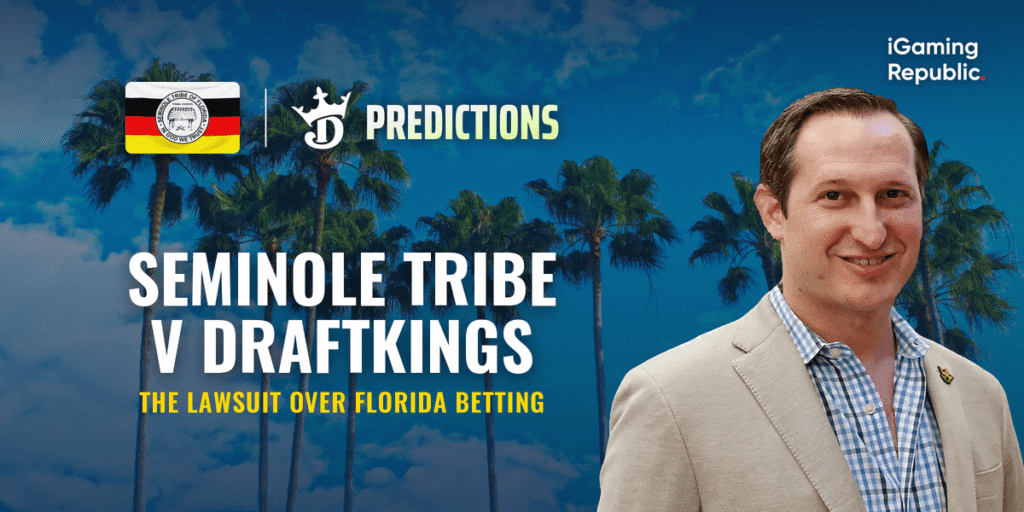
- Seminole Tribe files 72-page complaint against DraftKings and CEO Jason Robins in Broward County.
- Suit targets Pick6 and Super App sports contracts, with a Florida RICO claim against Robins personally.
- DraftKings says its products comply with federal law under the Commodity Exchange Act.
The Seminole Tribe of Florida has taken DraftKings to court, accusing the operator of running an unlicensed sportsbook in the state under a prediction markets label.
The 72-page complaint, filed in Broward County on Thursday, October 8, also names chief executive Jason Robins personally.
Same bet, new label
The suit, filed in the 17th Judicial Circuit, names DraftKings Inc., Robins and GUS III LLC, which trades as DraftKings Predictions. It targets Pick6 and the sports tab of the DraftKings Sports & Casino app.
According to the complaint, Floridians can trade moneylines, spreads, totals, player props and parlays on an interface that mirrors DraftKings’ licensed sportsbooks. The Tribe says the app switched from American odds to prices in cents on August 28. That was three weeks after Commodity Futures Trading Commission guidance against sportsbook-style odds.
The complaint states:
“DraftKings changed the label on the price. It did not change the price, the product, or the transaction.”
The Tribe also alleges DraftKings serves users as young as 18, although Florida’s sports betting age is 21. It claims Pick6 offers college player props, which the compact bans.
The five-count complaint includes an action to stop illegal gambling and claims under Florida’s Deceptive and Unfair Trade Practices Act and unfair competition law. It also asks the court to declare the products illegal gambling. A separate Florida RICO count targets Robins alone, citing his control of about 89% of DraftKings’ voting power.
The Tribe wants an injunction and disgorgement of revenue and profits earned in Florida, plus nominal damages and fees. It has pledged to prioritize any recovery for consumer protection and problem gambling programs.
None of the allegations has been tested in court.
Old rivals, new courtroom
Florida’s 2021 compact, negotiated by Governor Ron DeSantis, gives the Tribe exclusive sports betting through Hard Rock Bet until 2051. Mobile wagers count as tribal gaming because they are processed on servers on tribal land.
In return, the Tribe guaranteed the state at least $2.5 billion over the first five years. A federal judge struck the deal down in 2021. An appeals court reinstated it in June 2023, and Hard Rock Bet relaunched that November. The US Supreme Court declined to intervene in 2024.
The Tribe alleges DraftKings funded that challenge, brought by pari-mutuel operator West Flagler Associates, and later bankrolled others in secret. DraftKings had already spent $22.7 million alongside FanDuel on a 2022 ballot initiative that never qualified.
On September 17, DraftKings joined a separate state court challenge to the compact. It named itself sole member of Protect the Constitution LLC, the plaintiff in that case.
The ballot route still appeals elsewhere. DraftKings has now given just over $7 million to Nebraska’s betting campaign ahead of the November 3 vote.
Florida is tightening enforcement on other fronts too. Attorney General James Uthmeier sued Stake and VGW in August over their sweepstakes operations. State regulators sent cease-and-desist letters to PrizePicks, Underdog and Betr in 2023. All three now run prediction markets.
The predictions playbook
DraftKings entered prediction markets in December 2025 and brought Pick6 to Florida in January. In June it folded everything into one app. That app sends users to a sportsbook or to event contracts depending on where they are.
Florida users get contracts only. The complaint says that did not stop billboards and social ads declaring DraftKings Sports “Now Live in Florida!”
Robins said last year that DraftKings would not offer sports contracts in states where it holds a sportsbook license. The aim was to protect its relationships with regulators. In September, Connecticut ordered nine prediction platforms to stop offering sports contracts. DraftKings and FanDuel are licensed there, so neither was named.
DraftKings’ own numbers show why it keeps pushing. The company said folding Predictions into its main app cut customer acquisition costs by more than 80% in April. Contracts also fall outside state sportsbook taxes, which reach 51% in New York.
Stephen Miraglia, Senior Director of Communications, DraftKings, said:
“DraftKings’ prediction markets offering operates in accordance with applicable law and the federal regulatory framework established under the Commodity Exchange Act.
“Furthermore, DraftKings Pick6 is a peer-to-peer fantasy sports variant centered on a simple ‘more or less’ mechanic tied to individual athlete performance metrics and is not sports betting. While the company has deep respect for Seminole Tribe’s sovereignty, we remain confident in our legal position.”
The federal question
DeSantis, speaking in Miami on Thursday, admitted he had not read the filing. He still sided with the Tribe’s reading of the compact.
Ron DeSantis, Governor of Florida, said:
“The question is that if you have a certain regime on sports gaming, and then the prediction markets come in, does that fall under that or do they just get to do it?”
The federal appeals courts have answered that question differently. The Third Circuit backed Kalshi against New Jersey, and the Sixth and Ninth Circuits sided with Ohio and Nevada. New Jersey has asked the Supreme Court to hear its case, with support from 39 states and the NFL. Earlier this month, Ohio ordered 10 platforms to halt sports contracts.
Those fights have mostly set state regulators against exchanges. An injunction in Broward would give other tribes with exclusive compacts a template to follow.
About the author
Bianca Máthe
Bianca Máthe is Publisher of iGaming Republic. She spent close to a decade on the supplier side of iGaming, working across the sector's core verticals: platform and player-engagement technology and crypto payments. That mix gave her a working knowledge of how operators, suppliers and payment providers actually run. In 2025 she started a media project, bringing that operational grounding to her editorial work. Her output includes interviews with high-profile iGaming executives, original reports, and in-depth features covering licensing, M&A, and the operators and suppliers shaping the sector. Based in Malta, she spends much of her time getting closer to emerging sectors like prediction markets, tracking how they're developing before the rest of the industry catches up.
Do you have a story worth sharing?
Send it over to our editors!