Greece holds firm on online casino winnings tax
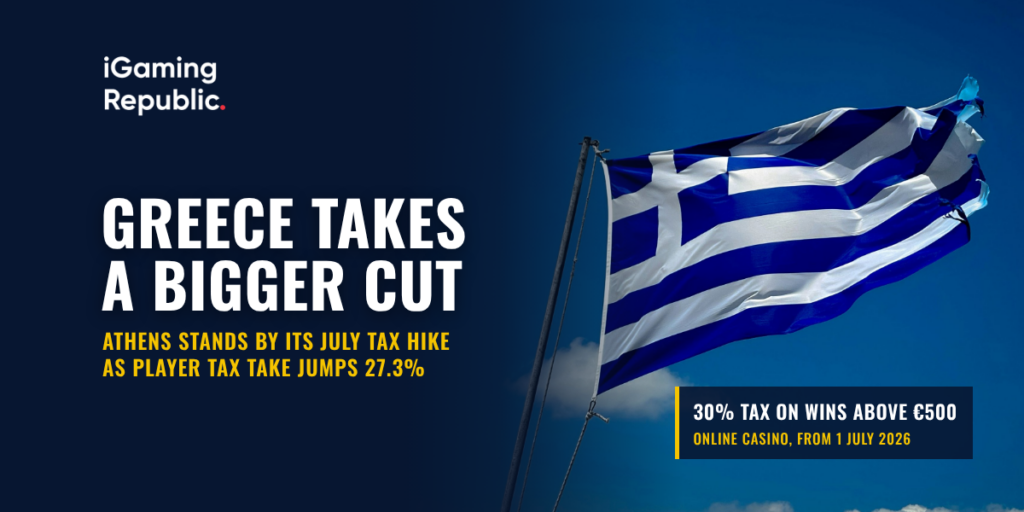
- Greece keeps the higher online casino winnings tax introduced on 1 July.
- Tax withheld from player winnings reaches €369.4m in January to August, up 27.3%.
- Hellenic Gaming Commission seeks 40 seconded inspectors, with applications closing on 6 November.
Greece is standing by its higher tax on online casino winnings, four months after it took effect. Data from the Hellenic Gaming Commission (EEEP) shows tax withheld from player winnings up 27.3% in the first eight months of 2026, and the regulator is now recruiting 40 inspectors to police the market.
A bigger bite per session
Since 1 July, online casino winnings between €100 and €500 per session have been taxed at 20%, up from 15%. Winnings above €500 now face 30%, against 20% before. The first €100 remains tax-free.
The change covers online casino-style games, including slots and poker. OPAP’s betting and retail products sit under a separate regime and are unaffected.
Minister of National Economy and Finance Kyriakos Pierrakakis presented the increase on 23 March with Deputy Minister Thanos Petralias. It formed part of a €300m package to cushion households and businesses from rising energy costs, Pagenews reported. Unlike the temporary support measures, the tax rise is permanent.
Pierrakakis said at the press conference, in remarks translated from Greek:
“The revenue is calculated at €100m a year.”
He explained that OPAP products were left out because the growth had come online, in casino games and slots. The government expects around €50m in the second half of 2026, with the full effect landing from 2027.
Receipts up, cause unproven
EEEP data for January to August, published in late October, puts tax on player winnings at €369.4m. That compares with €290.2m a year earlier, according to Powergame.
Gross gaming revenue across the legal market rose 4.2% to €2.06bn. The state’s participation rights from operators grew 7.9% to €484.5m. Together, the two streams brought in €853.9m, up about 15.5%.
Online is doing the heavy lifting. Online operators’ GGR rose 13.1% to €853.7m, around 41.4% of the legal market. OPAP’s retail network, including VLTs, saw GGR slip 1.2% to €962.5m.
The figures cover all eight months and every vertical, however. The higher rates applied only in July and August, and the data does not isolate their contribution.
Elasticity on the spreadsheet
The government says it modelled the downside before acting. The increase was calculated using demand elasticity and leaves the lowest band untouched, the Finance Ministry said, Newsit reported.
Before the change, the state collected about €270m a year in tax on winnings from these games. The ministry expects that figure to climb to roughly €370m.
In March, Pierrakakis also pointed to forthcoming measures to stop the tax pushing players towards illegal gambling.
A €1.67bn shadow market
EEEP’s own numbers show why that risk matters. Some 799,000 Greeks played on illegal networks in 2024, generating estimated turnover of €1.67bn. The state lost around €400m as a result, a figure the government cited when it ramped up enforcement earlier this year.
Authorities estimate that around 11,000 illegal gambling websites are operating in Greece.
The new framework, part of a sweeping gambling reform, brings faster blocking of illegal sites and an expanded blacklist. It also gives inspectors investigative powers and the ability to seal premises. Organisers of illegal games of chance face prison terms of at least 10 years.
Promotion is in scope too. Administrative fines apply to advertising illegal gambling, including through influencers and digital networks. Authorities have already filed complaints against 18 influencers.
Inspectors wanted
EEEP is now staffing up to enforce the rules. The regulator has opened 40 posts in its Gaming Inspectors Corps, to be filled by secondment from the public sector. Applications close on 6 November.
The intake includes seven IT specialists, 25 administrative and economic officers, three legal staff and five accountants. Candidates need at least five years of public service.
The Hellenic Gaming Commission said in its call, translated from Greek:
“With 40 posts in the Gaming Inspectors Corps, we invite officials from across the public sector to bring their experience, ideas and creative thinking to the EEEP.”
The reform also lifts EEEP’s permanent headcount from 80 to 110 posts. Filling them has not always been easy. Dimitris Ntzanatos, then EEEP’s chair, told Powergame in an earlier interview that secondees preferred other authorities, such as tax body AADE, because they paid better.
Who absorbs the hit
Some operators are already shielding players from part of the increase. bet365 tells Greek customers it covers the tax due on the 20% band, so those winnings are not reduced by withholding, according to its Greek help centre.
That buys goodwill, but at a price. Licensed operators already pay a 35% GGR tax, so every point of player tax they absorb comes straight out of margin.
Watching for leakage
The first full quarter under the new rates will be the cleaner test. If online GGR keeps growing at double digits as withheld tax climbs, the ministry will say its elasticity model held. A sharp slowdown would hand critics their strongest argument yet.
Greece is not acting in isolation. Neighbouring Cyprus wants zero tolerance on illegal operators, and in the UK, higher duties have put 1,400 Flutter jobs at risk.
For now, Athens is wagering that its new inspectors can move faster than its players.
Do you have a story worth sharing?
Send it over to our editors!