Lithuania targets big operators with 36% tax band
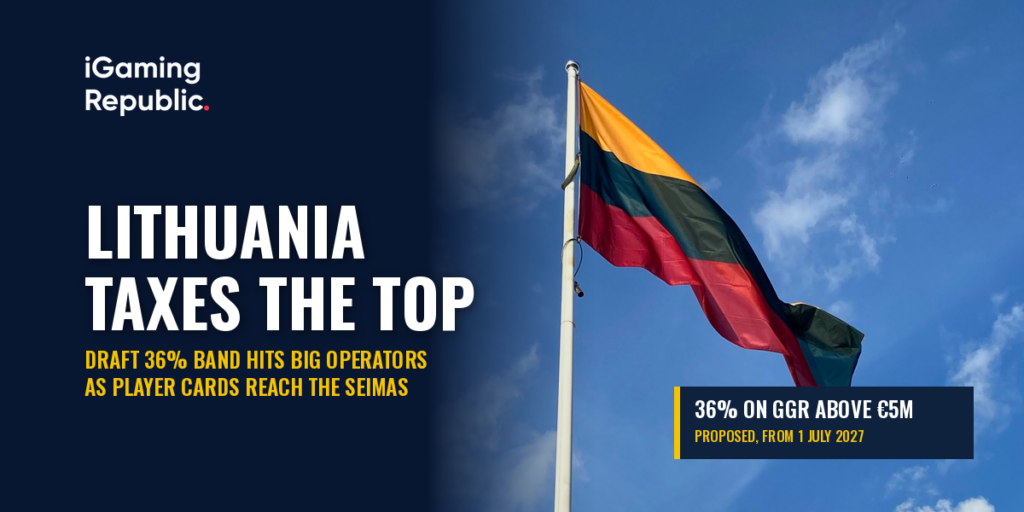
- Lithuania’s draft tax would charge 36% on GGR above €5m from July 2027.
- The Seimas voted 34 to zero to take up a mandatory player card bill.
- Monthly loss limits above €20,000 would require proof of income.
Lithuania’s Ministry of Finance has drafted a progressive gambling tax that would charge 36% on GGR above €5m from July 2027. It lands as the Seimas takes up a separate bill making player cards compulsory for all online and land-based gambling from 2029.
Three tax bands
The ministry registered the tax draft last week, LRT reports, citing news agency ELTA. The bands are marginal, so each rate applies only to the slice of revenue inside it.
The first €3m of GGR would stay at today’s 22%. Revenue between €3m and €5m would be taxed at 29%, and only the portion above €5m would pay 36%. Lottery tax would rise from 18% to 20%.
Tomas Tomilinas, chair of the Seimas Committee on Social Affairs and Labour, has put the extra revenue at around €36m. He gave that estimate after coalition partners backed a progressive gambling tax in principle on 5 November.
The ministry took a tougher view in September, rejecting a Farmers and Greens Union proposal for a flat 30% rate as disproportionate.
Who pays most
The new rates would take effect on 1 July 2027, starting with third- and fourth-quarter liabilities. Operators would make quarterly interim payments, then have their tax recalculated on full-year revenue.
With the top band starting at €5m, most of the extra tax would come from the largest brands, led by market leader TOPsport. Licensees under €3m would see no change to their rate.
The ministry plans to send the draft to government with the revised 2027 to 2029 budget.
One card, every operator
The player card bill targets a different problem. Under current rules, spending and time limits work only within a single company, so a player who hits a cap with one operator can keep playing elsewhere.
The card would come in physical or digital form and be required for both online and venue play. A central system would record deposits and winnings across every operator, along with each player’s money and time limits and any gambling restrictions.
Virginijus Daukšys, Head of the Gaming Control Authority under the Ministry of Finance, said:
“The main aim of the amendments is to reduce the accessibility of gambling and the damage to individuals’ mental health. In order for this to be realistic, the player card becomes an essential tool.”
Now in Parliament
The government approved the proposals on 17 June. Vice-Minister of Finance Rūta Carik presented them to the Seimas on 10 November, and lawmakers voted 34 to zero, with no abstentions, to take them up. The chamber returns to the bill on 17 December.
If passed, general amendments would take effect on 1 May 2027. Mandatory cards and cashless venues would follow on 1 January 2029, with land-based operators given three years to upgrade or replace equipment.
The package also amends Lithuania’s anti-money laundering law. The ministry says removing cash from venues would cut money laundering and other risks.
Prove it or stop
Operators would have to set daily, weekly and monthly deposit limits based on each player’s income and financial means.
If a player chooses a monthly loss limit above €20,000, the operator would have to assess their income and financial capacity. The ministry says the player would need to provide supporting documents, or would not be allowed to gamble at that level.
Lithuania is putting a firm number on a question other markets are still debating. In the UK, 65% of bettors told a Betting and Gaming Council poll they would refuse to share payslips or bank statements for affordability checks.
The bill would also give the Gaming Supervisory Authority (LPT) wider powers to supervise the market.
Losses hit €274m
Ministry figures show Lithuanian residents lost €274m to gambling in 2025, up 13% from €242m in 2024. Gambling tax paid to the state rose to €60.3m from €48m.
Self-exclusion requests are climbing too. The national register had received more than 101,000 applications by 31 October 2026, with about 22,000 still active.
The card follows a minimum age that rose to 21 in November 2025. A sponsorship ban takes effect on 1 January 2028.
Two deadlines, one squeeze
For the market’s biggest operators, the two reforms arrive close together. Higher tax bills would start in July 2027, and card integration, cashless venue payments and affordability checks would need to be live about 18 months later.
Estonia went the other way last year, approving a cut to its online gambling tax from 6% to 4%.
Lithuanian authorities describe the card as the EU’s first fully centralised player monitoring system. Poland and Norway use cards mainly for land-based slots, so a market-wide model would give other regulators something new to study from 2029.
Do you have a story worth sharing?
Send it over to our editors!