Kalshi app goes down after $5 billion Saturday
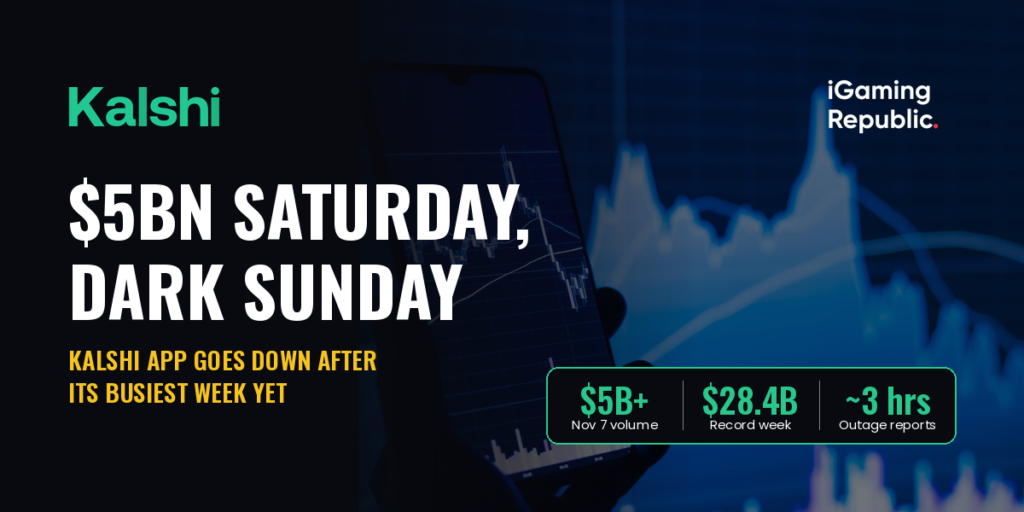
- Kalshi trades between $5.04 billion and $5.33 billion on November 7, depending on the tracker.
- Buyers put up about $1 billion in cash for those contracts, according to DeFi Rate.
- Outage reports build from late afternoon ET on November 8.
Kalshi’s app stopped loading for many users on Sunday afternoon, November 8, a day after the exchange traded more than $5 billion in contracts. One tracker logs that Saturday as Kalshi’s biggest day ever. Another puts it just short.
Record or near miss
Kalshi does not publish an official daily volume figure. The industry relies instead on independent dashboards built from its public trade data, and two of them disagree on Saturday.
DeFi Rate counts $5.04 billion in notional volume on November 7, across 17.9 million trades. That is 98% of its October 24 record of $5.1 billion.
TickerTracker shows $5,331,546,274 for the same day. That beats its own October 24 figure of $5,296,258,958 by about $35 million.
Both show a record week. DeFi Rate logs $28.4 billion from November 1 to 7, and TickerTracker $28.98 billion for the seven days to November 7.
TickerTracker’s monthly figures put Kalshi’s full 2025 volume at roughly $24 billion, so Saturday alone equaled about 22% of last year. DeFi Rate gives Kalshi 76% of tracked prediction market volume over the past 30 days.
Contracts versus cash
Notional volume counts every contract at its $1 maximum payout, whatever the buyer paid. A contract bought at 5 cents still adds a full dollar to the total.
That matters most for combos, Kalshi’s parlay-style product. A combo bundles several outcomes into one contract that pays only if every leg wins. Long-shot combos trade at very low prices and swell notional totals.
TickerTracker attributes $73.5 billion of Kalshi’s past 30 days, about 69%, to combos. DeFi Rate’s monthly review found combos made up at least 68.1% of Kalshi’s $98.15 billion October volume, up from 58.3% in September.
The cash picture is far smaller. DeFi Rate counts $105.6 billion in 30-day volume but $23.3 billion in dollars paid, the money buyers actually put up. Combos account for $7.8 billion of that, or 34%. On November 7, buyers paid $1.01 billion for $5.04 billion of contracts.
For anyone benchmarking Kalshi against a sportsbook, dollars paid sits much closer to handle than the notional headline does.
The share also moves with the calendar. Kalshi’s October streak began with back-to-back $4 billion days during the sector’s first $11 billion weekend.
What broke on Sunday
User reports climbed from late afternoon ET. Downdetector logged problems from 4:37 p.m., and Instatus said many users could not load the app from around 4:30 p.m. Some could not log in. Others saw no markets or positions.
Instatus’s incident log shows reports peaking near 4,000 an hour and settling after about three hours. Entireweb Status found no outage notice on Kalshi’s website or help center. Kalshi had not explained the cause as of publication.
The open question is whether the exchange itself kept matching orders. That distinction mattered in October 2025, when Kalshi’s app and website failed during a college football Saturday. Trading through its API and Robinhood continued, so app users’ resting orders could still be filled. Kalshi later refunded affected users.
A recurring weak spot
CNBC reported that close to half of Kalshi’s users hit glitches during that 2025 outage. At Super Bowl LX in February, deposits failed through the game, which DeFi Rate counted as the third consumer-facing breakdown in five months. Instatus lists 16 Kalshi incidents in the past 90 days.
Polymarket has its own record. It halted trading on its .com site in late October after a third-party script breach drained user wallets, its third security incident since May.
Courts and competitors
Kalshi’s legal exposure is rising in parallel. Utah filed 14 criminal counts, 13 of them felonies, against KalshiEX and co-founders Tarek Mansour and Luana Lopes Lara on October 28, after an undercover agent placed 12 sports bets.
DraftKings and FanDuel responded by pulling event contracts covering sports, politics and novelties in Utah. Fanatics stopped offering all event contracts there from November 4.
At federal level, the CFTC’s interim rule excluding licensed sportsbook and casino wagers from the swap definition took effect on October 19. A companion proposal would write sports event contracts explicitly into that definition, backing Kalshi’s argument that they fall under federal oversight.
DraftKings is spending to catch up, cutting its 2026 guidance by up to $625 million to fund Predictions. CEO Jason Robins says its DKeX exchange already ranks third in US prediction markets.
Every peak-day outage gives those rivals a reliability argument to put to customers and partners. And until Kalshi publishes official daily figures, operators sizing up the threat will keep working from dashboards that disagree.
Do you have a story worth sharing?
Send it over to our editors!