Kalshi CEO calls state lawsuits “faux indignation”
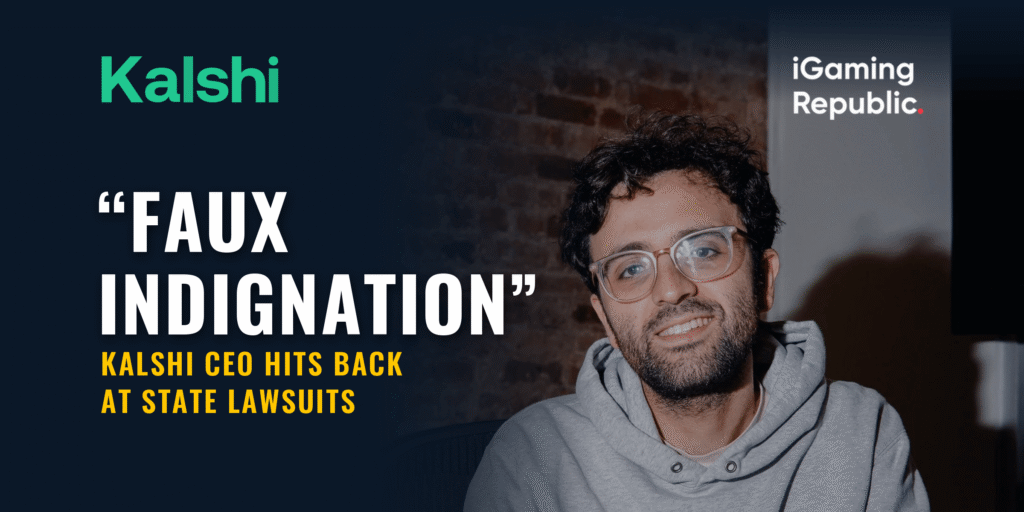
- Kalshi CEO Tarek Mansour argues in the Wall Street Journal that his exchange is not a sportsbook.
- The CFTC and Justice Department sue Utah the same day to block state gambling enforcement.
- Kalshi must file its opposition to New Jersey’s Supreme Court petition by November 9.
Kalshi CEO Tarek Mansour has taken his fight with state gaming regulators to the Wall Street Journal. In an op-ed published on October 27, he argues that prediction markets are exchanges, not casinos, and belong under federal oversight.
The piece lands 13 days before Kalshi must file its opposition to New Jersey’s petition for Supreme Court review in Flaherty v. KalshiEX. On the same day, the CFTC and the Justice Department sued Utah to stop it using state gambling law against Kalshi and other federally regulated exchanges.
The house always wins
Mansour opens with a question regulators keep asking. What separates a sportsbook customer backing the Milwaukee Brewers from a Kalshi trader buying a contract on the same game? Both get paid if the Brewers win and lose if they don’t.
His answer is who sits on the other side. A sportsbook sets the odds and books bets against its own customers, so every loss becomes house revenue. An exchange matches buyers and sellers and charges a fee on each trade.
Tarek Mansour, CEO at Kalshi, wrote:
“But we at Kalshi operate a market, not a casino. A century ago, all derivatives trading was derided as ‘gambling.’ What matters is the structure, not the label.”
He takes the comparison to Wall Street. Professional traders would never take odds on financial events from a sportsbook, he argues, because those prices are built so customers lose in aggregate.
Winners welcome
The op-ed leans hard on how each model treats skilled customers. Sportsbooks stop consistently correct bettors from wagering, Mansour wrote. An exchange earns nothing from outcomes, so it has no reason to ban winners.
He also goes after the cash-out feature that US operators heavily promote. A sportsbook’s early settlement is a discounted buyout set by the bookmaker, he argues. On an exchange, traders can sell positions to other buyers, sometimes at a higher price.
Mansour added:
“And have you ever tried selling a bet back to a sportsbook? Good luck with that.”
The Dodgers hedge
Mansour concedes that not every Kalshi user is hedging risk. Speculators supply liquidity in stocks, options and commodities, he argues, and sports speculation is more popular but no different in kind.
His showcase example is a Los Angeles bar owner. He bought contracts that would pay out if the Dodgers failed to advance in the playoffs, offsetting the hit an early exit would cause his business.
The op-ed then claims public benefits sportsbooks cannot match. Mansour cites an independent study showing political trades outperformed polls in the 2024 election. He adds that some weather trades beat the National Weather Service, according to third-party analysis.
According to Mansour, three-fourths of visitors to Kalshi’s website never trade. Those forecasting claims are under scrutiny. Kalshi priced Luiz Inácio Lula da Silva at about 20% to win on the day he won Brazil’s October 25 runoff.
Fifty rulebooks, one market
Mansour says Kalshi supports calls for more regulation, including rules for sports and election markets. He insists those changes must come from Washington, not from a patchwork of state laws.
“Imagine subjecting the New York Stock Exchange to 50 different sets of state laws. It would dry up the liquidity that comes with a national pool of traders and diminish the pool of expertise that determines prices. National markets require national regulation. Casinos don’t.”
State gaming commissions exist to keep the house solvent and stop it abusing its odds-setting power, he argues. Neither goal fits an exchange, where a clearinghouse stands behind trades and prices come from buyers and sellers.
The CFTC has drawn a similar line. Its interim rule, in force since October 19, takes house-priced wagers from licensed sportsbooks and casinos out of the swap definition. Exchange-traded contracts do not qualify for the carve-out. A companion proposal that would classify sports and other event contracts as swaps is not yet in force.
Mansour saves his sharpest words for the motives behind the state lawsuits. He accuses sportsbooks of fueling addiction nationwide for almost a decade.
“This faux indignation is an effort by industry incumbents to exclude an innovative competitor.”
Sportsbooks hit back
The gaming industry sees Kalshi’s position differently. Kalshi secured a month-long extension to answer New Jersey, which the industry took as a sign of weak confidence, Semafor reported. A litigator working with Kalshi called the request routine.
Rob Lockwood, spokesperson at the American Gaming Association, told Semafor:
“It’s fitting that as Halloween approaches, Kalshi seems spooked by the idea of the Supreme Court taking up the case next year. Because they don’t want to risk losing sports gambling — which is roughly 85% of their total volume!”
Kalshi’s own numbers tell a different story on revenue. Mansour told Reuters’ Econ World podcast that sports now account for about 65% of revenue, down from roughly 95% nine months ago, Covers reported. Lockwood’s figure refers to trading volume.
Countdown to November 9
The appeals courts remain split. The Third Circuit sided with Kalshi in April. The Ninth Circuit ruled for Nevada in August, and the Sixth Circuit backed Ohio and Tennessee in September.
Utah is the newest front. Its attorney general sued Kalshi in state court on October 20, seeking up to $61.2 million in allegedly unlawful proceeds. A federal judge in Utah had already dismissed Kalshi’s own suit against the state in August.
The federal complaint asks a court to bar Utah from enforcing its gambling, election-betting and public nuisance laws against registered exchanges. Utah is the 10th state the CFTC has sued over prediction markets.
New Jersey’s petition has support from attorneys general in 39 states and the District of Columbia. The NFL, the AGA, gaming regulators and 145 tribes and tribal organizations have also filed in support. The Court has not yet agreed to hear the case.
Mansour’s op-ed reads as an opening statement for that hearing. The exchange-versus-house distinction is the argument Kalshi needs justices to accept, and the CFTC’s new rule gives it a federal text to cite.
Sportsbooks running their own exchange products face the same question from the other side. A Kalshi win would let them follow it under one federal rulebook. A loss would leave every contract exposed to 50 state regulators.
Do you have a story worth sharing?
Send it over to our editors!