Prediction markets beat TV networks to midterm calls
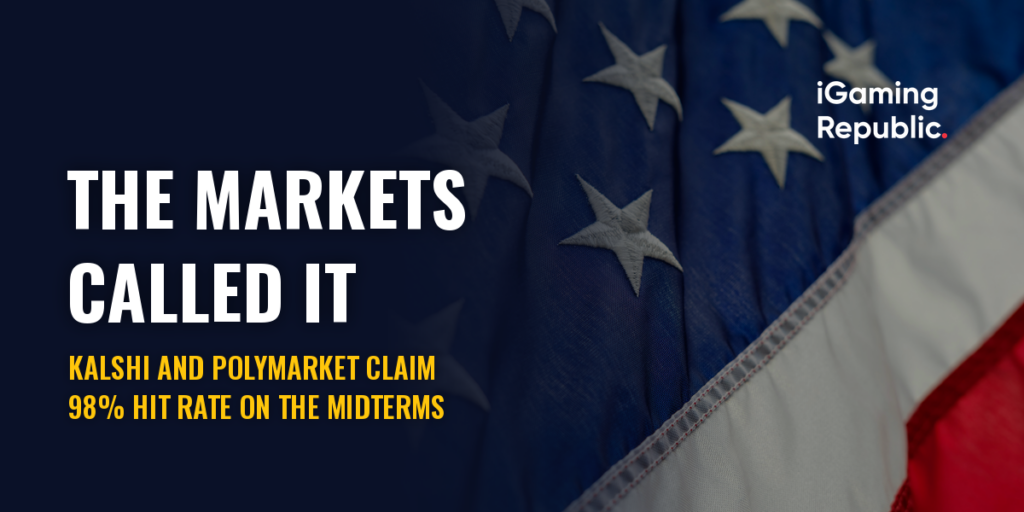
- Kalshi says favorites won 479 of 487 resolved races, about 98%.
- Polymarket says its 99% calls led CNN, Fox News and AP by a median 31 minutes.
- Kalshi’s reported midterm volume passes $2.5 billion in its post-election recap.
Kalshi and Polymarket spent Wednesday publishing scorecards for the 2026 US midterms, and both arrived at roughly the same number: 98%.
That is the share of resolved races in which the platform favorite went on to win, according to the companies. Both had made Democrats clear favorites to take the House and Senate before the polls closed.
Keeping score
Kalshi’s figure is 479 correct calls out of 487 resolved races. The company took its favorites at 5 p.m. ET on Tuesday, shortly before polls closed in Indiana and Kentucky. It then checked them against every race resolved by 6 a.m. Wednesday, according to DeFi Rate.
The sample reaches well beyond Congress. It also includes governor, attorney general, lieutenant governor and secretary of state contests. Nicole Kagan, Kalshi’s head of research, told Bloomberg the platform’s bets were more than 98% accurate across Tuesday’s races.
Polymarket used a different cut-off and got almost the same answer. Measured against prices the day before Election Day, its favorite won 419 of 426 resolved markets, or 98.4%. The company put House accuracy at 98.6% and Senate and governor races at about 97%.
The chamber markets were never really close. Before the first polls closed, Kalshi had Democrats at just over 93% to win the House, and Polymarket had them at 94.5%, according to RotoWire. The Senate was less certain, at 81.5% on Kalshi and 75.5% on Polymarket.
Faster than the desks
Polymarket’s sharper claim is about speed. It says its 99% calls in 10 key races came a median 31 minutes before CNN, Fox News and the Associated Press. In Michigan’s Senate race, it puts the gap at about four hours.
Kalshi’s own number is bigger. Across the key Senate races, its markets had the winner at 99% or better an average of 115 minutes before CNN called them, the company said.
Kalshi spokesperson Jack Such explained the threshold to CNBC. The platform projected a race once a candidate cleared 99% and buying on the other side had stopped.
Shayne Coplan, CEO of Polymarket, said:
“It’s now routinely hours between when prediction markets call it versus the TV networks. The networks hold out until absolute certainty, and the suspense keeps it entertaining all night. No knock to them, but now there’s Polymarket, and many people are realizing they want to know what’s happening in real time.”
An early call is not the same thing as a forecast. DeFi Rate argued that a market jumping to 99% once the counting starts is reading the returns quickly. Picking the winner before any ballots are counted is the harder test.
Texas bites back
Texas is where the scorecards look thinnest. Democrat Gina Hinojosa unseated Gov. Greg Abbott, and Vikki Goodwin beat Lt. Gov. Dan Patrick. Traders had favored the Republican in both races.
Kalshi priced Abbott at between 62% and 66% over the final two days, according to the company’s own market updates. Semafor listed his defeat among the markets’ misses. Polymarket odds for Hinojosa then jumped from 39% to 73% within five minutes of the first poll closings, CNBC reported.
South Carolina told a similar story. Democrat Annie Andrews defeated Sen. Graham, who was still trading at roughly 70% before the result. Kagan later cited the race as one traders repriced within minutes of the polls closing. That repricing came after the count had begun.
Timing changes the grade, too. A week before the vote, Kalshi favored Republicans in Iowa and Kansas. By Tuesday morning, both had tipped toward the Democrats, who won both.
Not everyone accepts the 98% headline. Watchdog group Better Markets published an analysis on November 4 arguing that prediction markets failed to predict Tuesday’s results accurately. DeFi Rate made a narrower point: Kalshi’s figures are self-reported and unaudited, and they leave out unresolved races.
The year had already produced some bruising misses. Kalshi gave Lula da Silva about 20% before polls closed in Brazil, and his win became a shock for forecasters. In Wisconsin’s August Democratic gubernatorial primary, traders priced Francesca Hong near 95%. David Crowley won by less than half a percentage point.
The real money
Kalshi’s post-election recap puts its midterm volume above $2.5 billion. That figure is Kalshi’s own count. It values each contract at its $1 settlement value, not the price traders paid, so it tracks potential payouts rather than cash at risk.
Outside tallies use different scopes and timings. On Tuesday, Reuters reported more than $1.48 billion wagered. That total combined the $1.33 billion Kalshi reported on Monday with about $145 million that the Anti-Corruption Data Collective tracked on Polymarket’s congressional markets.
A Washington Post analysis put wagering across platforms at nearly $2 billion. A pre-election Bloomberg review of Dune data found about $1.5 billion on Kalshi and Polymarket combined. None of these figures measures the same thing.
Courtroom value
Kalshi has been arguing for months that it runs a market, not a casino. Chief executive Tarek Mansour dismissed state lawsuits as “faux indignation” in a Wall Street Journal op-ed last week. Tuesday’s numbers give that argument fresh material.
Harry Crane, professor of statistics at Rutgers University, sees a clear change in how seriously the markets are taken. He said:
“Last time around [in 2024], prediction markets were in the discussion, but they were in the discussion in a way that was a little bit unsure. This [was] the first true prediction markets election.”
The pressure has not eased. Lawmakers are pressing the platforms over insider trading and gambling addiction. In Utah, Kalshi and co-founders Mansour and Luana Lopes Lara face 14 criminal counts, 13 of them felonies. DraftKings, FanDuel and Fanatics have since pulled back their own prediction products in the state.
Utah’s prosecutors are not asking how accurate the odds were. They are asking whether event contracts are gambling, and an election-night scorecard does nothing to answer that.
Do you have a story worth sharing?
Send it over to our editors!