DraftKings’ DKeX climbs onto prediction market podium
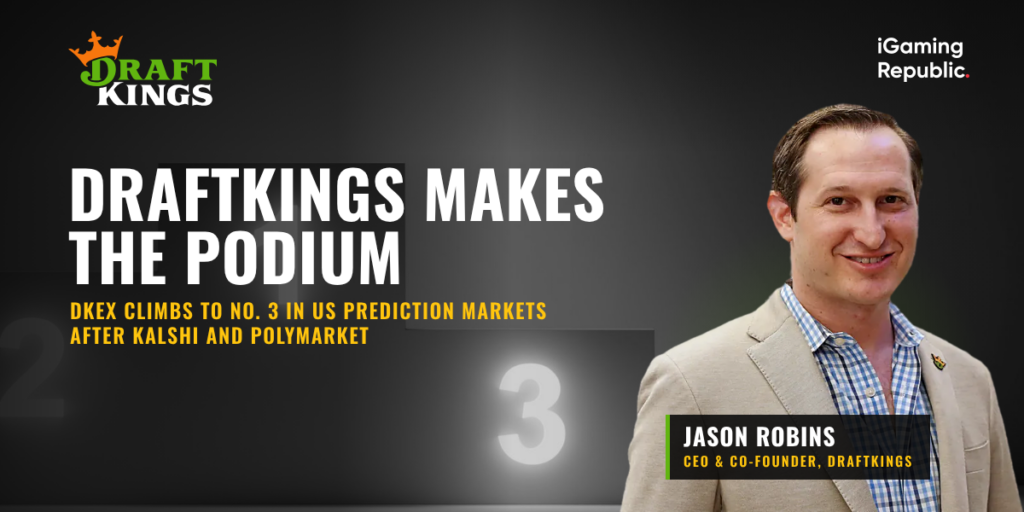
- DKeX ranks third by notional volume behind Kalshi and Polymarket for the week ended October 18.
- The exchange recorded $1.04 billion in notional volume, lifting its market share to 3.57% from 2.33%.
- DraftKings reached the podium without sports contracts in its licensed sportsbook states.
DraftKings’ in-house exchange DKeX has climbed to third among US prediction market operators by weekly notional volume, less than four months after launch. CEO Jason Robins made the claim in New York on October 22, and third-party trading data backs him up.
Bronze in four months
Robins took the stage at the NEXTPredict Summit for a fireside chat hosted by CNBC’s Contessa Brewer. Asked why DraftKings’ prediction business was suddenly drawing more attention, he pointed to the leaderboard.
Jason Robins, CEO and co-founder at DraftKings, said:
“We only launched the DraftKings exchange a few months ago, and we’re already the clear No. 3, which is great, and we continue to gain share.”
Aldrin Research figures support the claim. DKeX recorded $1.04 billion in notional volume for the week ended October 18, a 3.57% share of the market. For the week ended September 26, its share stood at 2.33%.
Kalshi remains well clear in first place, and Polymarket sits a relatively distant second. Behind them, DKeX led a crowded chasing pack by notional volume that week, in a field of exchanges spending heavily on infrastructure, regulatory approvals and customer acquisition.
The ranking landed on the sector’s first $11 billion weekend. DKeX set its own record that Sunday with $316 million in notional volume, up 42% on the previous Sunday, according to Aldrin. On September 13, the same figure was $139.8 million.
One hand tied
The more striking part of the story is how DraftKings got there. DraftKings Predictions is live in 48 states, with Maine and New Hampshire the exceptions. The full menu of event contracts, sports included, is available in only 18, among them California, Florida and Texas.
In states where DraftKings runs a licensed sportsbook, such as Colorado, New York and Pennsylvania, sports contracts are off the table. The company keeps sports event contracts out of every market where it books traditional sports wagers. Kalshi and Polymarket do not apply the same sportsbook-state restriction.
Robins said:
“We’ve done that with a much more limited state footprint than all of the others that we’re talking about competing with.”
He conceded that DKeX would carry more weight if it could list sports contracts in a market the size of New York. In his view, the trade-off was never close.
“The alternative was we would have had our licenses under threat, and I think that wouldn’t have been a smart move.”
Under its “super app” strategy, DraftKings markets itself as available in all 50 states. That claim counts the sportsbook, Predictions and free-to-play contests together, so the product mix varies by state.
Robins credited sportsbook experience for the exchange’s fast traction: “We know what works. We know what customers want.”
The metric matters
Notional volume counts contracts at their full payout value, not the cash traders actually commit. That distinction flatters some exchanges more than others, and it reshuffles the order behind the top two.
Using Aldrin data for a slightly later window, October 17 to 23, the Earnings+More newsletter put DKeX on $1.24 billion in notional volume. That left it comfortably ahead of Novig at $802 million and Crypto.com at $573 million.
Switch to dollar volume, which measures what traders actually paid for their contracts, and the order flips. Novig led the group on $217 million, with DKeX and Crypto.com level on $179 million each.
By the newsletter’s maths, DKeX produced about 55% more notional volume than Novig that week, but Novig generated roughly 21% more dollar volume.
Product mix explains much of the gap. Combination contracts made up 78% of DKeX’s notional volume on October 18 but only 31% of dollar volume. According to Aldrin, the money customers actually spent on DKeX has held between $40 million and $42 million across the last three Sundays.
Wall Street wants proof
Legal challenges to sports event contracts, by far the most popular prediction market product, are edging toward the US Supreme Court. Robins said some rivals have staked a great deal on one outcome. DraftKings, he argued, sits in a “win-win spot” however the ruling falls.
Part of that hedge is non-sports trading. Robins said the company was pleasantly surprised by growth in markets such as financial contracts, which could survive even if courts remove sports event contracts. That growth partly explains DraftKings’ heavy investment in the platform.
Investors are not convinced yet. DraftKings shares have fallen more than 40% this year. Robins rejected the idea that the market fears sportsbook cannibalization, blaming uncertainty around the federally regulated exchange business instead.
“Private markets love uncertainty. That’s what they thrive on. They like big beta. Public markets are the opposite. They do not like uncertainty,” Robins said.
Scrutiny follows volume
Louisiana recently granted DraftKings only a conditional license extension, running to February 2027, as regulators review its use of AI and shareholder suitability. Robins said the company does the opposite of targeting problem gamblers and refers them to a specialist team.
“It’s just completely not how we’re built and how we philosophically and in-practice operate.”
He said little about the Seminole Tribe lawsuit in Florida. He found it interesting that DraftKings was singled out when other prediction markets operate in the state, but said he could not speak to why.
The ground is shifting at both federal and state level. The CFTC has formally split sportsbooks from prediction markets by taking state-licensed sportsbook wagers out of its swap definition.
Ohio has ordered 10 platforms to stop offering sports contracts. Every new state order strengthens the case for DraftKings’ restraint. If the Supreme Court sides with the exchanges, the same restraint could leave it playing catch-up in the states it chose to sit out.
Do you have a story worth sharing?
Send it over to our editors!