Betway extends Spanish casino and racing licences
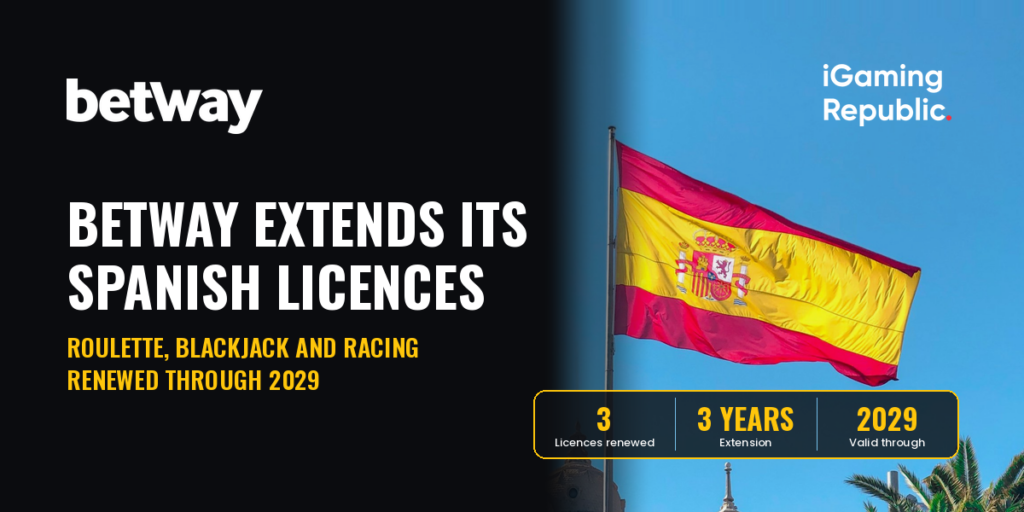
- Betway secures three-year extensions to its roulette, blackjack and fixed-odds horse racing licences in Spain.
- DGOJ resolutions are dated 29 October for blackjack and 6 November for roulette and horse racing.
- The renewals come after Super Group pulled Betway out of Sweden, Brazil, Portugal and the US.
Betway has extended three of its Spanish product licences by three years, keeping roulette, blackjack and fixed-odds horse racing betting live on betway.es through 2029.
Spain’s gambling regulator, the DGOJ, approved the extensions for the Super Group brand in resolutions dated 29 October and 6 November 2026.
Three licences, three years
The blackjack resolution came first, on 29 October. The roulette and fixed-odds horse racing extensions followed on 6 November, according to the DGOJ.
SBC News, which first reported the renewals, said they run for a further three years. Betway Spain’s wider portfolio covers sports betting, horse racing betting, slots, roulette and blackjack.
The rest of that portfolio sits on different timetables. The DGOJ’s register shows Betway’s slots licence was extended in September 2024. Its general betting licence was renewed the same year.
Spain licenses operators in two layers. Under the 2011 Gambling Law, general licences run for ten years and can be renewed for ten more. Singular licences for specific products are only open to holders of the matching general licence.
Betway’s Spanish history goes back to the opening of the regulated market. Its general licence for other games was issued on 1 June 2012, according to Betway’s own Spanish terms and conditions.
Off the shirts
The brand used to be far more visible in Spain. Betway sponsored several LaLiga clubs, including Deportivo Alavés, CD Leganés and Levante UD.
Those deals ended when Royal Decree 958/2020 on gambling advertising banned betting sponsorship of sports clubs, with the ban in force from 2021.
When Betway signed Atlético de Madrid as a global partner later that year, the deal covered every territory except Spain and Asia. Since then, the Spanish business has competed without shirts, stadium boards or broadcast spots around live sport.
The exit list
Staying in Spain sets Betway apart from much of its recent history. Since 2024, Super Group has reviewed the brand’s footprint market by market and pulled out where the numbers failed to add up.
Sweden went first in Europe. Betway closed its Swedish operation on 1 October 2024, even though its licence there was not due to expire until 2029. Brazil followed in November 2024, ahead of the January 2025 launch of its regulated market.
Portugal went next. In January 2026, regulator SRIJ cancelled Betway’s licences following the operator’s request.
In the US, the group began closing state operations in 2024 and completed its withdrawal in 2025. Chief executive Neal Menashe has also named Belgium, France and India among the markets the group stepped back from.
On Portugal, a Betway spokesperson said:
“After a thorough review we have decided to relinquish our licence in Portugal in order to focus on existing markets and growth areas with more potential.”
Spain makes the cut
Spain has given the group fewer reasons to leave. The DGOJ’s latest quarterly report puts online gross gaming revenue at more than €539m for the second quarter of 2026, up 31.16% year on year.
Betting grew fastest, up 47.46%. Average monthly active gaming accounts climbed 20.13% to 2.04 million, with 42 operators active in betting and 52 in casino.
Marketing spend kept pace. Operators put €194.46m into marketing in the quarter, almost 18% more than a year earlier. Earlier in 2026, first-quarter Spanish online revenue reached €454.1m.
Super Group itself has had a bumpier autumn. The group grew third-quarter revenue 10% to $611m, but cut its 2026 outlook after sports results went the way of bettors.
€700 a day
The extended licences will run under very different rules from the last cycle. From 25 March 2027, every player in Spain will face a combined deposit cap, tracked centrally by the DGOJ across all licensed operators.
Under Royal Decree 520/2026, the default limits are €700 per day, €1,750 per week and €3,300 over four weeks. Operators must check the central system before accepting a deposit. They must refuse any payment that would take a player over their joint limit.
They must also explain the joint deposit limits in the safer gambling sections of their websites. A new Player Portal lets players see their deposits, stakes, winnings and losses across every licensed operator in one place.
Changes to limits are deliberately slow. Raising or removing a limit takes three working days, and a player who raises it must wait three months before asking again.
The DGOJ launched the system and began operator integration testing on 21 October 2026. Trade body Jdigital has said it will challenge the decree before the Supreme Court.
DGOJ Director General Mikel Arana has questioned the industry’s early engagement with the project, and how slowly operators are connecting. He said:
“It is surprising that at this stage operators have still not effectively and generally connected to the system.”
Ballots and bets
The rules around Betway’s renewed licences are still changing. The DGOJ says prediction market platforms offering gambling products need a domestic licence, with no dedicated framework planned.
Politics adds another layer. Prime Minister Pedro Sánchez has called a snap general election for 29 November. The Gambling Act overhaul cannot reach parliament until a new legislature sits.
For Betway, the immediate job is technical. Payment flows, onboarding and safer gambling messaging all need to plug into the DGOJ’s joint limits system before the March deadline.
The commercial maths changes too. A combined cap limits how much any player can deposit across Spanish brands, so keeping existing customers becomes worth more than winning new ones. Betway’s casino and racing products now have until 2029 to prove they can grow on those terms.
Do you have a story worth sharing?
Send it over to our editors!