Kambi doubles profit as AI takes 85% of bets
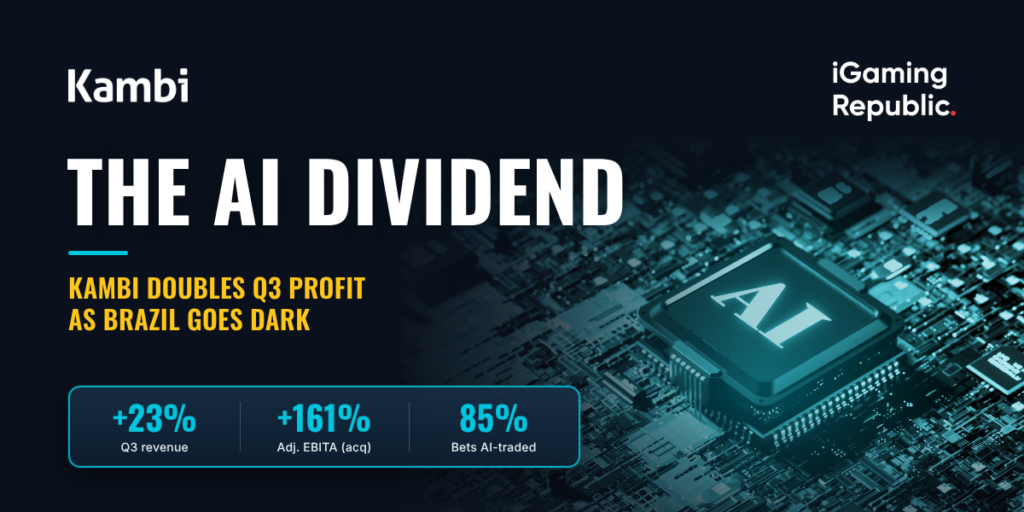
- Q3 revenue rises 23% to €46.0m as adjusted EBITA (acq) more than doubles to €7.9m.
- AI trading now handles 85% of Kambi network bets, with the NBA added after quarter end.
- Guidance narrows to around €26m as Brazil’s ban weighs on the fourth quarter results.
Kambi Group grew third-quarter revenue 23% to €46.0m and more than doubled adjusted EBITA (acq) to €7.9m, with its AI system now trading 85% of network bets.
The supplier narrowed 2026 guidance to around €26m, building in the impact of Brazil’s ban on fixed-odds betting and online casino.
Reading the numbers
Revenue rose to €46.0m from €37.4m a year earlier, according to Kambi’s Q3 report. Adjusted EBITA (acq) climbed 161% to €7.9m, lifting the margin to 17.3% from 8.2%.
That metric strips out amortisation of acquired intangibles, FX revaluations and one-off items. Kambi changed the definition this year to exclude FX, so the prior-year comparisons use restated figures.
On a reported basis, operating profit rose to €5.1m from €1.6m and profit after tax reached €3.4m. The gap includes €1.7m of one-off items, mainly redundancy costs and costs linked to the novation of the OLG contract.
Over nine months, revenue rose 13.5% to €135.4m and adjusted EBITA (acq) more than doubled to €21.2m. Kambi said this was its third straight quarter of year-on-year revenue and profit growth.
Werner Becher, CEO of Kambi Group, said:
“We delivered revenue of €46m in the quarter, a year-on-year increase of 23%, while adjusted EBITA (acq) in the same period more than doubled to €7.9m, reflecting the strength of our diversified business model, continued cost discipline and favourable FX movements.”
Margin over volume
The growth did not come from betting volumes. The Kambi Turnover Index rose just 3.0% year on year.
The reason lies in how Kambi gets paid. Alongside fixed and per-event fees, it takes a revenue share of operators’ net gaming revenue. This means the operator trading margin moves the top line as much as turnover does. That margin reached 11.9%, up from 10.3%.
July carried the closing stages of the World Cup, including what Kambi called a record-breaking final. Player-friendly results followed in August and September, including at the start of the Champions League.
Becher said:
“While we experienced less favourable sports results in August and September, operator trading margin for the full quarter was still our second strongest quarterly margin ever at 11.9%, underlining the edge we have through our powerful network scale and AI-powered trading capabilities.”
New partner launches, including Ontario Lottery and Gaming Corporation and PMU, added to revenue. So did a stronger Colombian peso, worth €1.7m on a like-for-like basis.
Gross margin fell to 80.9% from 85.8%. This reflects €4.2m of higher-priced World Cup data, which Kambi passes on to operators. The data lifts both revenue and costs without touching profit. Operating expenses were flat at €29.2m.
The AI dividend
Kambi now trades 85% of network bets through its proprietary AI system. Since the quarter closed, the system has also taken over the NBA, one of the largest leagues on the network.
Becher said:
“Our proprietary AI trading capabilities also continue to deliver material results as deployment expands beyond soccer, tennis, ice hockey and baseball, with rollout underway across basketball, American football and table tennis.”
The clearest commercial effect is in live betting. The system sets the live delay for each bet individually, based on match state and expected value. Kambi said 59% of AI-traded live bets are now accepted with zero-second delay, which it expects to add millions of live bets a year.
Becher added:
“In short, we are increasingly able to offer a larger number of betting opportunities that we can keep available for longer, enabling greater player engagement at consistently strong margins.”
Kambi is also pitching the platform as a defence against AI betting agents that hunt for pricing inefficiencies. According to the report, each bet updates the underlying match parameters and related markets reprice instantly.
The business has been reorganised around the system. Abios, Shape Games and Tzeract now sit under a single Kambi brand, and headcount fell to 943 from 1,054.
Brazil goes dark
The new target of around €26m replaces a range of €23m to €27m, nudging above the previous €25m midpoint. Kambi credited strong trading and FX tailwinds. Its Q4 estimate absorbs operator migrations and the hit from Brazil.
The figures point to a softer finish. On iGaming Republic’s arithmetic, the target leaves roughly €4.8m of adjusted EBITA (acq) for Q4. Kambi’s restated figures put the same quarter last year at €7.3m. Investing.com’s account of the earnings call says management also cited termination fees.
President Luiz Inácio Lula da Silva imposed the ban through Provisional Measure 1,394, published on 25 September. Licensed sites went offline on 6 October. Congress has until 23 November to vote, a deadline that can be extended by 60 days. The ban is also before Brazil’s Supreme Court.
Becher said:
“The disruption caused by Brazil’s decision to ban online gambling highlighted the strength of our partner network. Given our growing partner base and geographical footprint, Brazil accounted for a low single-digit percentage of Kambi’s 2026 revenue, although the development could remove the long-term growth potential of the market.”
The guidance assumes an operator trading margin of around 11% for the rest of the year, unchanged from the previous outlook.
Off the Strip
Kambi’s first Nevada partner is Station Casinos, the market-leading operator off the main Las Vegas Strip. The 10-year deal covers its Turnkey Sportsbook, a pari-mutuel racebook and its in-house PAM platform across retail and online.
The Q3 report calls this the first deployment of the combined sportsbook and PAM offer. Launch is due in the coming weeks through the Nevada regulatory field test.
Becher said:
“I’m excited at the prospect of showcasing just how strong our online and retail sportsbook is in one of the most thoroughly regulated markets in the world.”
Elsewhere, Kambi signed Pure Casino Entertainment in Alberta’s regulated market. It also added RETABET on Odds Feed+ in Spain and Peru, and UK and Irish operator QuinnBet, which is due to launch in Q4.
Americas turnover grew 6.7% to 59.9% of the total. Europe fell 3.1%, mainly due to migrations.
Costs still to land
The AI system still has a bill attached. Kambi disclosed a contingent liability for a final performance-based payment to the third-party consultants who helped build it, estimated in the high-single-digit millions of euros. It expects to recognise the payment in 2027 and amortise it as an intangible asset.
Kambi has spent €13.1m on buybacks this year, leaving net cash at €40.9m. From April 2027, most UK remote betting profits move to a 25% tax rate. Finland’s licensed market is due to open in July 2027.
For operators weighing suppliers, the Nevada launch is the next test of the AI-led pitch. Kambi reports full-year results on 17 February 2027.
Do you have a story worth sharing?
Send it over to our editors!