AI-flagged Casumo promotion breaches ASA gambling rules
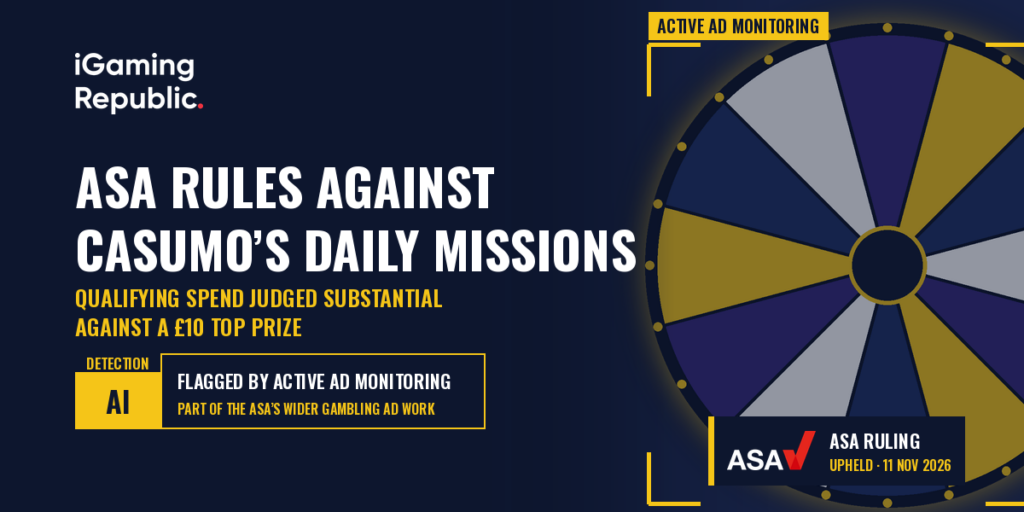
- ASA bans Casumo’s Spinumo ad for encouraging repeated deposits and wagering.
- Each daily mission required a £50 deposit and £200 in wagers.
- The ad was flagged by the ASA’s AI-driven Active Ad Monitoring system.
The Advertising Standards Authority (ASA) has banned a Casumo display ad after ruling that its Spinumo promotion pushed customers to keep depositing and wagering.
Published on 11 November, the ruling finds the offer encouraged socially irresponsible gambling that could lead to financial harm.
Fifty pounds a mission
The paid-for online ad ran for Recro Ltd, which trades as Casumo, and was seen in August 2026. Next to a sign-up button, it promised “UP TO 100 SPINS ON SPINUMO” above the tagline “QUEST. SPIN. WIN.”
Behind the banner sat a targeted, opt-in promotion for eligible UK customers, running from 6 July to 2 August. Players unlocked one spin of the Spinumo wheel for every daily mission they completed.
Each mission carried the same price of entry: a minimum £50 deposit and at least £200 in wagers on eligible games. Customers could repeat the cycle up to five times a day.
The wheel paid out a random number of free spins, capped at 100 and valued at £0.10 each. That put the top prize from any single spin at £10. The free spins expired 48 hours after being credited.
The £28,000 ceiling
The ASA ran the numbers on full participation. Five missions in one day meant £250 in deposits and £1,000 in wagers.
Stretched across the 28-day promotion, the theoretical ceiling reached £7,000 in deposits and £28,000 in wagering. Those were maximums, not requirements, and not losses.
The regulator still judged the qualifying activity substantial against a reward worth no more than £10 per spin.
The prize itself added pull. Every extra mission offered another shot at 100 free spins, which the ruling says gave players a further reason to keep going.
The copy did the rest. The ASA said in its ruling:
“The description of the qualifying activity as a ‘daily mission’ alongside the wording ‘QUEST. SPIN. WIN.’, presented gambling as a challenge that could be completed repeatedly.”
With up to five spins on offer every day, the regulator found the messaging encouraged consumers to maximise their participation.
Opt-in, still out
Recro’s defence leaned on choice. Customers needed only one mission to earn a spin, it said, and could stop after any of them. Nobody was expected to hit the maximum totals.
The operator also argued that wagering is not equivalent to loss. It said the offer neither encouraged repetitive gambling nor pressured anyone to play again on the same day. According to Casumo, winnings from the free spins carried no further wagering requirement.
On the slogan, Recro said “QUEST. SPIN. WIN.” simply described the promotional journey. In its view, the line did not suggest gambling was a route to financial gain. It added that the ad disclosed its significant terms and that the reward was genuinely available.
The ASA accepted that the promotion was opt-in and that wagering was not equivalent to loss. It nevertheless rejected Recro’s overall position:
“Although consumers could choose whether to complete further missions, we considered that the mechanic risked encouraging continued gambling, particularly among more vulnerable consumers.”
The regulator found breaches of CAP Code rules 16.3 and 16.3.1. The ad must not appear again in the form investigated. Recro must also ensure future promotions do not encourage socially irresponsible behaviour or financial harm.
In a statement to SBC News, Casumo said:
“Casumo prides itself on its record of customer protection and regulatory compliance.”
The algorithm’s catch
Spinumo did not reach the ASA through a wave of consumer complaints. The regulator identified the ad through its Active Ad Monitoring system, which uses AI to search proactively for online ads that may break the rules. The case formed part of its wider work on gambling advertising.
Proactive monitoring is not new. Law firm Mishcon de Reya has noted that many recent strong appeal rulings were also detected through the system. Those cases mostly turned on who an ad might reach, including action against Oddschecker’s Instagram posts and Betway and Kwiff.
Spinumo is a different kind of case. Here the ASA is picking apart how a promotion is built, mission by mission and deposit by deposit.
Back in the dock
Casumo has been here before. In October 2019, the ASA ruled against a Casumo Google search ad served to someone who had searched how to unsubscribe from all gambling. The ad was found in breach of rule 16.1.
At the time, Casumo said it kept a list of excluded search terms. It argued that “unsubscribe” was more commonly linked to leaving mailing lists than to self-exclusion.
In March 2021, the Gambling Commission fined Casumo £6m over social responsibility and anti-money laundering failings. The regulator found one customer had lost £1.1m over three years without a single responsible gambling interaction. Both earlier cases involved Casumo Services Ltd, which ran the brand at the time.
Reward loops on notice
The timing is pointed. Since 19 January 2026, UK-licensed operators have been barred from applying wagering requirements above 10 times bonus funds. They also cannot combine different gambling products within a single incentive, subject to limited exceptions.
Spinumo did not trigger the 10x cap, because its £200 wager was a qualifying condition rather than a playthrough requirement on bonus funds. The ASA ruling shows that front-loading wagering does not place an offer beyond regulatory scrutiny.
A £50 deposit and £200 wager chasing a prize capped at £10 is the ratio the ASA objected to. Missions, quests and prize wheels are everyday tools in casino CRM. Operators can expect each qualifying step to be weighed against the value at the end, much like the deposit-and-wager structure at the heart of DraftKings’ Massachusetts lawsuit.
The Gambling Commission is introducing financial risk assessments in stages, beginning with the largest operators and the highest-spending customers. That puts promotions built on deposits in front of two regulators.
Campaigns no longer need a pile of complaints to reach a ruling either. The ASA’s ban on Midnite’s Built Different campaign followed 125 complaints. Spinumo got caught by an algorithm.
Do you have a story worth sharing?
Send it over to our editors!