Alberta iGaming hits C$122m in first 80 days
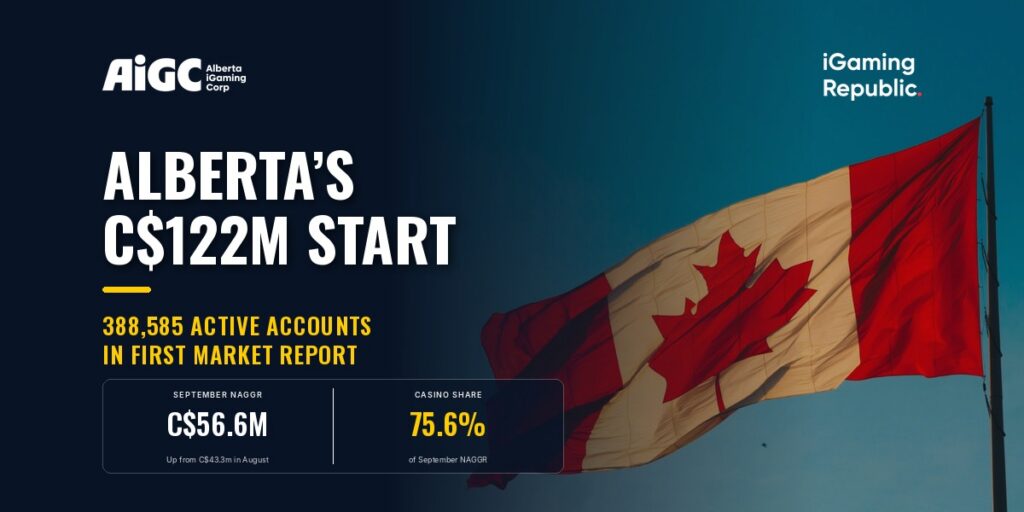
- Alberta’s regulated market generated C$122.1m in NAGGR between July 13 and September 30.
- September revenue reached C$56.6m, with casino games taking 75.6% of the total.
- At least 51 licensed sites were live by October 15 as AiGC moves to monthly reporting.
The Alberta iGaming Corporation (AiGC) has published its first market report, with monthly figures totalling C$122.1m in non-adjusted gross gaming revenue (NAGGR) over 80 days of regulated play.
The data covers July 13 to September 30, and AiGC says early results suggest players are transitioning toward regulated platforms.
AiGC runs Alberta’s commercial iGaming market. Licensing and oversight sit with the regulator, Alberta Gaming, Liquor and Cannabis (AGLC), in a structure closely modeled on Ontario’s.
Revenue nearly doubles
Alberta’s market went live on July 13 with a launch-day roster that included several of North America’s biggest sportsbook brands. That made Alberta the second Canadian province, after Ontario, to open online gambling to private operators. The first partial month produced C$22.2m in NAGGR.
August, the first full month of trading, came in at C$43.3m, almost double July’s figure. September added a further C$56.6m, lifting the period total to C$122.1m.
September alone delivered nearly half of the 80-day total. That makes it a better guide to the market’s current run rate than the headline figure.
The growth tracks the expanding operator list as much as player demand. 15 operators went live with 22 sites on day one. By September 30, AiGC counted 24 operators in the market.
Casino sets the pace
The product mix mirrors what Ontario has shown since 2022. Casino games generated 75.6% of NAGGR in September, according to the AiGC report. In Ontario, online casino typically takes 85% to 90% of both handle and GGR.
Sports and event betting contributed 19.5%, with live casino taking the remaining 4.9%. Casino and live casino combined accounted for 80.5% of operator winnings in September.
That split reinforces why operators prioritized casino content from opening day. BetMGM CFO Gary Deutsch told analysts this month that around 20% of the new players the company acquired in Q3 came from Alberta.
Chief revenue officer Matt Prevost said that adoption has run well ahead of Ontario’s on a scale basis. Deutsch added that Alberta has lifted BetMGM’s online casino growth by roughly two percentage points.
The player count
AiGC recorded 388,585 active player accounts in September. The corporation is clear that this is not a headcount, since many Albertans hold accounts with more than one operator.
Average revenue per active player account came to C$146 for the month. Those accounts are spread across a market that has grown considerably since the reporting period closed.
Ontario posted C$60.9m in GGR and 299,000 active accounts in June 2022, its third month of competition. Alberta’s population is roughly a third of Ontario’s, however, which makes direct comparisons with Ontario’s market difficult.
Keene makes his case
The AiGC chief tied the early numbers to the province’s central argument for opening the market.
Dan Keene, CEO of the Alberta iGaming Corporation, said:
“Early results indicate that Albertans value the strong oversight and greater accountability offered by a regulated market. We hope to continue educating Albertans about the risks associated with illegal offshore sites and move them onto regulated platforms where they have rights and recourse when iGaming.”
Before launch, the government estimated that around 70% of online gambling in Alberta took place on unregulated sites. The government-owned PlayAlberta held an estimated 23% to 32% share and recorded C$275m in net sales in fiscal 2024-25.
Under the new model, 2% of gross gaming revenue is directed to First Nations and 1% to social responsibility programs. AiGC says the money will fund mental health and addiction programming, along with research.
The province had forecast C$76m in first-year proceeds before the market opened. Keene said:
“Regulation matters. This is a market where approved iGaming Operators are held to high standards of accountability, and where revenue stays in the province to fund programs and services Albertans rely upon.”
Mind the gaps
AiGC itself flags the limits of its data. The figures capture the gradual onboarding of operators, so they do not represent the full Alberta market.
The report also leaves out PlayAlberta, which publishes its results annually. Any reading of overall channelization will need both sets of numbers.
The biggest gap is timing. The gray-market transition window closed on October 13, and brands such as Stake Canada lined up launches around that deadline. By October 15, there were at least 51 licensed sites run by 30 companies.
Brands that stayed outside the window face a tougher stance. Service Alberta Minister Dale Nally said earlier this month the province will examine all available routes to shut down unlicensed operators.
October is the test
AiGC says it will now report every month, similar to iGaming Ontario’s releases. The October data will be the first to include brands that crossed over from the gray market.
AiGC expects another 10 to 15 sites to go live before the end of 2026, taking the total to as many as 65. Betano, GGPoker, PointsBet, River Cree iGaming and ToonieBet are registered with the AGLC but not yet taking bets.
Officials have set a 70% channelization target for year one, and Keene said in July that he expected Alberta to beat it. AiGC has yet to publish a channelization estimate, so the next few releases will show whether that confidence holds.
Advertising is another live issue. The Alberta government has come out against S-211, a federal bill on sports betting advertising now under review in the House of Commons.
A crowded field also changes the economics. More brands chasing the same pool of accounts will test both acquisition budgets and that C$146 revenue figure well before the market’s first anniversary next July.
Do you have a story worth sharing?
Send it over to our editors!