Q3 Results: GiG bets big on Africa as B2B revenue falls
- Q3 revenue falls 12% to €8.5m as GiG Software’s operating loss widens to €4.3m
- The 888AFRICA acquisition completes at quarter-end, lifting group cash to €8.0m
- GiG targets combined 2027 revenue of €85–90m and adjusted EBITDA of €17–19m
GiG Software posted a wider third-quarter operating loss of €4.3m on Wednesday (28 October), as revenue fell 12% to €8.5m.
The Stockholm-listed platform supplier now needs 888AFRICA, the African operator it took control of at the end of September, to carry its 2027 plan.
One client, one hole
The headline drop is easier to read once you split GiG’s revenue in two. There is the recurring part, the monthly platform and sportsbook fees paid by live operators. Then there are one-off fees, mostly charged when a new brand is set up.
The recurring part barely moved. It edged up to €7.1m from €7.0m. The drop came from the one-off side and from clients leaving, led by the insolvency of Richmond Atlantic.
That one client has done real damage this year. Its collapse forced €3m of bad debt provisions into GiG’s Q2 accounts. In Q3, it took a chunk of revenue with it. For a platform business with a short client list, losing a single operator shows up on the top line straight away.
Profit followed revenue down. Adjusted EBITDA, which strips out items such as bad debts and redundancy costs, fell by a third to €0.8m, according to the company’s Q3 results. Before those adjustments, EBITDA was just €0.4m. Once amortisation of its platform development is counted, the business lost €4.3m at operating level.
The contrast with a year ago is sharp. In Q3 2025, GiG grew revenue 31% and posted its first-ever Rule of 40 score, a growth-plus-margin benchmark software investors use.
Fewer launches, fewer fees
Set-up fees depend on new brands going live, and the pipeline slowed. GiG signed one new partner in Q3 and extended one existing deal. It delivered three brand launches, all in newly regulated Alberta and all with operators already on its books.
In Q2, it had launched nine brands, including a day-one entry into the same province. Three launches with existing partners bring in little fresh set-up income. They also add little to the recurring base until those brands build volume.
Cutting to fit
GiG has spent the year shrinking its cost base to match its revenue. Operating expenses were €1.0m lower year on year, mostly from headcount.
That follows the €4.5m cost savings programme set out in January, which GiG said in August it had completed. A second round worth €6.0m a year started in June. It came mainly from shutting the white label business and pulling out of the US and the Philippines.
The cuts have not yet caught up with the lost revenue. Over nine months, revenue fell to €26.3m from €28.0m. Adjusted EBITDA slipped to €1.8m from €2.6m. The operating loss widened to €16.2m from €11.6m, and loss after tax reached €16.9m.
Paying for Mozambique
The 888AFRICA deal completed on 30 September, and GiG confirmed it on 1 October. GiG bought 80% of the business from London-listed Evoke for €16.4m.
888AFRICA was set up in 2022 as a joint venture between Evoke, then trading as 888 Holdings, and Christopher Coyne, who runs it as CEO. The founders keep 20% and stay in management. The company leads the market in Mozambique and holds licences in Angola and Tanzania. GiG puts its annualised net gaming revenue at around $50m.
The payment structure matters as much as the price. GiG paid €6.1m at completion. The other €10.3m falls due in instalments over the next ten months.
To fund the first payment, GiG raised €8.5m in August. That comprised €2.5m of new shares sold to existing shareholders and €6.0m of two-year convertible loans carrying 15% annual interest. On those terms, the loans cost around €0.9m a year in interest.
Consolidating 888AFRICA lifted group cash to €8.0m, up from €3.5m in June. That figure sits below the €10.3m still owed to the sellers. GiG therefore needs 888AFRICA’s own cash generation to help cover the instalments.
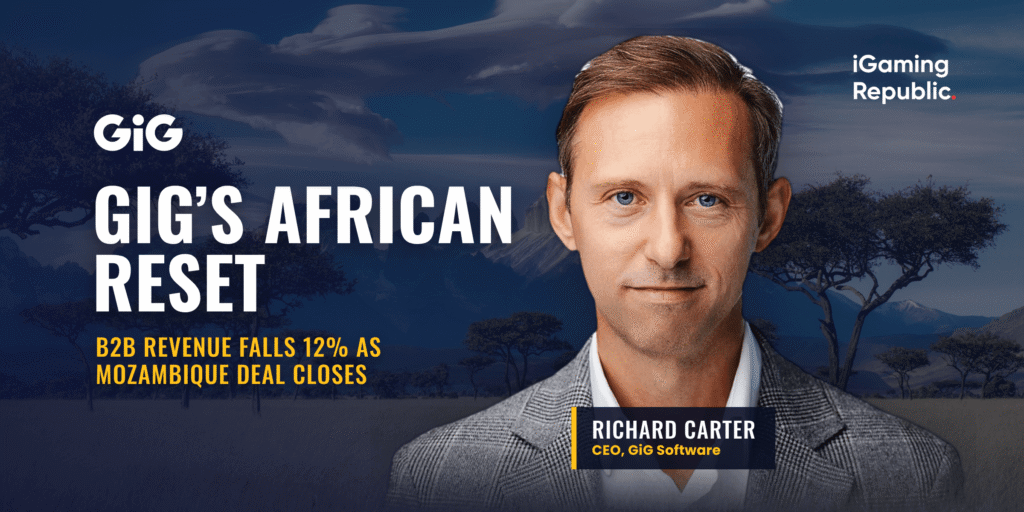
Richard Carter, Chief Executive Officer of GiG, said:
“This quarter marked an important step forward for the Group, with the transformational acquisition of an 80% stake in 888AFRICA, a cash-generative and fast-growing African B2C operator. The acquisition has strengthened our financial position, with Group cash and cash equivalents increasing to €8.0 million, creating a solid foundation for future growth.”
A different company by 2027
GiG kept its FY26 guidance for combined revenue of €45–48m and adjusted EBITDA of €5.5–7.0m, slightly tighter than August’s ranges. A year ago, it was guiding to at least €56m of revenue from the platform business alone. Even with one quarter of 888AFRICA included, the new range falls €8–11m short of that.
The 2027 outlook is where the deal shows. GiG targets combined revenue of €85–90m and adjusted EBITDA of €17–19m. Against this year’s numbers, that roughly doubles revenue and nearly triples adjusted EBITDA at the top of the range.
Carter added:
“Looking ahead, we remain focused on leveraging the opportunities created by 888AFRICA while continuing to drive sustainable growth through our partnerships and market expansion.”
The market took the longer view. Following the release of its Q3 2026 financial results, GiG’s share price spiked 20% to reach 3.28 SEK.
What to watch
Q4 will be the first quarter with 888AFRICA fully in the accounts. It will show how much of next year’s €85–90m comes from African player revenue, and how much from platform clients. On current trends, the consumer side looks set to be the bigger share.
That changes the conversation with operators. A platform supplier earning most of its money from its own consumer brands has to show clients that the B2B roadmap still gets funding and attention.
The cash timeline is tight too. GiG must meet ten months of deferred payments and service 15% debt from a starting balance of €8.0m. Any slip in Mozambique, or another client failure on the platform side, would leave little room to absorb it.
Do you have a story worth sharing?
Send it over to our editors!