Lula’s historic win puts betting ban on trial
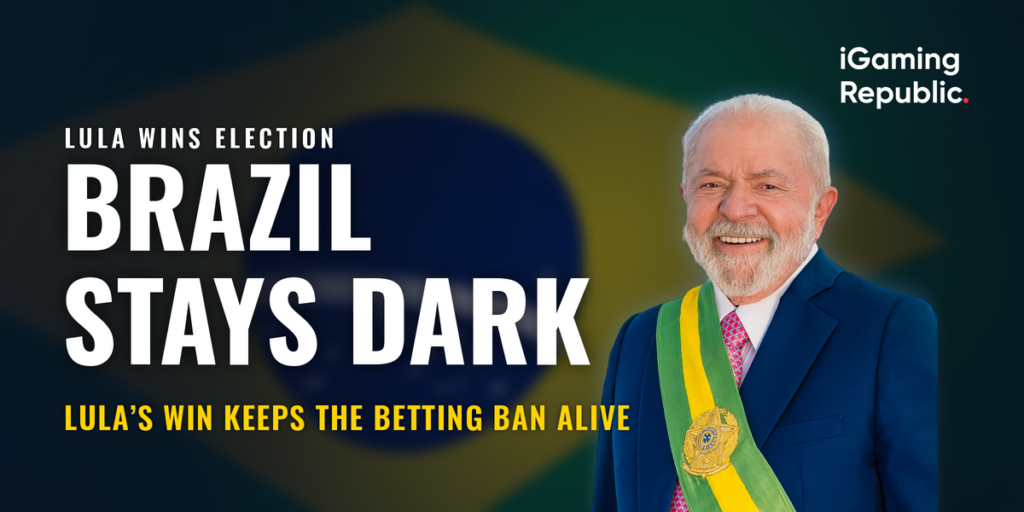
- Lula wins a fourth non-consecutive term with 51.79% of valid votes, the first runoff comeback since 1989.
- His win keeps the betting ban in force, with 85 authorizations covering 188 brands expiring on October 25.
- Justice Luiz Fux is now expected to rule on the ban, as a right-leaning Congress weighs its next move.
Luiz Inácio Lula da Silva has won a fourth non-consecutive term as Brazil’s president, coming from behind to beat Flávio Bolsonaro in Sunday’s runoff.
The president who switched off Brazil’s licensed betting market stays in power. The ban’s future now sits with the Supreme Court and a Congress that has moved to the right.
Second place, first prize
Lula took 51.79% of valid votes to Bolsonaro’s 48.21%, according to the final count from the Superior Electoral Court (TSE). More than four million votes separated them.
Since Brazil returned to direct presidential elections in 1989, no candidate had won a runoff after finishing second in the first round. In the October 4 first round, Bolsonaro took 47.03% to Lula’s 45.16%.
Betting sat at the center of the race. Lula signed the ban nine days before the first round, and his campaign team went as far as calling the vote a plebiscite on betting.
He doubled down three days before the runoff, during a YouTube live broadcast with federal deputy André Janones.
Luiz Inácio Lula da Silva, President of Brazil, said:
“The bets will not return. Anyone who wants to make money should go to work.”
Fux holds the key
The Supreme Federal Court (STF) offers the industry its fastest route back. Justice Luiz Fux is rapporteur for three direct actions of unconstitutionality against the measure: ADI 8024 from Anseja, ADI 8027 from the National Association of Games and Lotteries (ANJL) and ADI 8028 from the mayors’ association ANPV. Broadcasters’ body Abert has also requested a suspension.
So have 16 football clubs, including Cruzeiro and Fluminense. They want the measure frozen until Congress reviews it.
On October 2, Fux gave the Attorney General’s Office (AGU) 72 hours to respond. The AGU asked him to reject the challenges and keep the ban. Fux then held the file, according to UOL, having told colleagues that a ruling before the runoff could be read as taking sides. He is now expected to rule, with no date yet announced.
Analysts point to three possible outcomes. Fux can deny the injunction, suspend the measure outright, or restore sports betting and keep online casino banned. Any individual ruling would still need confirmation by the full Supreme Court.
Licensees are already paying for the delay. The 85 federal authorizations, granted to 82 companies and covering 188 brands, expired on October 25. The fees will not be refunded. A ruling with retroactive effect could treat the authorizations as valid throughout.
The lower courts have offered nothing durable. Operators and the ANJL filed 19 actions in the federal courts. The only favorable decision, a partial injunction for Stake in São Paulo, was suspended by the president of the TRF3 regional court at the government’s request.
The human cost keeps climbing. The ANJL says more than 3,500 jobs have been lost since the measure was issued and expects the figure to approach 6,000 by year-end. A study by LCA Consultores for the Brazilian Institute of Responsible Gaming (IBJR) estimates lost tax revenue of R$58 billion to R$73 billion between 2027 and 2030.
International groups are counting their own losses. Flutter Brazil generated $74 million in revenue in H1 2026. Allwyn says Betano is preparing legal action to protect its five-year license, and Evolution has temporarily closed its Brazil studio.
The clock nobody started
In Brasília, the measure has hardly moved. The joint committee designated on September 30 is still awaiting installation, according to the congressional record, and has no chair or rapporteur.
Lawmakers filed 99 amendments before the October 13 deadline. Senate President Davi Alcolumbre had pushed that deadline back because of the elections. Several amendments would restore operator licenses. Others would keep sports betting and ban online casino.
The calendar now tightens. Under the congressional timetable, the measure enters an urgency regime on November 9 that locks the agenda of the house reviewing it. Its first 60 days run out on November 23, followed by an automatic 60-day extension.
That timeline could hand the decision to a new legislature. Bolsonaro’s Liberal Party (PL) won 121 seats, the largest single-party bloc elected to the Chamber since 1990. Poder360 counts 276 right-leaning deputies from 2027, against 124 on the left and 113 in the center. The PL is also on course for 28 of the Senate’s 81 seats.
Lula brushed off talk of a hostile Congress in his victory speech in São Paulo, saying:
“I didn’t choose Congress. The people chose it, and it is with this Congress that I will vote, work and get things approved.”
Oliver Stuenkel, professor of international relations at the Getulio Vargas Foundation, said:
“He is likely to be a lame duck from the start”
Sports betting only?
Fux’s ruling is the next marker. A ruling that revives sports betting alone would still leave most of the market dark. Online casino accounts for around 70% of betting companies’ revenue, with the offshore market holding more than 40% of the volumes before the ban.
If the ban survives in court, the fight moves to a Congress where the PL sits at the center of any majority. Lawmakers would also need to settle whether former licensees must reapply for authorizations.
Operators paid R$30 million per authorization for five-year licenses, with the regulated market opening in January 2025.
Do you have a story worth sharing?
Send it over to our editors!