Bettors react as Massachusetts limit notices land

- Licensed Massachusetts sportsbooks began issuing mandatory account-limitation notices on June 1, 2026, in what regulators describe as the first state-level rule of its kind in US sports betting.
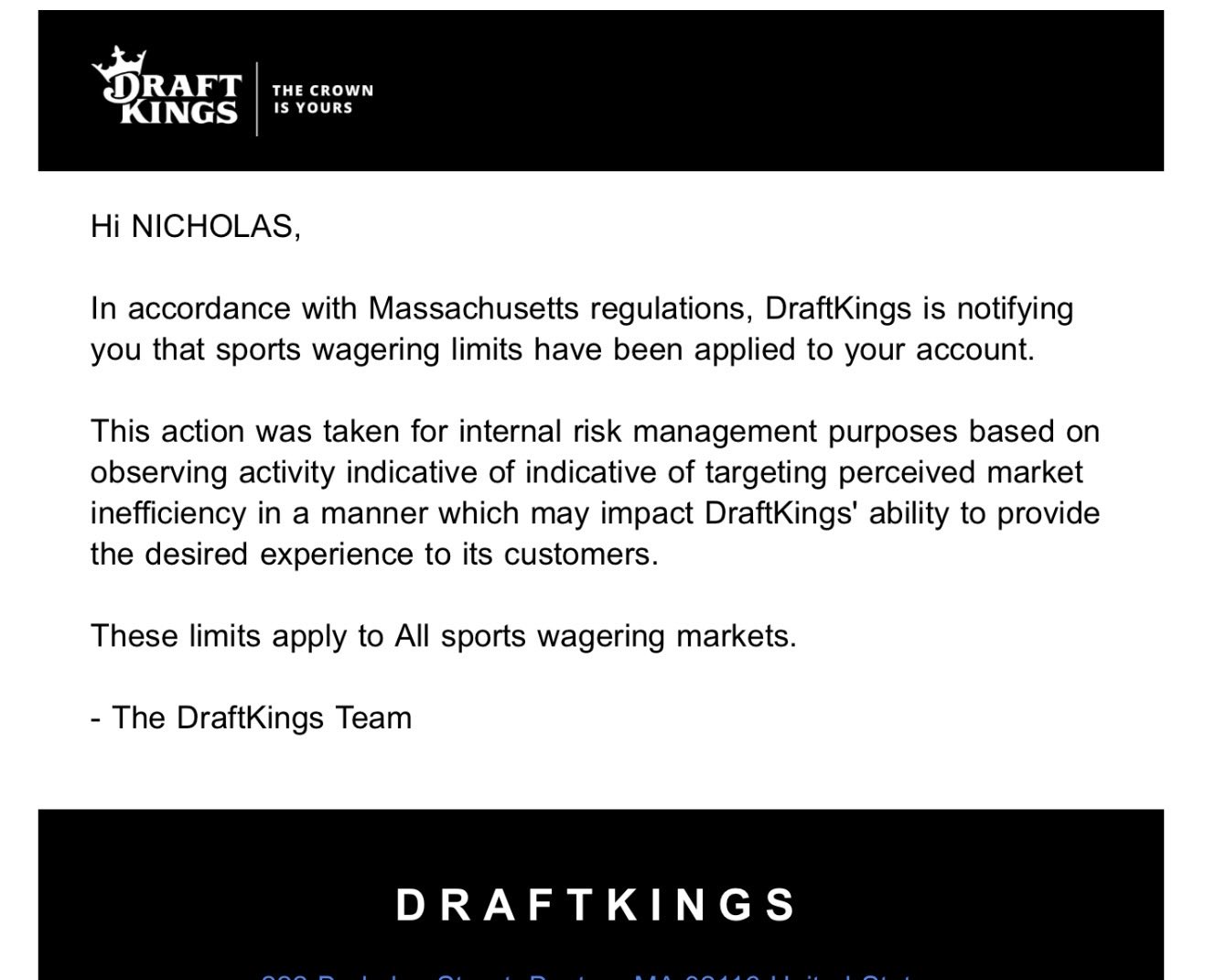
- DraftKings cited reasons including market inefficiency targeting and coordinated wagering in notices shared by customers on X.
- Sharp bettors flooded X with criticism, arguing the language confirms operators penalise winning customers.
Sharp bettors took to X on Monday to vent frustration after Massachusetts sportsbooks began sending the first mandatory account-limitation notices in US state-regulated sports betting, with many interpreting the operator language as confirmation they are being punished for winning.
‘Penalised for winning’
The messages started landing from June 1, 2026, the date the Massachusetts Gaming Commission’s (MGC) landmark transparency rule came into force. Each notice must be tailored to the individual and give a specific reason for the restriction. Boilerplate responses are not acceptable under the regulation.
Operators must also identify which markets are affected, issue retroactive notices to users limited before June 1, and send a separate notice if a limitation follows a bettor into Massachusetts from another state.
Among the reasons cited in DraftKings notifications shared publicly on X were “targeting perceived market inefficiency,” “attempting to exploit potential latency associated with live market updates,” and “coordinated or structured wagering activity.”
The reaction was swift. Rob Pizzola, a prominent betting analyst, posted on X:
“I respect everyone pushing for change in regulated betting but Massachusetts forcing books to give a reason for limiting was always likely to end up here. Forced to explain themselves they wrote a bunch of nonsense that translates to you were good at this and we did not like it.”
Professional bettor Gadoon “Spanky” Kyrollos (@spanky) also criticized the reasoning:
“If you are unable to handle the market inefficiency, why hang up the market in the first place. Hang a number to take a hit. If you don’t wanna get hit, then why did you hang that number?!? The true inefficiency lies in the bookmaker’s incompetence. And you wonder why the Prediction Markets are dominating.”
The frustration feeds into a wider debate about the structural difference between sportsbooks and prediction markets. CFTC Chairman Michael Selig made that distinction explicit in a May 12 interview, arguing that derivatives platforms are prohibited from restricting winning customers, unlike sportsbooks.
Selig said:
“What you’re seeing is markets versus entertainment. For those that want the discipline and integrity of a market, it’s a better model. For those that want entertainment, the casinos might be the model for them.”
The notices also reignited debate around Matt Kalish, the DraftKings co-founder who left his role as president in March 2026 and has since run a sustained public campaign on X defending traditional sportsbooks against the rise of prediction markets.
User @Johnnyp135DFS posted:
“Seems like only yesterday that Kalish was saying DraftKings doesn’t limit like this lmao.”
Adam Robinson, board member at American Bettors’ Voice, had previously told bookies.com:
“The data confirmed a clear relationship between betting performance and limit treatment.”
What the notices say
The regulation requires operators to notify limited bettors within 48 hours, explain why they were limited with no boilerplate language, and identify the markets affected.
Users limited before June 1 were still required to receive a notification on the rule’s start date. If a limitation follows a bettor from another state into Massachusetts, a separate in-state notice must also be sent.
A DraftKings spokesperson said:
“In accordance with updated Massachusetts regulations, DraftKings has notified impacted customers regarding certain account restrictions and will continue to do so, as required.”
FanDuel and Fanatics Sportsbook are also subject to the Massachusetts notice requirement and began sending notices on June 1.
MGC officials have described the rule as a first-in-the-nation effort to bring transparency to sportsbook limits. MGC spokesperson Thomas Mills said:
“The Massachusetts Gaming Commission is proud to be the first regulator to address the issue of sportsbook limits to provide transparency to Massachusetts patrons.
“The Commission did not prescribe specific language but did direct operators to be specific. Compliance with this first-in-class regulation will be monitored and its impact evaluated, including the potential for modifications in the future.”
Rule born from years of complaints
The regulation traces back to complaints and public comments in 2023 from limited bettors. A first roundtable in May 2024 was declined by all active operators. A second discussion followed later that year, where sportsbooks argued limiting was applied to a very small share of accounts and was not targeted at winners.
MGC research found roughly 13,400 of the state’s 2.1 million online wagering accounts (0.64%) had been restricted.
Commissioners Eileen O’Brien and Nakisha Skinner signalled they will seek more detailed reasoning if bettor complaints continue after the rule takes effect.
Commissioner Paul Brodeur said:
“We’ll know pretty quickly who is making that good-faith effort toward the transparency goal.”
Monday’s reaction on X suggests that for many bettors, receiving a reason — however specific — does not equal receiving a satisfactory one. Regulators in other states are watching the Massachusetts model, with similar bettor-protection measures under discussion in parts of the US.
Industry sources say a key question now is whether the MGC moves to regulate the grounds on which operators can limit accounts, rather than merely requiring disclosure.
Do you have a story worth sharing?
Send it over to our editors!