Willem van Oort, Gaming in Europe: When protecting players pushes them offshore

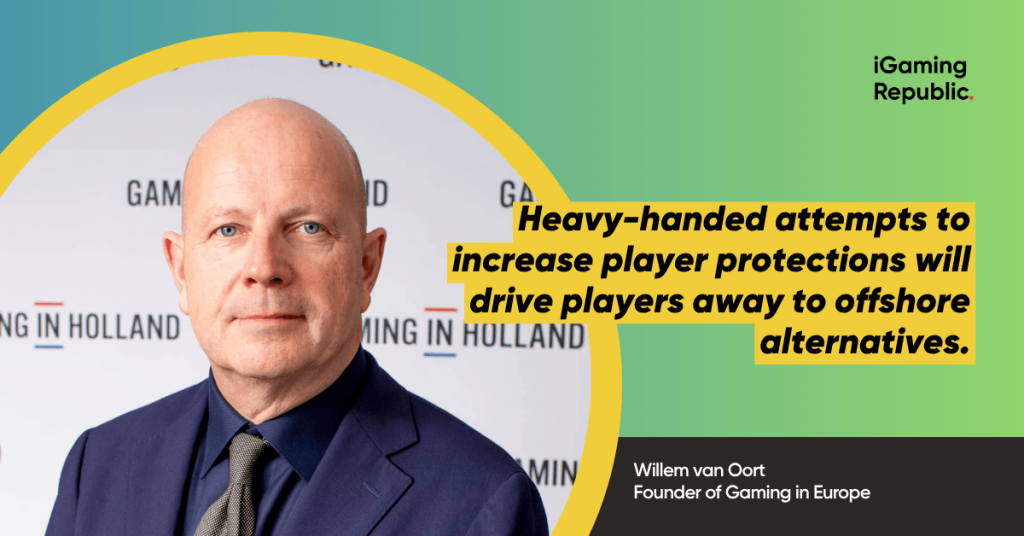
Willem van Oort, founder of Gaming in Europe, explains why Europe’s tightening approach to gambling regulation risks pushing players toward unlicensed operators, and where a more pragmatic model might emerge first.
Across Europe, gambling regulators are tightening rather than loosening their grip, and the industry is increasingly asking how much protection is too much.
From deposit limits in Germany and the Netherlands to Spain’s new cross-operator caps, policymakers are testing how far restrictions can go before players simply leave the regulated market altogether.
Willem van Oort, founder of Gaming in Europe and the business communities behind Gaming in Holland, Gaming in Spain, Gaming in Germany and Gaming in the Nordics, has spent two decades building relationships with regulators and operators across the continent, giving him a rare cross-market view of how European gambling policy actually gets made.
The conversation follows the inaugural edition of Gaming in the Nordics in Copenhagen, and lands as the European Commission floats internal estimates for a 3% tax on online gambling net turnover, a proposal that would touch every licensed operator on the continent.
This Q&A gets into…
- What stood out from the launch edition of Gaming in the Nordics, and why the Nordic markets might lead the next wave of iGaming regulation
- Why “shared European philosophy” is more myth than reality across Europe
- Van Oort’s verdict on the European Commission’s proposed gambling turnover tax
- Where crypto payments and crypto-native operators currently stand with European regulators
- Why slow-moving regulators risk pushing players toward the unlicensed market
Let’s dive in!
iGaming Republic: Congratulations on Gaming in the Nordics, which just wrapped up. What were some of the key takeaways or conversations from the event that stood out to you?
Willem van Oort: The first thing that comes to mind is the amazing speakers who shared their knowledge and participated in the ensuing conversations. Anders Dorph, Director of Danish regulator Spillemyndigheden, stressed that, contrary to offshore providers, operators in Denmark’s regulated market are very eager to be compliant.
Pontus Lindwall, CEO of Betsson, and Jesper Kärrbrink, CEO of Immense Group, in turn, provided an operator perspective on the dos and don’ts of iGaming regulation. Lindwall specifically listed the three prerequisites for having a healthy market with a high player channelization rate: a competitive product, meaningful player protections, and real enforcement.
This led to a quite interesting follow-up conversation where different stakeholders – each with their own perspective – discussed how to best keep players in the licensed market without compromising player protections.
It was a very enlightening illustration of Nordic pragmaticism at work. Although operators and market regulators have different roles to play, they do have a common interest in keeping as many players as possible from leaving the regulated market, while also ensuring the long-term economic, social, and political sustainability of said regulated market. For me, this was certainly one of the highlights.
Of course, we had quite a few other speakers who managed to provide interesting and relevant contributions. All in all, I think our Gaming in the Nordics launch event was a major success, and a great step towards a highly successful, full-size Gaming in the Nordics Conference we will be hosting next year in Copenhagen.
iGR: You work across multiple European markets through Gaming in Europe, including established markets like the Netherlands, Germany, and Spain, where you run events, alongside emerging markets like Finland. How would you compare the regulatory challenges across these different regions?
WV: Generally speaking, policy makers – and thus regulators – are increasingly cracking down on regulated gambling. This is most noticeable in markets that regulated last and were never particularly liberal to start with. Regrettably, the idea of largely self-regulating markets that would require only light-touch regulation never quite materialized. Because of this, I can understand, at least to some extent, that policy makers are looking to tighten the reins a bit.
I am quite concerned, however, that the pendulum will swing too much in the other direction, and that heavy-handed attempts to increase player protections will drive players away to offshore alternatives. This is something that we are clearly seeing in Germany and the Netherlands. Spain recently announced cross-operator deposit limits, and we will soon see to what extent this will impact the regulated market.
“Heavy-handed attempts to increase player protections will drive players away to offshore alternatives.” – Willem van Oort, Founder of Gaming in Europe
I would like to note, though, that during our recent Gaming in the Nordics event, Morten Ronde, CEO of the Danish Online Gambling Association, observed that – due to a combination of Scandinavian pragmatism and the willingness to be early adopters – the Nordic markets will be where the next generation of innovative iGaming regulation will likely be deployed first.
This means that I am rather optimistic about market re-regulation in Finland. I think they might be able to strike a balance that will work in other markets, too.
Related to this observation, it is Gaming in Europe’s aim to share lessons from across Europe and to actively promote the kind of in-depth conversations among stakeholders that can contribute to long-term market sustainability – not just economically but also from a broader public perspective.
iGR: Having built relationships with regulators across Europe, do you see a shared philosophy emerging among European regulatory bodies, or do you think they are pulling in different directions?
WV: It remains true that culture informs politics, and politics informs policies. Thus, I don’t think we will ever get to what one could call a shared philosophy. Nonetheless, as mentioned before, I think there exists a general tendency to impose additional restrictions on legal online gambling – at least for now.
At the same time, it is important to realize that regulators are more open to listening to the industry than the average politician is. Regulators, at least, tend to actually understand the market to a meaningful degree. But – and this is something that licensees sometimes forget – they do not work for the industry, which sometimes makes it seem that they do not actually understand the market.
This is one reason why our relationships with European regulators have always been part of our DNA. As an industry, we must understand that sometimes we need to listen to, as well as address broader social concerns. In turn, regulators can bring across the industry’s concerns to political decision makers.
One thing that regulators and licensed operators have in common is a desire for a viable and sustainable market. Even if there are no common interests in other areas, this remains something to build on.
iGR: The European Commission has circulated internal estimates suggesting a 3% tax on online gambling net turnover could generate €1.9bn a year for the EU budget. What is your take on that proposal, and how do you think it would play out for licensed operators?
WV: As long as gambling remains a national rather than an EU competency, I think this is a terrible idea. Under current conditions, it would undermine the entire idea of having a coherent gambling policy – of which taxation rates are naturally an important part.
“As long as gambling remains a national rather than an EU competency, I think this is a terrible idea.” – Willem van Oort, Founder of Gaming in Europe
iGR: Regulators across Europe have traditionally been cautious around new game formats and mechanics. How do you think they should be approaching innovation, and is there a risk in moving too slowly?
WV: Most gambling regulations operate under the principle of “it is prohibited unless…” This means that when it comes to innovation, regulations will always be lagging – especially if permitted game types are defined in primary legislation.
A good first step would be to define permitted game types and modes as much as possible in secondary legislation, i.e., the kind of regulation that can be modified by governments without full parliamentary approval.
At least in such cases, governments, or even regulators, would be much more flexible, as well as a lot quicker, in allowing new, popular game types to be offered by licensed operators. And why not? Not every new game type is necessarily riskier than what we already have.
The risk of being too slow in allowing new game types is quite obvious: if people cannot find what they are looking for in the legal market, they will start looking somewhere else. To the extent that enforcement is effective, it is also very expensive. So why not simply allow innovation if the resulting risk to the player remains effectively the same?
This is one area, I believe, where Gaming in Europe can help educate all relevant stakeholders.
“If people cannot find what they are looking for in the legal market, they will start looking somewhere else.” – Willem van Oort, Founder of Gaming in Europe
iGR: Crypto remains a grey area in most European regulated markets. How would you describe the general attitude among regulators toward crypto payments and crypto native operators at the moment, and where do you see that heading?
WV: I don’t think regulators are fundamentally opposed to crypto payments. Regulators are, however, opposed – for quite understandable reasons – to anonymous payments, due to player protection and AML concerns.
I am also not sure if regulated online gambling is something that crypto holders are interested in. To me, it seems likely that crypto adoption is at least partially tied to a desire to remain anonymous.
We are, however, following this topic closely and would welcome any insights from experts in this field. Personally, I would love to explore the idea of crypto gambling in regulated markets at one of our events. I invite any expert who feels they could seriously contribute to this topic to contact me at [email protected].
About Willem van Oort
Willem van Oort is the founder of Gaming in Europe, the network of business communities that includes Gaming in Holland, Gaming in Spain, Gaming in Germany and Gaming in the Nordics, each serving thousands of iGaming professionals through events, webinars, newsletters and industry coverage.
An independent gambling consultant active in the sector since 2005, he also serves as CEO of eGaming consultancy GranViaOnline and sits on the board of player-protection specialist Mindway AI.
About the author
Bianca Máthe
Bianca Máthe is Publisher of iGaming Republic. She spent close to a decade on the supplier side of iGaming, working across the sector's core verticals: platform and player-engagement technology and crypto payments. That mix gave her a working knowledge of how operators, suppliers and payment providers actually run. In 2025 she started a media project, bringing that operational grounding to her editorial work. Her output includes interviews with high-profile iGaming executives, original reports, and in-depth features covering licensing, M&A, and the operators and suppliers shaping the sector. Based in Malta, she spends much of her time getting closer to emerging sectors like prediction markets, tracking how they're developing before the rest of the industry catches up.
Do you have a story worth sharing?
Send it over to our editors!