Michigan targets 33 offshore sites over self-exclusion
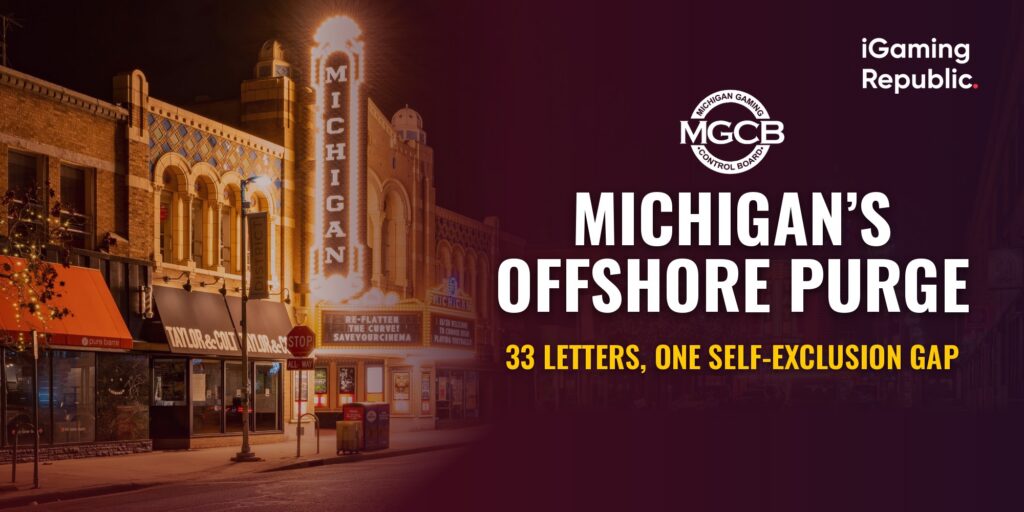
- Michigan regulator issues cease-and-desist letters to 33 offshore gambling operators.
- Sites offered casino, sweepstakes-style games or sports betting without a license.
- Board warns self-excluded players have no protection on unlicensed sites.
The Michigan Gaming Control Board (MGCB) has issued cease-and-desist letters to 33 offshore gambling operators it says were illegally offering casino-style games, sweepstakes-style games or sports betting to residents.
Announced on October 8, the action puts self-excluded players at the center of the regulator’s case against unlicensed sites.
Recipients include Azartzona Casino, Lucky Charm Sweep, Basepoker, Cryptoplay, Genie Jackpot, mBit Casino and Raging Bull Slots. Regal Casino and Sportsbook, which also trades as Wager Street, is also on the list.
One recipient is a company rather than a consumer brand: Guangzhou Snail Interactive Technology Co., Ltd. The MGCB did not specify which of the three product categories applied to it.
According to the MGCB announcement, investigations found each operator was serving Michigan players without a state license. Under the Lawful Internet Gaming Act and the Lawful Sports Betting Act, online casino and sports wagering operators need MGCB approval.
Operators that ignore the letters may face further action in conjunction with the Michigan Department of Attorney General. The announcement did not set a compliance deadline.
No safety net
Licensed operators must check players against the Internet Gaming and Sports Betting Responsible Gaming Database, Michigan’s voluntary online self-exclusion register. Offshore sites carry no such obligation.
The MGCB said a self-excluded player can still sign up, deposit and bet on an unlicensed site. Many do so without realizing the site operates outside Michigan law.
Earlier research from the American Gaming Association (AGA), cited by the MGCB, found 70% of bettors who placed most of their wagers with illegal operators believed they were using only legal books, or splitting evenly between the two.
Henry Williams, executive director at the Michigan Gaming Control Board, said:
“Choosing to self-exclude is one of the hardest and most courageous decisions a person can make, and in Michigan’s legal market, that choice is respected. Offshore sites don’t respect it. They will take a deposit from someone who has asked for help, and the MGCB has no way to help that person get it back.”
What players lose
Players also give up deposit limits, independent testing of game fairness and data protection under Michigan’s standards. If winnings are withheld or an account is closed, there is no recourse through the regulator.
The board is steering residents to its list of authorized platforms. Illegal sites can be reported to [email protected] or the anonymous tip line on 1-888-314-2682.
Williams added:
“These 33 letters put operators on notice that our residents are not an untapped market, and that anyone who thinks they can ignore our protections will hear from us.”
Legal-only play shrinks
The MGCB backed its warning with an August 2025 analysis from the AGA. The trade body estimated Americans wager $673.6 billion a year with illegal and unregulated operators, offshore sites included.
The AGA found the illegal market has grown 22% since its previous report in 2022, driven partly by a sharp rise in illegal online casino play.
The share of online casino players using only legal sites fell from 52% in 2022 to 24%. Nearly half now play on both legal and illegal sites, almost three times the earlier rate.
On the sports side, Americans placed an estimated $84 billion with illegal bookies and offshore sportsbooks in the year studied. One in ten sports bettors use illegal sources exclusively.
Round two
This is the board’s second large batch of letters this year. In April 2026, the MGCB said it had sent cease-and-desist letters to 45 offshore operators over four months.
Prediction markets are in the frame too. Robinhood agreed in a court-approved stipulation to stop offering new sports-related event contracts to Michigan customers by the end of September 9. Its remaining positions were due to close by October 9.
Coinbase followed on October 7, agreeing to stop new sports-related event contracts and wind down open positions by October 10.
In neighboring Ohio, the Ohio Casino Control Commission has ordered 10 prediction market operators to stop offering sports event contracts. Connecticut’s Department of Consumer Protection ordered nine prediction markets to do the same in September.
What’s at stake
Michigan’s commercial and tribal iGaming and online sports betting operators reported $337.6 million in August gross receipts, according to MGCB figures published September 18.
The board has not said how many April recipients have stopped taking Michigan players. The next signal will be how many of the latest 33 are referred to the Attorney General.
The harder problem sits in the AGA data. With under a quarter of online casino players sticking to legal sites only, the European argument that enforcement alone cannot win players back looks increasingly relevant to Michigan.
Do you have a story worth sharing?
Send it over to our editors!