Nevis follows Gibraltar with prediction market licence
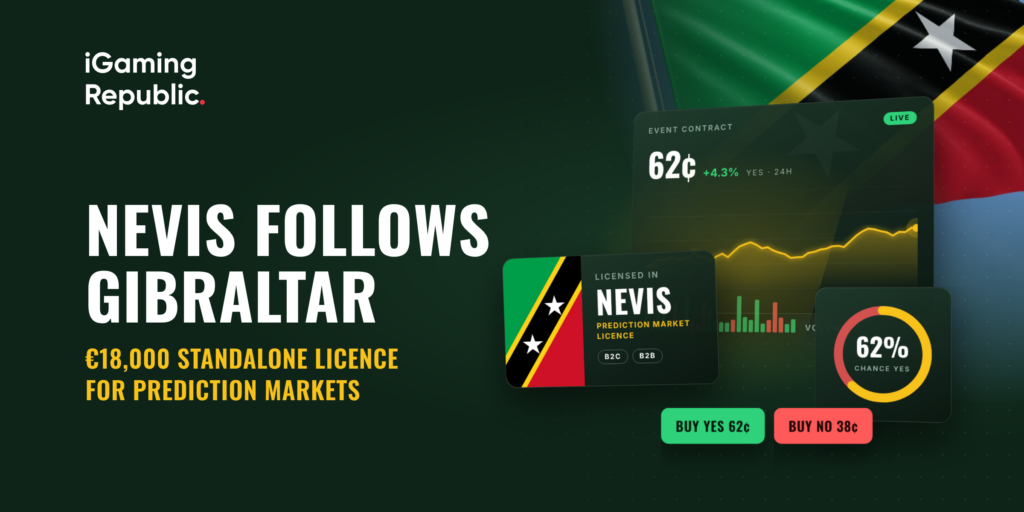
- NOGA launches a standalone prediction market licence for B2C operators and B2B suppliers
- Setup and annual renewal fees are €18,000, against €28,000 for iGaming
- Existing NOGA licensees must apply separately to run prediction markets
The Nevis Online Gaming Authority (NOGA) has launched a standalone prediction market licence, less than four months after Gibraltar brought in its own dedicated regime.
The category went live on 30 October, and application forms and full licence conditions followed on 2 November.
Ten grand cheaper
The licence covers platforms where users buy and sell contracts on the outcome of future events. NOGA’s launch notice names sport, elections, economic data and culture as examples.
It sits apart from NOGA’s B2C and B2B gaming licences, with its own application form and conditions.
On price, NOGA’s fee schedule sets a €18,000 setup fee for both B2C operators and B2B suppliers of prediction market services. Renewal costs another €18,000 every year.
A Nevis iGaming licence costs €28,000 to set up and the same to renew. Prediction market operators therefore pay €10,000 a year less than casino and sportsbook licensees.
Holding an iGaming licence does not cover the new product. NOGA says current B2C and B2B licensees must apply separately to add prediction markets. Its application page also restricts eligibility to companies incorporated in Nevis.
Built for exchanges
NOGA says prediction markets match users against each other instead of taking bets as the house. Its conditions target the risks of that model.
Market integrity leads the list. Operators must set out how each event is defined, resolved and disputed, and name a credible source for the result.
Licensees also need manipulation and insider controls to catch trades on non-public information and attempts to influence outcomes. Further rules cover the safeguarding of customer funds, including balances and open positions, plus KYC checks and transaction monitoring under Nevis AML rules.
Custody of customer money is a live issue for the sector. Polymarket halted trading last week after a third-party script breach, its third security incident since May.
Sport is only part of the menu. Binary and multi-outcome markets on financial indicators, political events, entertainment, weather and digital assets all qualify.
Nuri Katz, CEO, Nevis Online Gaming Authority, said:
“As prediction markets continue to develop, regulatory approaches need to reflect the way these platforms operate and the risks associated with their activities. With this dedicated framework, our aim is to provide greater clarity for businesses entering this sector while ensuring that market integrity and participant protection remain central to the licensing process.”
Gibraltar got there first
Gibraltar’s Prediction Market Regulations took effect on 13 July. Its government billed them as the world’s first dedicated framework for the sector.
NOGA positions its licence against the rest of the offshore market. Its announcement says most other offshore jurisdictions still license these platforms under general gaming or betting permits that were never written for them.
The authority first opened the door in June, saying it would consider event-based forecasting models under its existing framework. Four months later, those platforms have a licence of their own.
Established gambling suppliers are also building for the vertical. Hacksaw recently launched a B2B platform for prediction markets, backed by an MGA-approved licence extension.
The payments pitch
Part of NOGA’s case is aimed at the businesses that sit around the operator. It says the category gives payment service providers and technology partners a clear answer on which licence covers the product.
For offshore platforms, that answer can determine which processors and banks will take them on.
Market access is another matter. NOGA states that authorisation stays subject to the laws of each jurisdiction where licensees offer services.
In the US, a new CFTC rule has taken licensed sportsbook and casino wagers out of the swap definition, formally separating them from event contracts.
Two-tier offshore market
The early-stage platforms that cannot fund a European base are NOGA’s most likely applicants. For them, a cheaper permit written for their product is an easy sell.
Curaçao, a regular comparison for Nevis, is still bringing licensing in-house after a nine-month breach of its portal.
What an offshore licence cannot buy is recognition in markets that demand local authorisation. US and European regulators are still fighting over how event contracts should be classified.
Each new dedicated regime makes the catch-all gaming permit harder to defend for prediction market operators. Payment partners, more than players, will decide which of the two they hold.
Do you have a story worth sharing?
Send it over to our editors!