Ivan Nikolaev, Zillion Games: From zero to 900 operators by building slots that perform, not just launch

Ivan Nikolaev, CPO of Zillion Games, explains how consistent operator performance, controlled iteration, and market-specific development helped the studio grow from zero to over 900 partnerships in under five years.
Every casino content studio knows how to launch a slot. The harder problem is what happens after: whether the game actually holds players and shows up in operator retention data week after week. In a market flooded with new titles every day, the studios pulling ahead are the ones that have shifted their focus from launching to optimising.
Ivan Nikolaev, Chief Product Officer at Zillion Games, has built the studio’s product strategy around that distinction. Zillion Games has grown from zero to over 900 operator partnerships in under five years, releasing one to two titles per month, each one shaped by performance data, player retention mechanics, and direct operator feedback.
In 2025, the approach earned the studio EGR Europe’s “Casino Content Supplier Under 5 Years” award, ahead of competitors with bigger teams and longer track records.
This Q&A gets into:
- What Zillion Games built differently to earn operator trust at that pace
- How the studio approached Hold & Win in an already saturated market
- Why co-developed titles with operators like BetBoom are becoming central to the roadmap
- What actually tips an operator’s decision when two suppliers offer similar mechanics
- And where Nikolaev sees the biggest product risks over the next 12 to 18 months
Let’s dive in!
iGaming Republic: Zillion Games won EGR Europe’s “Casino Content Supplier Under 5 Years” in 2025, competing against studios with bigger budgets and longer track records. From a product standpoint, what did you build differently that made operators choose you?
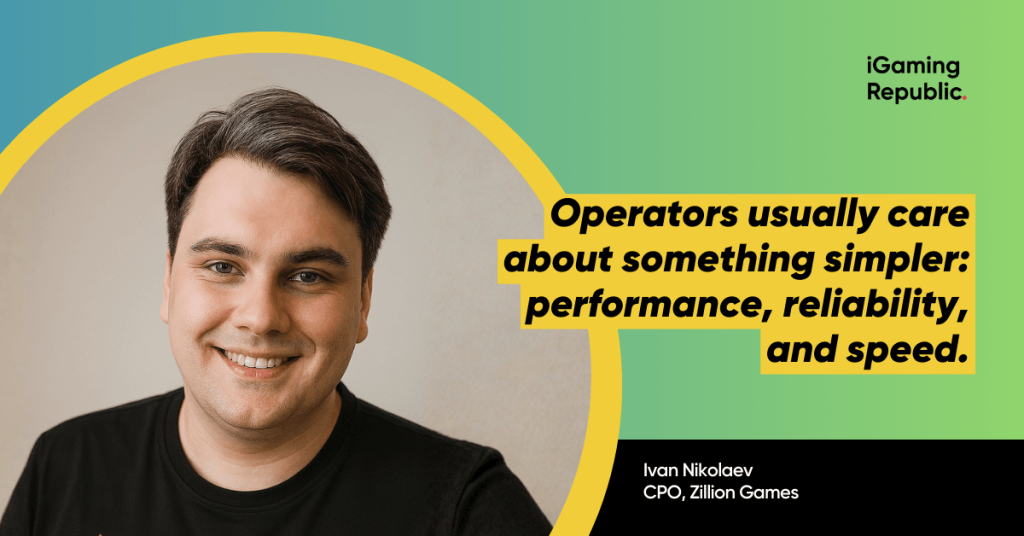
Ivan Nikolaev: A lot of young studios try to compete by promising innovation, but operators usually care about something simpler: performance, reliability, and speed. From day one, we built Zillion Games around those three pillars.
First, we focus heavily on player retention mechanics. Our games are designed to create momentum—features that trigger frequently enough to keep players engaged, but still leave room for meaningful wins. Operators see the result directly in session length and replay rates.
Second, we prioritised operator usability. Integration is simple, games are lightweight and stable across devices, and our content works well inside aggregator environments where visibility windows are short.
Third, we move fast. Releasing 2 games per month allows operators to constantly refresh their lobby with new Zillion content without overwhelming them with dozens of similar titles.
So the difference isn’t one big breakthrough feature. It’s consistent performance across the portfolio, which operators quickly learn they can rely on.
“The difference isn’t one big breakthrough feature. It’s consistent performance across the portfolio, which operators quickly learn they can rely on.”
Ivan Nikolaev, Chief Product Officer of Zillion Games
iGR: Wolf’s Moon launched as your first Hold & Win release. Walk us through how you decided it was time to build your own version of Hold & Win when that mechanic is already saturated, and what you did to make yours worth integrating?
IN: You’re right—Hold & Win is probably one of the most saturated mechanics in the industry. So the question wasn’t whether to build one, but when we could do it properly.
We waited until we felt confident we could approach the mechanic with a clear design philosophy rather than just copying the format. With Wolf’s Moon, we focused on three things:
- Volatility balance — many Hold & Win games lean too heavily into extremely rare bonuses. We tuned ours to trigger in a way that keeps players engaged without losing the big-win potential.
- Visual pacing — the feature had to feel exciting every time it triggered, not just when a jackpot lands.
- Operator performance — the game had to perform well in real environments where players often decide whether to stay within the first few spins.
Hold & Win might be familiar to players, but familiarity can actually be an advantage when the game is tuned well. Our goal wasn’t to reinvent the mechanic—it was to make it perform consistently for operators.
iGR: You’ve gone from zero to over 900 operator partnerships in under five years, releasing 1 to 2 titles per month. How do you maintain product quality and differentiation under that kind of release pressure?
IN: The key is that we don’t treat each release as a completely new experiment. Instead, we work with iterative development cycles.
When we discover a mechanic or feature combination that performs well, we refine it across several titles rather than abandoning it immediately for the next trend.
That allows us to improve what works while still experimenting with themes, volatility curves, and presentation.
Another important factor is team structure. Our production pipeline is built so that design, mathematics, and QA run in parallel, which keeps quality high without slowing releases.
Finally, we listen very closely to operators. If a game performs well in certain markets or player segments, we use that information to guide future releases. So the pace is fast, but it’s controlled iteration rather than constant reinvention.
“The pace is fast, but it’s controlled iteration rather than constant reinvention.”
Ivan Nikolaev, Chief Product Officer of Zillion Games
iGR: You’re working with operators like BetBoom on market-specific releases such as Muerto Fortuna for Brazil. How important are exclusive or co-developed titles in your overall product strategy, and do you foresee more of these joint collaborations in the future?
IN: They’re becoming increasingly important. Operators today are looking for ways to differentiate their lobby, and exclusive or co-developed titles give them exactly that.
For us, these collaborations are also extremely valuable because operators understand their audiences better than anyone. When we combine that market knowledge with our development experience, the result is often a product that performs better than a generic release.
The Brazilian market is a great example. Themes, pacing, and player expectations there are different from Europe, so working closely with partners helps us adapt faster.
I expect we’ll see more of these collaborations going forward, especially in emerging regulated markets.
iGR: Most slot studios talk about innovation, but cloning is rampant and operators have thousands of near-identical titles. When an operator is evaluating Zillion Games versus a competitor with a similar mechanic or theme, what actually tips the decision in your favour?
IN: In practice, the decision usually comes down to performance data and trust.
Operators track metrics very closely: session length, bet frequency, retention curves. If a studio consistently delivers games that perform well on those metrics, operators remember that.
Another factor is consistency. Some studios release one strong game followed by several that underperform. Operators prefer suppliers whose portfolio behaves predictably.
Finally, there’s relationships and support. We work closely with operators on promotions, cross-marketing opportunities, and content launches. That kind of cooperation makes the partnership more valuable than just another game provider in the lobby.
So it’s rarely about who invented a mechanic first. It’s about who delivers games that actually work.
“It’s rarely about who invented a mechanic first. It’s about who delivers games that actually work.”
Ivan Nikolaev, Chief Product Officer of Zillion Games
iGR: The SOFTSWISS aggregator integration gives you massive reach, but it also means competing for visibility against hundreds of other studios in the same lobby. How does that distribution model change the way you think about product development and game positioning?
IN: Aggregator environments change player behaviour quite a lot. Players often discover games through short visibility windows—a banner, a new release section, or a recommendation block.
That means a game needs to communicate its appeal immediately.
So when we design a game, we think not just about gameplay but also about how clearly the concept is understood in the first few seconds. Theme clarity, strong visual identity, and recognizable mechanics all play a role.
Another implication is portfolio strategy. Because we release regularly, our games appear frequently in “new releases” sections, which increases the chances of discovery.
Aggregators create intense competition, but they also reward studios that are consistent and easy for players to understand quickly.
iGR: Looking ahead 12 to 18 months, where does Zillion Games need to be from a product perspective to stay competitive? What’s the biggest risk to getting there?
IN: From a product perspective, we need to continue improving in three areas:
- Stronger feature differentiation, even within familiar mechanics
- Deeper localisation for regional markets
- Better player engagement loops, especially for social and sweepstakes environments
The biggest risk isn’t technology—it’s losing focus. The iGaming industry moves very quickly, and studios are constantly tempted to chase every new trend.
For us, the challenge is to keep evolving while staying disciplined about what actually works for players and operators.
If we keep that balance—innovation with performance—we’ll remain competitive.
About Ivan Nikolaev – CPO, Zillion Games
Ivan Nikolaev is the Chief Product Officer at Zillion Games, where he leads product strategy, game design direction, and portfolio development. With extensive experience in iGaming product management and slot mechanics, Ivan focuses on building games that balance strong player engagement with operator performance.
At Zillion Games, he oversees the development pipeline of the studio’s growing portfolio, helping scale the company to hundreds of operator partnerships worldwide while maintaining a consistent release cadence and product differentiation.
About the author
Bianca Máthe
Bianca Máthe is Publisher of iGaming Republic. She spent close to a decade on the supplier side of iGaming, working across the sector's core verticals: platform and player-engagement technology and crypto payments. That mix gave her a working knowledge of how operators, suppliers and payment providers actually run. In 2025 she started a media project, bringing that operational grounding to her editorial work. Her output includes interviews with high-profile iGaming executives, original reports, and in-depth features covering licensing, M&A, and the operators and suppliers shaping the sector. Based in Malta, she spends much of her time getting closer to emerging sectors like prediction markets, tracking how they're developing before the rest of the industry catches up.
Do you have a story worth sharing?
Send it over to our editors!