Rivalry pauses betting platform and cuts jobs as board explores options
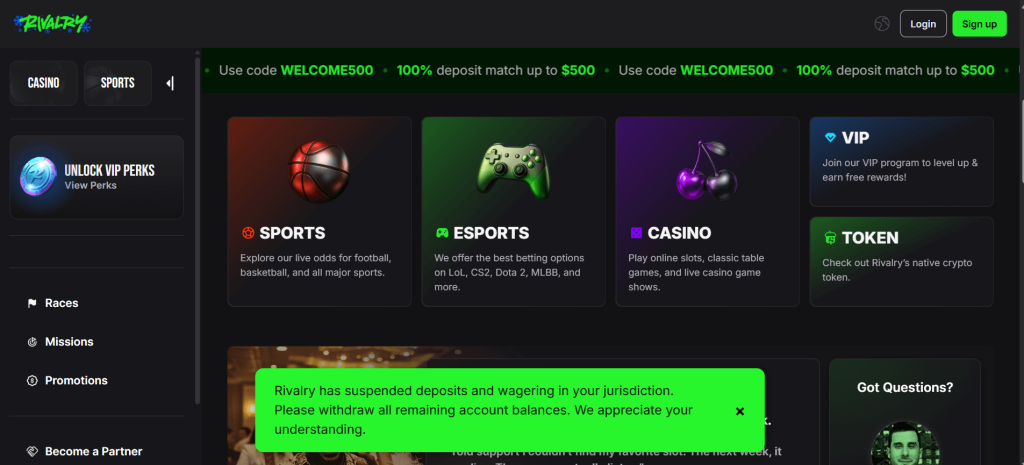
- Rivalry Corp’s board halted all player betting on its platform on 13 February 2026 and cut a significant portion of its workforce, while continuing to process player withdrawals.
- The Toronto-listed company is in talks with outside parties about a potential sale, merger, or restructuring of the business.
- The company has cautioned that no deal is guaranteed and that it may not continue operating in its current form.
Rivalry Corp., a Canadian company that lets people bet on esports and traditional sports, has shut down betting on its platform and laid off a substantial portion of its staff.
The move, announced on 13 February 2026, comes as the company’s board looks at all options for its future, including a possible sale or restructuring. Players can still log in to withdraw their funds.
What the company has announced
Rivalry’s board approved a major pullback in operations, pointing to what it called “recent performance volatility” as the reason. The company has not said exactly what went wrong in the weeks leading up to the announcement.
The company is assessing a range of potential alternatives, which may include asset-level transactions, corporate transactions, restructuring initiatives or other strategic outcomes. In plain terms, that means everything from selling off parts of the business to a full company sale or restructuring is on the table.
Rivalry confirmed it is already in conversations with outside parties about a potential deal. No details have been shared. Costs are being cut immediately, including through workforce reductions and lower operating spending.
The company was direct in its warning to investors and users alike. There can be no assurance that any strategic alternative will be completed or that operations will continue in their current form.
A turnaround that ran out of road
What makes this news jarring is how recently Rivalry appeared to be heading in the right direction. Throughout 2025, the company had been quietly rebuilding after a difficult period, posting improving numbers quarter after quarter.
According to the financial results, net revenue increased 19% sequentially to $1.93 million in Q3 2025, up from $1.6 million in Q2 2025 and $1.3 million in Q1 2025, representing 47% growth since the start of the year.
Costs were also being brought under control. Operating expenses declined 58% year-on-year to $3.52 million, down from $8.47 million in Q3 2024. Net loss improved 67% year-on-year to $1.96 million, compared to $5.89 million in Q3 2024.
The company’s regulated Ontario market had been growing quickly as a share of the overall business. According to company disclosures, Ontario had grown from representing under 20% of company net revenue to nearing 40% in Q3 2025.
At that time, CEO and co-founder Steven Salz had sounded confident just weeks before the collapse in activity.
“Player quality and monetization continue to reach new highs,” Salz said.
“The strategic shift we began last year continues to deliver. Our product is stronger, the funnel is smoother, and the economics per user are better than at any point in our history.”
In October 2025, the company had also completed a significant financial restructuring. This included $4.26 million in gross proceeds from a private placement, a settlement of $12.53 million in debt through the issuance of equity units, and an extension of remaining convertible debenture maturities to 2028.
Rivalry’s background
Rivalry Corp. wholly owns and operates Rivalry Limited, a sports betting and media company offering fully regulated online wagering on esports, traditional sports, and casino for the digital generation. Rivalry Limited has held an Isle of Man license since 2018 and also holds an internet gaming registration in Ontario.
The company has built its brand around younger, digitally native bettors and runs a global team across more than 20 countries. It trades on the TSX Venture Exchange under the ticker RVLY and on the OTC market as RVLCF.
This is not the first time Rivalry has faced serious difficulties. In 2025, the Ontario Securities Commission issued a management cease trade order against the company after it missed a deadline to file its annual financial statements for the year ended 31 December 2024. That order was lifted once the company met its filing obligations.
What happens next
For players, the immediate priority is withdrawing funds through the process Rivalry has put in place. For staff, the path ahead is uncertain. For investors, there is no timeline and no guarantee of any outcome.
The broader picture is one facing many smaller betting operators: building a loyal user base and improving efficiency is not always enough to survive in a market dominated by much larger, better-funded competitors.
Rivalry had made real progress on both fronts, but it was not enough to sustain the business in the long run. The company’s Isle of Man and Ontario licenses could still have value to a potential buyer looking for a regulated platform without the cost of building one from scratch.
Do you have a story worth sharing?
Send it over to our editors!