Baptiste Bachmann, 55 Tech: “Prediction markets open doors that sportsbooks simply can’t”

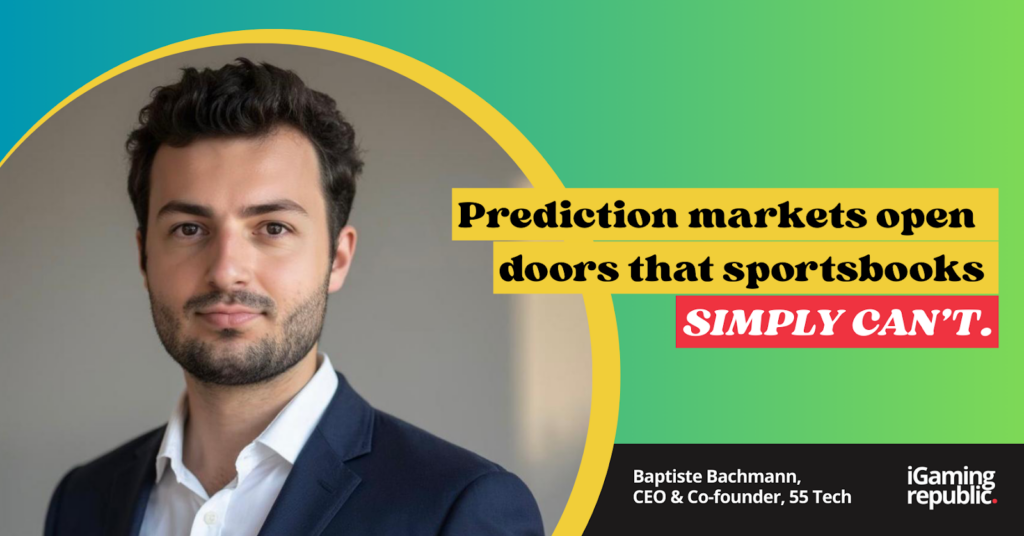
In an industry already divided between existing iGaming regulations and traditional sportsbook models on one hand, and the rise of prediction markets on the other, few people explain the differences between the two models better than Baptiste Bachmann.
Bachmann is the CEO of 55 Tech, a sports data provider, and has closely examined how both systems function and why their differences matter for everyday users, or players, depending on whom you ask.
This Q&A breaks down the divide between the two models.
- How do sportsbooks and prediction markets treat successful bettors?
- Who truly shapes the odds?
- How does liquidity work, and who benefits from it?
- And why are prediction markets creating opportunities that sportsbooks cannot match?
Bachmann walks through the incentives, the user experience, and the mechanics behind each system, revealing two worlds that may look similar from the outside but operate on completely different principles.
iGaming Republic: How would you describe the main differences in how sportsbooks and prediction markets treat bettors who are consistently successful, and what impact does that have on everyday users?
Baptiste Bachmann: Honestly, this is probably the clearest difference between the two models. Traditional sportsbooks are built around protecting their margin. The moment you start winning too often, you are flagged. Limits appear, bets get rejected, and eventually you get shown the door.
It’s almost a running joke in the industry: a skilled bettor doesn’t last long at a bookmaker.
Prediction markets take the opposite view. A winning trader doesn’t disturb the system: they improve it. They bring information, they help move the price where it should be, and that benefits everyone.
That’s why arbitragers are welcomed into prediction markets as well. For everyday users, it simply means the odds are more accurate and you’re not punished just for being good at what you do.
iGR: Big events can attract very large bets. How do sportsbooks and prediction markets each handle high-volume action, and what does that mean for fairness and risk on both sides?
BB: This is where the gap gets even bigger. On an exchange, seeing $1–2 million in liquidity on a single NFL line is becoming normal. If the liquidity is there, your stake goes through. No special treatment, no back-office approval.
Try placing that same amount on a sportsbook: you will need to be labeled a “VIP,” which usually means… a heavy losing customer. If you are a sharp bettor, you won’t even get close to those limits. If you get down $50 on the sportsbook, you would already be lucky.
Prediction markets don’t care who you are: they care about liquidity and information. That creates a far more level playing field, and far more transparency.
iGR: When news breaks — an injury, a lineup change, weather conditions — odds can shift quickly. How does that adjustment process differ between traditional sportsbooks and prediction markets, and how does it affect people placing bets?
In a prediction market, prices move instantly. If a major player pulls out during warm-ups, or the weather shifts unexpectedly, the market reacts within seconds because traders adjust in real time.
A sportsbook has a slower, more manual pipeline, often with several minutes of customer flow delay. That delay is precisely why sharp bettors exist: they exploit those slow moves.
For regular users, it means they often end up betting into outdated or protected odds on the sportsbook side, while prediction market users see the real probability almost immediately.
iGR: Beyond everyday betting, how do sportsbooks and prediction markets each fit into B2B scenarios, such as companies hedging against certain outcomes? Can you share real examples that show the contrast?
BB: This is an area where prediction markets open doors that sportsbooks simply can’t.
Take this example: a sports equipment brand has a bonus clause with a tennis player: if he wins a Grand Slam, the brand owes a major payout. If the player reaches the semifinals, the brand may want to hedge that exposure by taking a position on its win of the Grand Slam (if the odds are good).
Prediction markets allow them to take a position and reduce their risk. This is allowed as an exchange is the aggregation of market makers willing to trade tight with high sizings. A sportsbook can’t offer that.
They are built for B2C only, and they don’t price institutional hedging flow. Funny part, as a sportsbook, you might be interested to hedge yourself into prediction market platforms.
Prediction markets behave much more like financial instruments. That’s why they attract not only bettors, but also companies, funds, and market makers looking to manage risk efficiently.
iGR: When it comes to pricing accuracy, how do sportsbooks and prediction markets each approach forming their odds, and what challenges or vulnerabilities come with those models?
BB: Sportsbooks start with a model, add margin, and adjust based on customer flow, which often means shading the price away from the true probability. Protecting the book’s hold becomes a bigger priority than reflecting information accurately; the reason why they don’t accept any sharp flow.
Prediction markets rely on collective information. The price is shaped by people reacting to news, data, and sentiment in real-time.
Sharp action isn’t a threat: it’s the engine that keeps the market efficient. And because anyone can effectively be “the house”, it creates a completely different dynamic: users can take positions against others, provide liquidity, and experience the trading side of the market in a way a sportsbook simply doesn’t allow.
It’s genuinely more fun, you are not just placing bets, you are actively shaping the market.
Bookmakers are vulnerable to being slow and overly protected. Prediction platforms only face one challenge: liquidity, which does not seem to be an issue if you look at platforms such as Polymarket or Kalshi on US sports at least.
iGR: Fee structures vary widely across different platforms. How do sportsbooks and prediction markets each sustain their business models while setting those fees?
BB: Sportsbooks rely on high-margin odds: usually 5–15% built directly into the price. Most users don’t notice it, but it’s like paying a 10% fee every time you buy a stock. No one would accept that, yet it’s standard in betting.
Prediction markets flip this logic. Platforms like Polymarket or Novig charge zero commission (for now). They rely on tight pricing and liquidity. Lower fees attract sharper users, which improves the price, which brings even more volume: a virtuous cycle that books can’t replicate.
There is one important point: if takers constantly beat the market makers who provide liquidity, the system would stop working. Market makers do the heavy lifting, and exchanges need to maintain healthy relationships with them by supporting their trading journey so the ecosystem remains balanced.
iGR: Regulations differ across countries. How do the compliance requirements for sportsbooks and prediction markets compare, and how might this shape how each model grows globally?
BB: Sportsbooks operate within heavy, very established gambling frameworks. They face high licensing costs, strict local rules, and generally slow expansion.
Prediction markets are treated very differently depending on the region: some see them as financial products like in the US, others as betting, and some haven’t fully defined them yet.
Europe and Asia already have mature exchanges thanks to early actors like Betfair, which proves the model can scale once regulators understand how it works. That said, regulators often earn far more working with sportsbooks, so incentives do matter.
Sometimes you see decisions that show a real misunderstanding of the market. For example, when the French regulator caps return-to-player at 85%, the stated goal is to fight addiction, but the only thing it truly does is make players lose more. It doesn’t protect them; it just ensures the house wins more often.
About the author
Bianca Máthe
Bianca Máthe is Publisher of iGaming Republic. She spent close to a decade on the supplier side of iGaming, working across the sector's core verticals: platform and player-engagement technology and crypto payments. That mix gave her a working knowledge of how operators, suppliers and payment providers actually run. In 2025 she started a media project, bringing that operational grounding to her editorial work. Her output includes interviews with high-profile iGaming executives, original reports, and in-depth features covering licensing, M&A, and the operators and suppliers shaping the sector. Based in Malta, she spends much of her time getting closer to emerging sectors like prediction markets, tracking how they're developing before the rest of the industry catches up.
Do you have a story worth sharing?
Send it over to our editors!