Christine Virardi, HRLadderBox: The reality of iGaming hiring in 2026

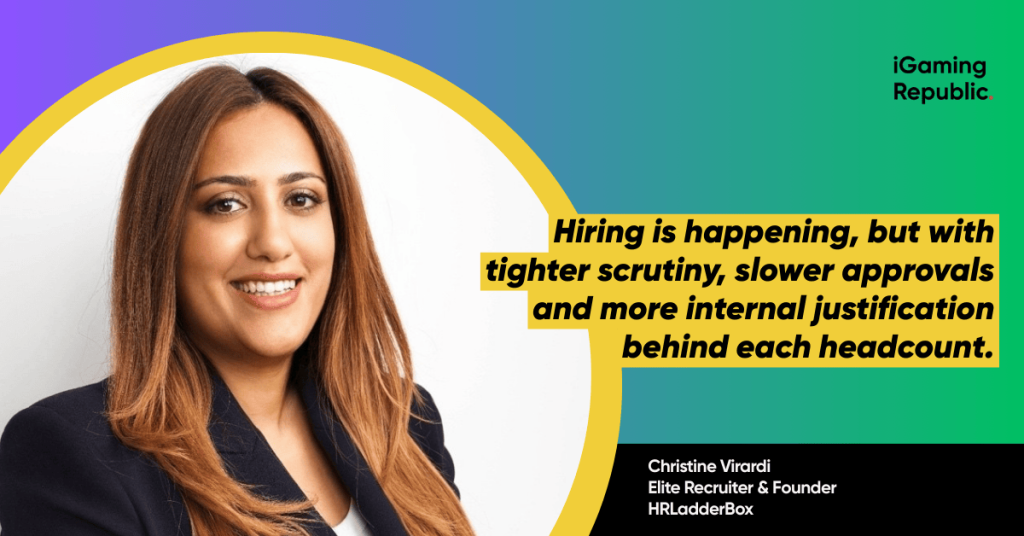
As the iGaming sector matures under tighter regulation, higher operating costs, and accelerating technological change, hiring has shifted from rapid expansion to calculated precision. Few people see that shift as clearly as Christine Virardi.
Founder of HRLadderBox and a leading recruiter in iGaming, Christine works directly with iGaming companies navigating leaner teams, stricter budgets, and new role requirements.
From AI’s impact on junior hiring to the recalibration of compensation and remote work, she has a clear view of how recruitment decisions are actually being made in 2026.
This Q&A breaks down the realities of iGaming hiring in 2026.
- How active is recruitment compared to the hypergrowth years?
- Is AI actually replacing entry-level positions?
- Are salary expectations aligned with what companies will pay?
- Has remote work disappeared from iGaming?
- And what strategies actually get candidates hired faster?
Let’s dive in!
iGaming Republic: From 0 (cold) to 10 (hot), how are hirings going in the industry right now? How does this look compared to previous years, and which specific areas of expertise are driving activity or stagnating?
Christine Virardi: Right now, I’d rate iGaming hiring at around 6/10. There is activity, roles are open and companies are moving but it doesn’t feel confident or aggressive. There’s caution in almost every decision.
Regulations shift, taxes rise, compliance pressure increases, and acquisition costs continue climbing. That level of uncertainty makes long-term workforce planning harder. So hiring is happening, but with tighter scrutiny, slower approvals, and more internal justification behind each headcount.
Compared to the hypergrowth years of 2020–2021, when many companies were scaling quickly and sometimes reactively, today feels far more disciplined. Growth is still on the agenda, but it’s measured. Companies want to expand, just with sharper focus and clearer ROI accountability.
In terms of expertise, compliance, regulatory, and risk roles are driving steady activity because regulatory pressure isn’t slowing down. Data, BI, CRM, and performance marketing also remain strong as operators focus on efficiency, retention, and smarter acquisition strategies. Product and tech hiring continues, but selectively prioritizing payments, platform stability, and optimization over expansion.
The areas that feel slower are more generalist or non-core functions, where the commercial or risk impact isn’t as immediate and therefore harder to justify in the current climate.
iGR: Is AI replacing entry-level jobs in iGaming? Are companies genuinely passing on qualified candidates who lack AI experience, or are they willing to hire strong performers and provide training? Where is the talent pool with both iGaming expertise and advanced AI skills actually coming from?
CV: AI isn’t taking away entry-level jobs in iGaming. It’s taking away the repetitive parts of them. Basic reporting, simple CRM sends, and first-line support can now be automated or heavily assisted. So when a company hires someone junior, they expect more than execution. They want someone who understands why they’re doing the work and how it affects revenue.
Most companies aren’t rejecting candidates just because they don’t have AI experience on their CV. They’re looking at mindset. If someone is curious, comfortable with data, and shows they’ve tried to learn new tools or improve processes on their own, they’re still very hireable. What doesn’t work anymore is being purely task-based and waiting for instructions.
As for where the iGaming + AI talent is coming from, it’s mostly being built inside the industry. CRM managers, BI analysts, and product people are teaching themselves automation and AI tools while doing their day jobs.
On top of that, data and tech professionals from fintech, e-commerce, and SaaS are moving into iGaming and learning the industry side. There isn’t a huge ready-made pool, it’s evolving in real time, which is why the market still feels tight.
iGR: Some industry salary surveys indicate single-digit percentage growth for 2025. How closely do actual offers align with these benchmarks? What discrepancies are you observing between candidate salary expectations and what employers are willing to authorize?
CV: Published 2025 compensation surveys indicate salary increase budgets in the 3–4% range across industries, and that broadly aligns with what I’m seeing in iGaming for hires at the same level and scope.
Most operators and suppliers are remaining disciplined on base salary and operating within approved compensation bands, particularly in more cost-conscious, EBITDA focused environments.
Where there is flexibility is in revenue-driving and specialist roles. In product, tech, data, and performance marketing, offers can stretch when there is genuine competition or urgency tied to growth objectives. Those situations are the exception rather than the rule.
The consistent negotiation dynamic I see is around expectations versus authorization. Candidates often ask for 10–15%+ increases when moving roles, but in the current market many offers are landing closer to mid-single digits on base unless the hire is scarce or commercially critical. That gap is typically bridged through compensation structure, bonus, commission, equity, or sign-on rather than significant expansion of base salary.
iGR: Has remote work died in iGaming? What is the general approach across key hubs like Malta, Gibraltar, or Cyprus? Are companies mandating office presence, or is flexibility still negotiable depending on seniority and role?
CV: Remote work has not died, but it’s no longer the standard it briefly became.
Across key hubs like Malta, Gibraltar, and Cyprus, most operators have settled into hybrid models, typically expecting two to three days in the office. Fully remote roles still exist, particularly in tech, but they’re fewer and often tied to niche expertise or strong commercial impact.
Flexibility today depends less on geography and more on seniority, skill scarcity, and the value a candidate brings. Remote arrangements can be negotiated, but they’re no longer automatically assumed.
iGR: What are the top pieces of advice you can give to people looking for an iGaming opportunity right now? What strategies and tools can get them hired faster in the current market?
CV: When people ask me for advice about getting into iGaming, I always say this: I don’t have all the answers, but I’ve seen what consistently works. The candidates who move fastest are the ones who take the time to understand how the industry actually operates. Even a basic grasp of how revenue is generated or how regulation impacts day-to-day decisions makes a noticeable difference in interviews and conversations.
I also encourage people to choose a clear direction instead of positioning themselves as everything at once. The market is competitive, and clarity creates confidence. Whether it’s CRM, analytics, compliance, product, or marketing, being specific about the problem you solve makes it easier for companies to understand where you fit.
Through my work, especially in doing executive hiring for iGaming companies, I’ve seen how much measurable impact matters. Being able to explain what changed because of your work, improved efficiency, stronger reporting, higher engagement, builds credibility quickly. Then visibility is another factor that’s often underestimated. Optimizing your LinkedIn profile with relevant keywords and clearly outlining your expertise makes it easier for recruiters to find you.
Finally, networking matters when it’s done genuinely. Reaching out thoughtfully, asking intelligent questions, and showing real interest in the industry goes much further than sending dozens of generic messages. The space may seem large, but it’s surprisingly well connected.
About Christine Virardi
With over a decade of HR leadership in tech and iGaming, Christine brings a personal touch to transforming corporate HR. Christine has partnered with startups and global organizations, aligning people strategies with business goals while navigating complex employee challenges.
She is also the Founder of HRLadderbox, a specialized firm supporting iGaming companies in securing senior and executive-level talent.
About the author
Bianca Máthe
Bianca Máthe is CEO and Publisher of iGaming Republic. She spent close to a decade on the supplier side of iGaming, working across the sector's core verticals: platform and player-engagement technology at EveryMatrix and Fast Track, and crypto payments at Payhound. That mix gave her a working knowledge of how operators, suppliers and payment providers actually run, from CRM and player engagement to licensing and settlement. She moved to the media side in 2025 to launch iGaming Republic, bringing that operational grounding to her editorial work. Her output includes interviews with high-profile iGaming executives, original reports, and in-depth features covering licensing, M&A, and the operators and suppliers shaping the sector. Based in Europe, she spends much of her time getting closer to emerging sectors like prediction markets, tracking how they're developing before the rest of the industry catches up.
Do you have a story worth sharing?
Send it over to our editors!