Atucha Advisory: “LATAM rewards those who take it seriously”

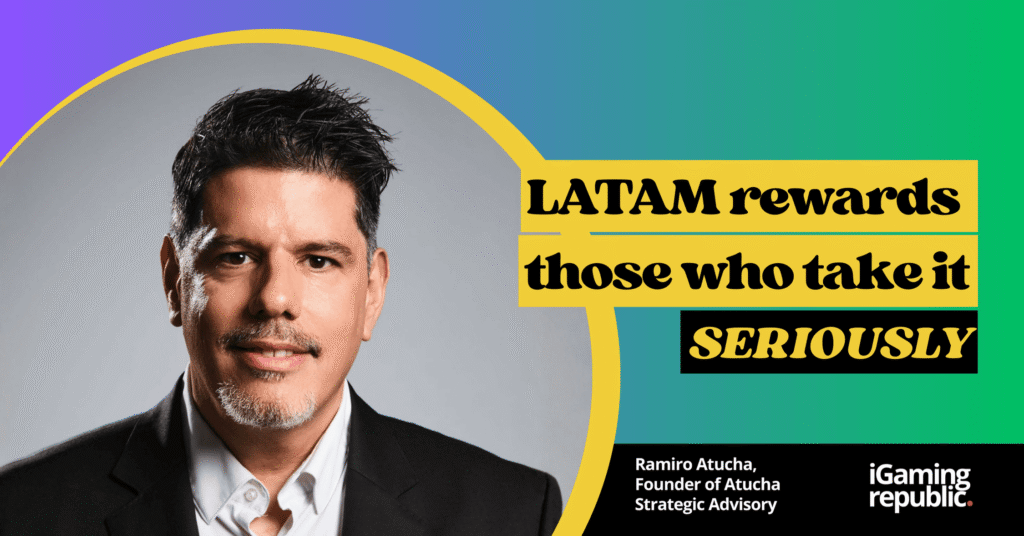
Latin America is often treated as a single opportunity, but for Ramiro Atucha, that assumption explains why many market entries fail.
After years of building and leading iGaming businesses across the region, he has seen how cultural, regulatory, and commercial realities vary widely, not only between countries, but within them. A clear view of those differences, he says, is the starting point for any serious LATAM strategy.
With the launch of Atucha Strategic Advisory, Atucha is focused on helping companies move beyond assumptions and take localisation seriously.
In this interview, he reflects on his time as CEO of Vibra Gaming and Leander, including how learning Portuguese during the pandemic became more than a personal achievement. It turned into a practical example of the mindset he expects operators to adopt when working in markets such as Brazil.
He also speaks openly about regulation, warning that instability, over taxation, and frequent rule changes are among the quickest ways to weaken regulated markets and push players toward the black market.
Drawing on examples from countries that have already faced these outcomes, Atucha argues that stable rules and balanced frameworks are essential for long term growth.
iGaming Republic: Having helped shape the early growth of iGaming in LATAM, what’s the biggest misconception about the region that you want to debunk through Atucha Strategic Advisory?
Ramiro Atucha: The biggest misconception about Latin America is the idea that it’s one single market.
It isn’t, and far from it. Each country has its own reality, and even within the same country, especially large ones like Brazil, Argentina, or Mexico, you find enormous differences between regions, cultures, behaviours, and regulatory dynamics.
A second misconception is believing you can enter LatAm with a purely European or U.S. mindset – platform, content, and no local presence – and expect it to work. That rarely works. Every market demands real commitment: a team on the ground, local partners, and active engagement with regulators, influencers, media, and the broader ecosystem.
Those two points alone explain why many strong international companies struggle on their first attempt. LatAm rewards those who take the market seriously.
iGR: From your CEO experience at Vibra Gaming and Leander, what’s one unexpected skill you picked up that genuinely changed the way you approach business today?
RA: Learning Portuguese. Argentinians and Brazilians usually manage to understand each other casually, but when Brazil became a key market for Vibra, I realised I had to do what I always preach: localise, adapt, and get closer to the audience.
During the pandemic, I took three classes per week with a Brazilian teacher, and the progress surprised me. I even ended up speaking on panels and moderating discussions entirely in Portuguese. It’s a skill I never expected to develop at this stage of my career, but I’m very glad I did. It improved my communication with Brazilian stakeholders, helped me understand the culture more deeply, and strengthened personal relationships across the market.
iGR: In your view, what’s the one “red line” in regulation that, if crossed, would unintentionally drive players straight into the black market?
RA: For me, the biggest red line is regulatory instability. Allowing operators to enter a licensing process, invest, plan, and build under one set of conditions – only to change the rules or tax structure shortly after, as we’re seeing in Brazil – is extremely damaging. Any business needs predictability. When the rules shift too quickly, regulated operators cannot compete fairly with the unregulated market.
Over-taxation is another red line. Excessive regulatory costs translate into worse value for players, pushing them offshore. And a very clear no-go is taxing players on their winnings. That drives black-market migration instantly.
Germany is a clear example: today, around 52% of its market operates outside the regulated system. For a country where people are culturally inclined to pay taxes and follow rules, that level suggests something went fundamentally wrong. Replicating actions that already failed elsewhere is never a good idea.
iGR: Given the patchwork of regulation across LATAM, how do you help clients balance new opportunities with long-term compliance?
RA: The key is understanding who the client is. What they can and cannot do. Where they’re competitive, and where they’re not.
A U.S. publicly listed company has a very different compliance posture than a privately backed operator. Their tolerance for regulatory ambiguity, their KYC expectations, and their approach to partnerships or M&A are fundamentally different. Their strategy for LatAm must reflect their structure, risk appetite, and internal governance.
So the first step is alignment: understanding the client deeply, then building a strategy that allows them to maximise opportunities without compromising their core markets, compliance frameworks, or long-term credibility.
iGR: When advising companies, how do you balance innovation with ensuring responsible gaming keeps pace, especially as AI shapes more of the player journey?
RA: Innovation and responsible gaming are not opposing forces. In fact, innovation should embed responsible gaming from the beginning. Compliance requirements, certification standards, and player protection should be part of the creative process not an afterthought.
We’ve seen this with crash games, new content providers, or influencer marketing. The issue was never the innovation itself; it was execution. Whether influencers acted responsibly, whether messaging was appropriate, whether safeguards were in place.
Innovation isn’t the enemy. Poor execution is. When responsible gaming is built into the design, both things advance together.
iGR: With Immensity.AI as your first client, how do you see AI reshaping business intelligence for operators in such a fast-moving LATAM market?
RA: I don’t see AI as something separate, it’s simply a tool that requires human criteria behind it. What excites me about Immensity isn’t “AI for the sake of AI,” but the fact that markets are becoming far more competitive and expensive. ROI is harder to achieve; competition, regulation and taxation have changed the cost structure.
Initially in Brazil, branding a football jersey was relatively inexpensive. When the market got more crowded, renewal costs skyrocketed because of increased demand. The same happens with Instagram, TikTok, and every advertising channel. Inefficiency is no longer affordable.
Immensity gives operators real visibility into ROI, attribution, and campaign performance, while using AI intelligently to monitor and recommend optimisations. In a market that moves this fast, that clarity is essential to stay competitive and maximise budgets and team resources.
iGR: As you launch Atucha Strategic Advisory, what core services are you focusing on, and what kind of client gets the most value from working with you?
RA: The ideal client is the one where I can genuinely add the most value. Those projects bring out my best energy and have the greatest impact.
This includes companies entering the gambling space for the first time, companies expanding from LatAm into Europe or the U.S., and international companies looking to enter LatAm. I’ve lived the challenges from both sides, so I can accelerate their learning curve and help them avoid some mistakes.
I also enjoy mentoring younger leaders, sharing both what I believe I did well and what I didn’t do so well. Being honest about failures creates valuable learnings and can save others a lot of headaches.
So the ideal client is one that benefits from that mix of strategic experience, cultural understanding, and practical guidance.
iGR: You’ve just announced multiplayer bingo and lottery technology provider End2End as your second client. How will you support them through 2026 and beyond?
RA: End2End is a fascinating company. It was built by professionals with more than 20 years of experience specifically in multiplayer bingo, creating highly successful products. What they’re building now is essentially the third iteration of their platform, refined through years of learning and evolution.
They’re a Latin American company ready to expand internationally, and one thing that truly differentiates them is their focus. Multiplayer bingo is a niche. Most companies offering it treat it as one of many verticals. End2End is fully dedicated to it, and that shows in product quality, investment, and team strength.
They’ve already been through certification and adaptation in multiple markets, and I believe they’re now ready to scale globally. My role is to help accelerate that growth throughout 2026 and beyond, bringing structure, strategic direction, and the right connections to expand their distribution.
About the author
Bianca Máthe
Bianca Máthe is Publisher of iGaming Republic. She spent close to a decade on the supplier side of iGaming, working across the sector's core verticals: platform and player-engagement technology and crypto payments. That mix gave her a working knowledge of how operators, suppliers and payment providers actually run. In 2025 she started a media project, bringing that operational grounding to her editorial work. Her output includes interviews with high-profile iGaming executives, original reports, and in-depth features covering licensing, M&A, and the operators and suppliers shaping the sector. Based in Malta, she spends much of her time getting closer to emerging sectors like prediction markets, tracking how they're developing before the rest of the industry catches up.
Do you have a story worth sharing?
Send it over to our editors!