Gareth Crook, Pragmatic Play: What the Grand National really tests in a sportsbook

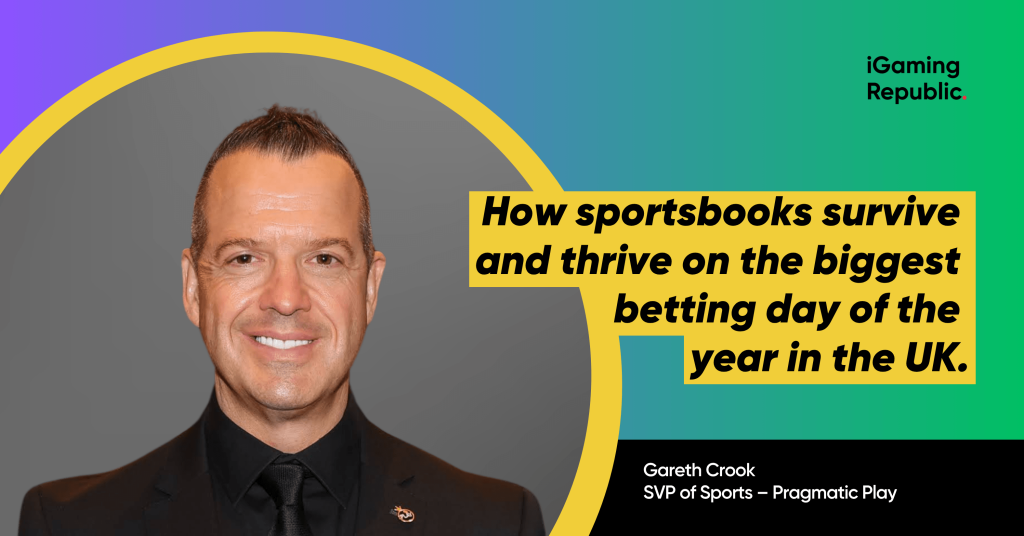
Gareth Crook, SVP of Sports at Pragmatic Play, draws on more than two decades of sportsbook experience to break down what operators must get right on the biggest betting day in the UK calendar.
The Grand National is not just a race. For UK sportsbooks, it is the single highest-pressure operational day of the year: a convergence of casual and core bettors, peak concurrent load, and post-race settlement demands that exposes every weakness in a platform simultaneously.
Gareth Crook, SVP of Sports at Pragmatic Play, has lived that pressure across every seat in the industry, from senior trading roles at William Hill and Coral through to sportsbook director at Ladbrokes Coral, and now as a platform provider.
With the 2026 Grand National two days away, this Q&A gets into what operators must prepare for and where they most often fall short.
- What makes the Grand National unlike any other event on the sportsbook calendar
- The three operational phases of race day, and where the real stress test sits
- What the customer data reveals about casual bettors and retention expectations
- The biggest risks operators face, and what mitigation actually looks like
- Whether personalisation has any role when simplicity and speed are everything
Let’s dive in!
iGaming Republic: The Grand National consistently drives some of the highest engagement in horse racing – what makes this event so unique from a sportsbook perspective compared to other major races?
Gareth Crook: From a sportsbook perspective, the Grand National is unique because it is arguably the single event in the UK calendar that drives the highest volume of active users into a sportsbook in a single day. It goes well beyond horse racing and becomes a national betting moment.
For operators, that means preparing across everything – marketing campaigns, front-end content positioning, and platform performance – because the audience is unlike anything seen at any other point in the year. The key difference is the crossover appeal. This is the one event where non-bettors feel comfortable having a go, often based on a horse name, a colour, or something they heard in the office five minutes earlier. Suddenly, everyone becomes a racing tipster!
There are comparable moments globally, such as the Super Bowl, the Kentucky Derby, or the Melbourne Cup, but very few events consistently pull in that level of casual participation.
From a personal perspective, it was always the one day in trading where the office felt different. Senior executives, board members, and half the business would suddenly appear on the floor, all wanting to see how things were going. That probably tells you everything you need to know about the scale of it.
“This is the one event where non-bettors feel comfortable having a go, often based on a horse name, a colour, or something they heard in the office five minutes earlier. Suddenly, everyone becomes a racing tipster!”
Gareth Crook, SVP of Sports at Pragmatic Play
iGR: How do sportsbooks like Pragmatic Play prepare technically and operationally for the sudden surge in traffic and betting activity during the Grand National?
GC: From a platform perspective, preparation for the Grand National is broadly the same, whether you are a provider supplying software like Pragmatic Play Sports or an operator on their own technology stack. I tend to think about it in three phases.
First, the build-up. From mid-morning through to race time, platforms need to handle a sustained increase in concurrent users and bet placement. This is where all your performance testing metrics such as bets per second and concurrent load are genuinely put to the test.
Second, the race itself. While the race only lasts around ten minutes, there is a brief lull in activity, but everyone in the business knows what is coming next.
The third phase is settlement, and in many ways this is the real stress test. The Grand National often includes extended place terms, meaning multiple outcomes must be settled simultaneously. This creates a surge in user activity as customers log in to check balances, review winnings, and initiate withdrawals. This puts pressure not just on trading platforms, but on payment and transactional infrastructure as well.
Operationally, it also means ensuring markets are configured correctly for each operator’s strategy, typically with enhanced place terms, and that support teams are fully staffed and ready to respond in real time. It is one of the few events where every part of the business is being tested at once.
iGR: What trends have you observed in customer behaviour during the Grand National – are casual bettors playing a bigger role compared to regular racing audiences?
GC: In truth, the trends around the Grand National have remained largely unchanged over time. It continues to be the single sporting event in the UK most capable of converting a non-betting audience into having a bet, whether that’s historically in retail or increasingly online.
If anything, the shift has been channel-based rather than behavioural. More of that Grand National activity now sits online, but the underlying customer profile looks very familiar. It drives the highest volume of unique actives and unique bets across the year for most UK operators.
Where it becomes interesting is when you look at the quality of that engagement. Core KPIs such as bets per customer and average spend are typically suppressed. That tells you the story quite clearly. This is a highly sporadic audience whose objective is simple: place a bet, watch the race, and if they win, withdraw.
From an operator perspective, the real acquisition and retention value still sits elsewhere, with events like Cheltenham or the domestic football calendar delivering more sustainable engagement over time.
“More of that Grand National activity now sits online, but the underlying customer profile looks very familiar. It drives the highest volume of unique actives and unique bets across the year for most UK operators.”
Gareth Crook, SVP of Sports at Pragmatic Play
iGR: With such intense, short-term demand, what are the biggest risks for operators (e.g. downtime, odds volatility, or fraud), and how can they mitigate them effectively?
GC: The biggest risk for operators during the Grand National is ultimately brand reputation, and that lives or dies on platform performance. Everything needs to be aligned, tested, and locked down well in advance. It is common to see code freezes deployed weeks before the event to avoid introducing any unnecessary risk.
The pressure points are well known. In the build-up, platforms are tested on concurrent users and bets per second. Post-race is where things can really be exposed. Settlement needs to happen at speed, often across tens or even hundreds of thousands of bets, while a surge of users log in simultaneously to check balances and withdraw.
Where operators fall short, the impact is immediate. If the site goes down, customers simply go elsewhere. If settlements are delayed, customer service teams are overwhelmed, and frustration quickly spills onto social channels. At that point, it is no longer a technical issue; it is a reputational one.
Mitigation is straightforward in principle but difficult in execution: prepare early, test thoroughly, and ensure every part of the platform is ready for peak demand.
iGR: How important is personalisation during high-traffic events like the Grand National, and are sportsbooks doing enough to tailor offers and content to different types of bettors?
GC: Truth be told, personalisation is less relevant during an event like the Grand National than it is across the rest of the sportsbook calendar. This is one of the few occasions where both betting and non-betting audiences converge, and the objective becomes very simple: make the race impossible to miss and incredibly easy to bet on.
From a site layout perspective, this is not the time for complexity. The Grand National should dominate the homepage, often at the expense of standard modules such as in-play content, to ensure users can find the race instantly, navigate to their selection, and place a bet in as few clicks as possible. On a day like this, simplicity and speed matter far more than tailored journeys.
“On a day like this, simplicity and speed matter far more than tailored journeys.”
Gareth Crook, SVP of Sports at Pragmatic Play
The same logic applies to promotions. The event largely sells itself, so competitiveness on each-way terms is often more important than layered promotional strategies. Personalisation has a clear role elsewhere, particularly in driving engagement during core betting periods, but for the Grand National, the priority is visibility, accessibility, and execution at scale.
About the author
Bianca Máthe
Bianca Máthe is Publisher of iGaming Republic. She spent close to a decade on the supplier side of iGaming, working across the sector's core verticals: platform and player-engagement technology and crypto payments. That mix gave her a working knowledge of how operators, suppliers and payment providers actually run. In 2025 she started a media project, bringing that operational grounding to her editorial work. Her output includes interviews with high-profile iGaming executives, original reports, and in-depth features covering licensing, M&A, and the operators and suppliers shaping the sector. Based in Malta, she spends much of her time getting closer to emerging sectors like prediction markets, tracking how they're developing before the rest of the industry catches up.
Do you have a story worth sharing?
Send it over to our editors!