SOFTSWISS x Marketing Decoded: positioning statements, brand evolution, and why retention is harder than growth

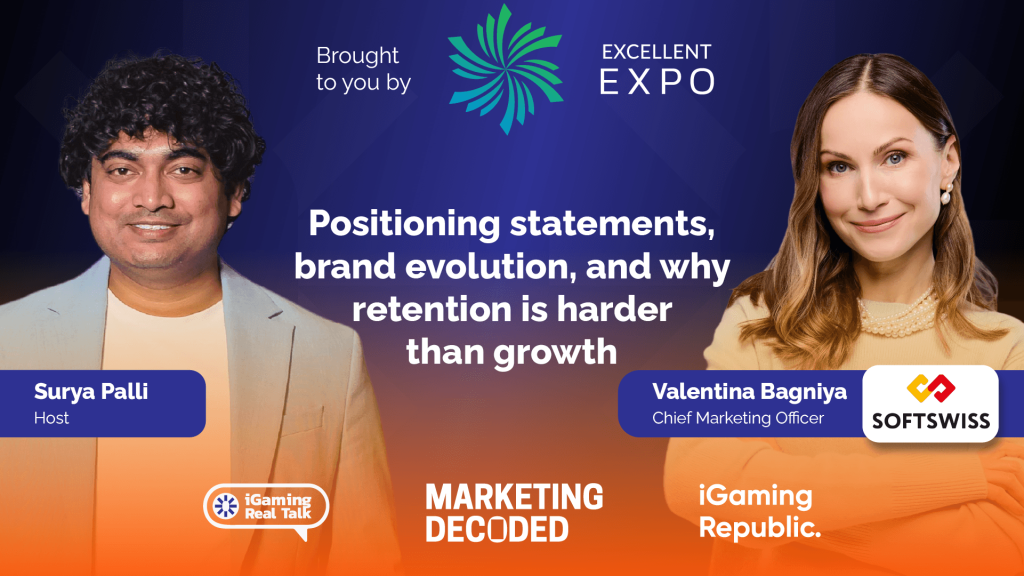
- Marketing Decoded debuts at ICE Barcelona 2026, featuring seven CMOs and marketing leaders from major B2B iGaming providers.
- In this episode, Valentina Bagniya, CMO at SOFTSWISS, discusses why marketers fail to convince C-suite leadership, how positioning drives brand strategy, and why brand has become the last growth lever in a maturing industry.
- Series presented by Excellent Expo, produced by iGaming Real Talk and iGaming Republic, focusing on actionable marketing insights.
A new interview series spotlighting iGaming’s marketing leaders has launched from ICE Barcelona 2026. Marketing Decoded brings together seven Chief Marketing Officers and heads of marketing from leading B2B providers to share the strategies behind their brands’ success.
This episode features Valentina Bagniya, CMO at SOFTSWISS, who reveals why positioning statements matter more than campaigns, how the company is evolving its brand in the shifting industry landscape, why retention is harder than growth, and why brand equity ultimately becomes the deciding factor.
SOFTSWISS is an international technology provider delivering comprehensive iGaming solutions, including the Casino Platform, the Sportsbook, the Game Aggregator for operators across regulated and emerging markets. Founded in 2009, the company is recognised for its technical excellence, reliability, and a structured, data-driven approach to marketing and product development.
Valentina brings experience from outside iGaming, having worked in FMCG before joining SOFTSWISS. This external perspective shaped her approach to positioning and brand strategy in an industry still learning how to build long-term brand equity.
Why marketers fail to convince C-suite leadership
The conversation opened with a direct question about SOFTSWISS’s marketing strategy. Valentina did not lead with campaigns or channels. She led with positioning.
“I’m absolutely sure that marketers sometimes make mistakes that don’t help them to convince the C-level board of the importance of marketing, because they make a lot of promises, but they forget about delivering commercial value. They do a lot of campaigns, but they don’t connect the dots yet.”
The gap between marketing activity and commercial results is a familiar frustration in B2B. Marketers launch campaigns, produce content, and attend events, but struggle to articulate how those efforts translate into revenue, retention, or market positioning.
Valentina’s answer was clear: start with positioning, not tactics.
“You have to think about your positioning. You have to understand how you’re going to stand out, and only after, based on that and your positioning statement, you have to build your marketing strategy and your brand strategy.”
A positioning statement is not a tagline. It is a foundational document that defines the brand, its audience, and its differentiation in clear, functional terms. Without it, marketing becomes reactive rather than strategic.
Brand evolution and the shift toward regulated markets
SOFTSWISS has been in the market since 2009. Valentina acknowledged that the company is evolving, both in maturity and in target audience.
“The thing we are working on is developing our updated brand positioning. SOFTSWISS is moving forward. We are getting more and more mature. We are getting more international and bigger. And of course this calls us to make some changes.”
The shift is strategic. SOFTSWISS is refining its positioning to better resonate with more mature, long-term market players, who require a different tone, visual language, and level of technical credibility than emerging markets.
“What we are planning to do based on our strategy for 2026 is to become more relevant for regulated markets, for our partners.”
The company’s ICE Barcelona 2026 stand reflected this evolution. The booth design was more technical, more minimal, and whiter than in previous years. Valentina confirmed this was intentional.
“This expo is our first step for this year’s change. We built this new booth. This is absolutely different from what we had before. It’s more technical, more mature. Because first of all, SOFTSWISS is about technology for iGaming.”
Three trends defining B2B iGaming marketing in 2026
Valentina outlined three trends she sees shaping the industry: regulation, AI, and brand.
“Regulation now is a part of strategy. If your business cannot survive in tighter rules, this is your way to lose the market, to lose your business.”
Regulation is no longer a constraint to navigate. It is a strategic advantage for companies that can operate effectively within it.
On the AI front, Valentina notes that AI can work as infrastructure, not experimentation. The companies that integrate AI quietly as infrastructure rather than promoting it as innovation are the ones moving forward.
“AI itself is not interesting right now, but the way how it is executed is what’s interesting. If you continue to experiment with AI now, it means that you are behind. You should already make AI a part of your business infrastructure.”
In a saturated market, product differentiation narrows. Technology becomes table stakes. Brand becomes the deciding factor in client retention and acquisition. SOFTSWISS recognises this shift and is adjusting accordingly.
“As our industry is getting mature, brand is one of the last levers that help you to survive and to grow your business.”
Retention is harder than growth
The interview closed with a rapid-fire round. When asked to choose between growth and retention, Valentina paused.
“It’s difficult. It’s tricky. I’d say both are important.. But retention is much harder than growth.”
Growth attracts attention. Retention requires discipline. In B2B iGaming, where switching costs are high but client expectations are relentless, retention is the metric that defines long-term success.
“You stay with a company because of the brand. Even if the service is going down. Because this brand emotionally is very close. It doesn’t matter whether it’s B2B or B2C. It works like that.”
This is the core of brand equity. A strong brand buys goodwill during service failures, delays, or competitive pressure. It creates emotional attachment in a sector that prizes technical performance. SOFTSWISS is building for that resilience.
Book recommendation: How Brands Grow by Byron Sharp
When asked for a book recommendation, Valentina did not hesitate.
“I would recommend How Brands Grow by Byron Sharp. I think this is the book every marketer should read. It was written more than ten years ago, but it really describes how marketing works.”
Byron Sharp’s work challenges conventional marketing wisdom, particularly around loyalty, targeting, and brand differentiation. For a company like SOFTSWISS, which is rethinking its positioning and audience, Sharp’s framework offers a rigorous alternative to intuition-driven branding.
Marketing Decoded is presented by Excellent Expo and produced by iGaming Real Talk in collaboration with iGaming Republic. The complete series features six additional episodes with marketing leaders from: Elen Atanesyan (18Peaches), Märit von Stedingk (Alea), Yaroslava Romaniv (GR8 Tech), James Bennett (EveryMatrix), Tereza Melicharkova (Elantil), and Irina Veselkova (Endorphina).
About the author
Bianca Máthe
Bianca Máthe is Publisher of iGaming Republic. She spent close to a decade on the supplier side of iGaming, working across the sector's core verticals: platform and player-engagement technology and crypto payments. That mix gave her a working knowledge of how operators, suppliers and payment providers actually run. In 2025 she started a media project, bringing that operational grounding to her editorial work. Her output includes interviews with high-profile iGaming executives, original reports, and in-depth features covering licensing, M&A, and the operators and suppliers shaping the sector. Based in Malta, she spends much of her time getting closer to emerging sectors like prediction markets, tracking how they're developing before the rest of the industry catches up.
Do you have a story worth sharing?
Send it over to our editors!