How Orange Synapse is turning game distribution into a scalable system


The iGaming industry knows how to build games.
Studios ship titles at pace, development pipelines run tight, and technology stacks grow more sophisticated every year. What the industry has been slower to figure out is what happens after a game is built. The operational layer between a finished title and its appearance on an operator’s lobby still runs largely on email threads, file-sharing links, and spreadsheets.
Orange Synapse, whose founders built their reputation working alongside studios including Pragmatic Play and Aspire Global, set out to close that gap with Velox Synapse. The platform centralizes game assets, compliance documentation, and partner access management for studios and their operator networks, replacing fragmented workflows with a single distribution system.
“A single game launch can involve dozens, sometimes hundreds, of operators, and each of those operators requires a range of materials: banners, icons, lobby images, promotional visuals, certificates, compliance documentation, roadmaps, and product information,” says Roxana Nazalu, Co-Founder and Marketing Director at Orange Synapse.
The ambition goes beyond better file sharing. Velox treats game distribution as a discipline in its own right: asset management, compliance tracking, brand architecture, and audience segmentation under one operational framework.
A portfolio of products, managed like an afterthought
Every title in a studio’s portfolio is essentially its own product. A studio managing 100 or more games across 20-plus regulated markets and distributing to hundreds of operators is running what amounts to a house of brands.
“Each game is essentially its own product, even if studios don’t always have the bandwidth to build a full visual identity for every single title,” Nazalu explains. “Ideally, games should exist within a structured visual and UX framework, a house of brands that sits under the studio’s overarching identity.”
That ideal rarely survives contact with the market. Operators adapt assets to fit their own brand environments, and when the organizational layer is missing, the studio’s marketing and account management teams become the organizational layer.
The problem compounds over time: older versions of promotional materials resurface months or years later, pulled from local folders rather than the current source. Across hundreds of titles, version control alone becomes a serious risk to brand consistency and compliance.
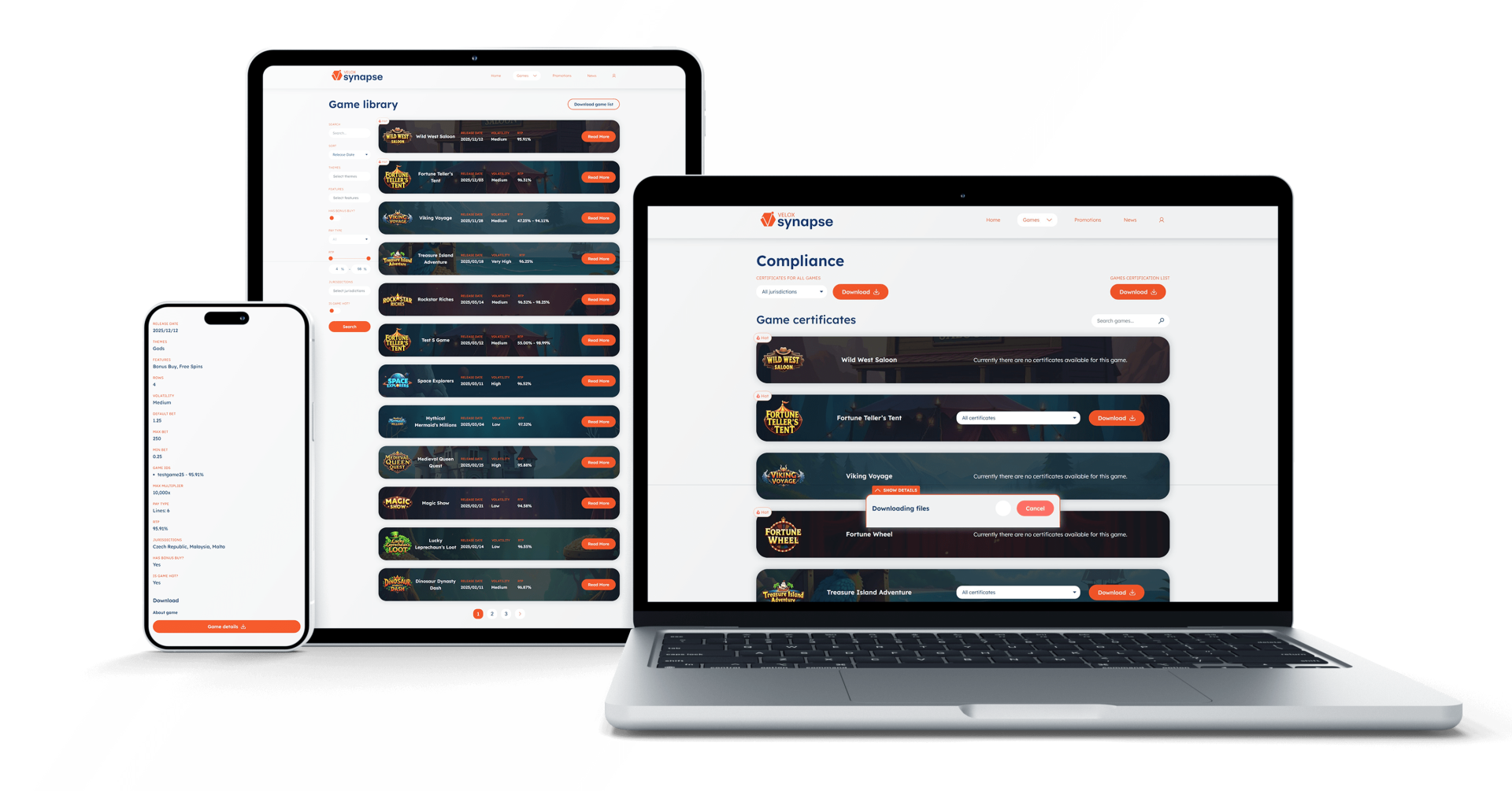
Velox addresses this by treating each game as a distinct product entity. Visual assets are categorized by size, format, and type. Studios can filter their portfolio by jurisdiction, language, currency, exposure level, and game mechanics. Every game gets the structural treatment of a standalone product without proportional headcount to maintain it.
The compliance burden that never ends
Brand and asset management is an organizational challenge. Compliance is an existential one. An outdated banner is cosmetic. An expired certificate can shut a game out of an entire market.
“If a certificate is outdated or missing, the consequences are far more serious,” Nazalu says. “It can prevent a game from being used entirely, leading to lost revenue for both studios and operators. In more severe cases, it can even result in regulatory penalties and reputational damage.”
Compliance is not a launch-day checkbox. It is a rolling obligation. Certificates carry start and expiration dates. Germany caps maximum bets, Greece enforces its own constraints. Regulators from the MGA to individual US state commissions update frameworks on their own timelines. What was compliant six months ago may not be today.
Velox treats compliance as a continuous operational discipline, tracking certification documentation with expiration timelines, reminders, and alerts.
“An expired certificate might be overlooked because someone is on vacation or because the information is scattered across multiple systems,” Nazalu adds.
The difference between a structured compliance workflow and a scattered one determines whether a studio can expand with control or accumulates risk with every new market.
The operator side of the equation
Game distribution is usually framed as a studio-side problem. But operators feel the weight too. They sometimes delay going live with new content not because they lack interest, but because onboarding is heavy enough to deprioritize. The bottleneck is often operational capacity rather than demand.
“From the casino’s perspective, new content often translates into additional workload,” Nazalu observes.
“Every launch requires coordination, asset preparation, internal approval, and compliance checks. Our goal is to reduce that friction so that new game launches feel effortless for operators rather than something they delay because of operational complexity.”
Some operators cannot use Dropbox or SharePoint due to internal IT policies or security audits. A delivery method that works for one partner can be inaccessible to another.
Velox addresses this from the operator side: when a casino team can access a single platform where assets, certificates, and product information are already organized, the barrier to going live drops substantially.
“If a casino can go live with a game even a week earlier, that directly impacts the bottom line,” Nazalu notes.
Beyond operators: the new distribution map
Game distribution used to follow a simple path: studios to operators, operators to players. That path has branched. Affiliate networks run cross-market campaigns requiring tailored promotional kits.
Streamers build content around exclusive access or themed launch events. Each partner needs different materials, governed by different market restrictions.
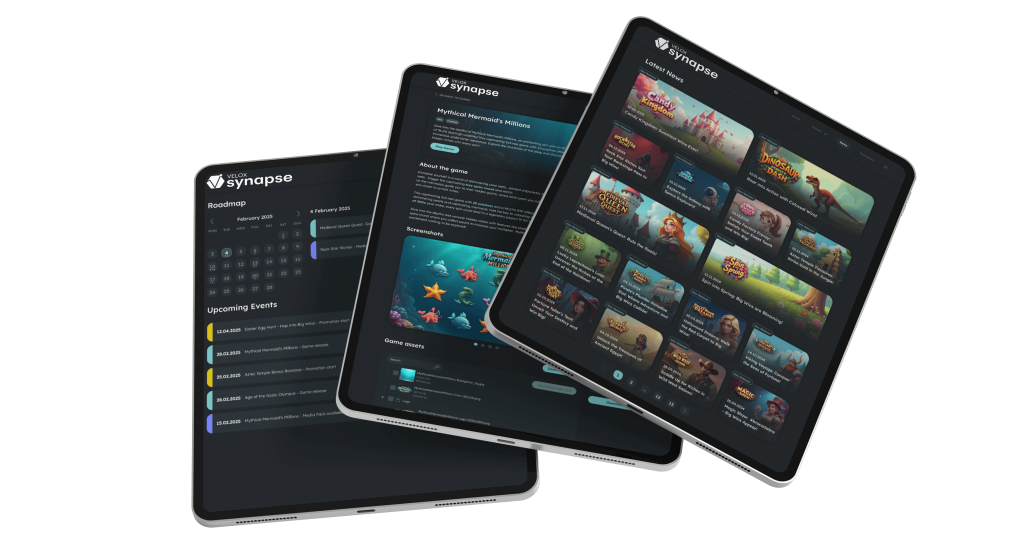
“Distribution is no longer limited to operators alone,” says Nazalu. “Studios need the ability to segment access to specific audiences, allowing affiliates and streamers to access promotional materials and game information relevant to their campaigns. Content can also be segmented by market, ensuring that creators only see the assets and information appropriate for their jurisdiction.”
Velox handles this through built-in segmentation tools. Affiliate partners see what is relevant to them. Operator materials stay restricted. Promotions can target individual partners or groups.
Two studios, two problems, one platform
Consider a startup with five games and ten operator partners. Every hour spent coordinating asset delivery is an hour diverted from growth.
“Even with a smaller number of partners, early-stage studios face significant challenges establishing workflows, building credibility, and expanding distribution,” Nazalu explains.
Now consider an established studio with 200 titles across 50 operator relationships spanning 20 jurisdictions. Onboarding a new partner means delivering the entire portfolio in one go. Without a structured platform, that process can take weeks of manual coordination.
“Without a structured workflow, scaling becomes chaotic,” Nazalu says. “Studios end up hiring more people simply to answer emails, manually send files, verify documentation, and manage countless versions of the same asset.”
Velox lets studios grow their portfolio and partner network without growing headcount at the same rate. Account managers and marketing teams can redirect their time toward commercial and strategic work.
Localization is becoming a brand problem, not just a language one
As studios push into diverse global markets, they are encountering a challenge at the intersection of brand strategy and cultural adaptation.
“Different regions have distinct visual preferences and player expectations,” Nazalu observes. “The aesthetic that resonates in Latin America may differ significantly from what works in Europe, North America, Asia, or emerging African markets.”
This is brand localization: adapting a studio’s visual identity and market positioning across culturally distinct environments while maintaining coherence under the parent brand. Velox enables this through segmented asset management and partner access controls, allowing studios to maintain region-specific brand ecosystems within a single platform.
Orange Synapse sees distribution platforms becoming standard infrastructure, much the way PAM systems and game aggregators became table stakes in earlier phases of the industry.
“Our goal is to ensure Velox evolves alongside these industry changes,” Nazalu says, “enabling studios to scale globally while maintaining control over compliance, brand identity, and promotional distribution.”
iGaming has professionalized nearly every layer of its value chain. The space between a finished game and a live operator lobby is one of the last to receive that treatment.
As regulatory complexity deepens and global expansion accelerates, distribution infrastructure is no longer optional for studios that intend to scale. It is the foundation that everything else depends on.
About the author
Bianca Máthe
Bianca Máthe is Publisher of iGaming Republic. She spent close to a decade on the supplier side of iGaming, working across the sector's core verticals: platform and player-engagement technology and crypto payments. That mix gave her a working knowledge of how operators, suppliers and payment providers actually run. In 2025 she started a media project, bringing that operational grounding to her editorial work. Her output includes interviews with high-profile iGaming executives, original reports, and in-depth features covering licensing, M&A, and the operators and suppliers shaping the sector. Based in Malta, she spends much of her time getting closer to emerging sectors like prediction markets, tracking how they're developing before the rest of the industry catches up.
Do you have a story worth sharing?
Send it over to our editors!