Google blocks prediction market ads in Connecticut
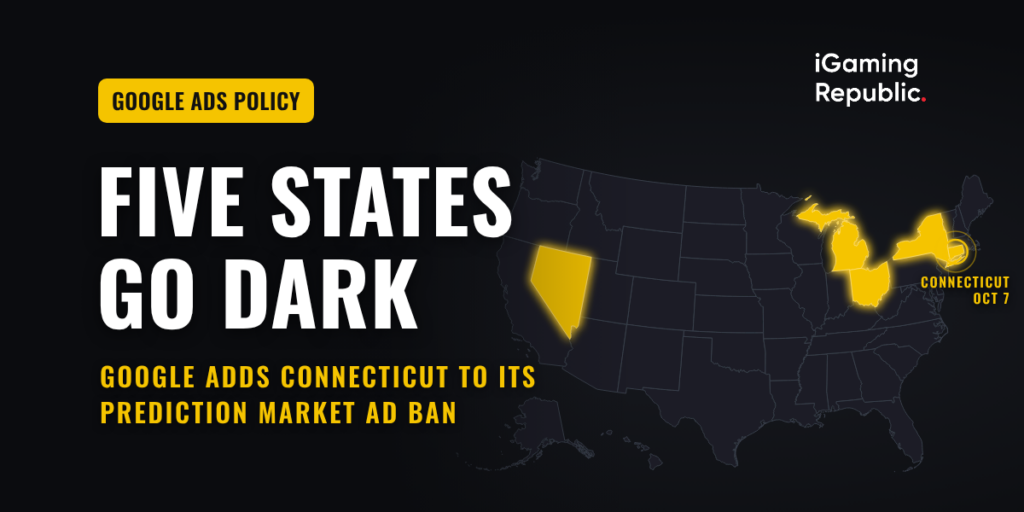
- Google bars prediction market ads in Connecticut from October 7, joining Michigan, Nevada, New York and Ohio.
- Only certified CFTC-regulated exchanges and NFA-authorized brokers can advertise in the remaining states.
- Michigan wants Kalshi held in contempt over ads that allegedly kept reaching residents after a court ban.
Google has banned prediction market advertising aimed at Connecticut, effective October 7, with no transition period.
Connecticut is the fifth US state on Google’s exclusion list, and all five have taken legal or regulatory action against prediction market operators.
How the list grew
Google published its prediction markets policy on January 5 and began accepting ads on January 21. Nevada was excluded from the start.
Google’s change log shows how the rest followed:
- Ohio: June 2
- Michigan and New York: July 13
- Connecticut: October 7
The Connecticut update gives no reason for the decision, and neither did the earlier ones. The main policy page now lists all five states as excluded from US targeting.
Google explains its caution with reference to the “inherent complexities, speculative nature, and unique regulatory classification” of these contracts. That reasoning sets a high bar for entry.
Only two types of advertiser can qualify:
- a designated contract market (DCM) authorized by the Commodity Futures Trading Commission (CFTC), where listing exchange-listed event contracts is the main business.
- a brokerage authorized by the National Futures Association to give customers access to a qualifying DCM.
Meeting those criteria only makes an operator eligible to apply. Advertisers must hold all applicable local financial, commodity and/or gaming licenses. They must also be certified by Google, with a separate application for every location they plan to target.
Search Engine Roundtable reported on October 14 that Google had moved these rules into its main Ads policies document the previous week.
The policy also lists what Google rejects outright:
- binary options and fixed-return contracts
- markets on games of chance or lotteries
- affiliate sites and broker reviews that publish trading signals
Gambling affiliates were already dealing with tighter certification rules on Google’s casino and sportsbook side.
Where the money goes
For the largest operators, paid search is one line in a much bigger budget. Ad spending by prediction markets and the major sportsbooks rose 21% year on year in the first seven months of 2026, according to Nielsen research provided to Axios.
Much of that has gone on celebrity deals. Polymarket has signed LeBron James, Derek Jeter and Eli Manning, and has run ads with Spike Lee and Alexandra Daddario. Kalshi brought in Giannis Antetokounmpo and has featured Timothée Chalamet in its campaigns.
Novig chose a riskier route. Its September campaign with actress Sydney Sweeney put a little-known brand in the headlines, and drew a backlash over how racy the ads were. Novig was also among the 10 platforms told by Ohio’s casino regulator this month to stop offering sports contracts.
The established sportsbooks are spending behind their own prediction products. DraftKings flooded California with ads for its Predictions platform ahead of the NFL season, and the campaign brought a new lawsuit with it.
Market share explains why. Traditional sportsbooks took an estimated 76% of legal US sports wagering in 2023, according to Sensor Tower research cited by Axios. By the first half of 2026, their share had fallen to 64%. Prediction markets rose from 1% to 16% over the same period.
Most Americans have still not tried the product. A S&P Global Market Intelligence consumer survey found that 44% of respondents had never heard of prediction markets.
Another 42% knew the operators but had not used them, which S&P linked partly to advertising during live sports. Among people who had traded, 70% had traded on sports outcomes.
Ads as evidence
State regulators now treat marketing as part of their case against operators.
On September 10, Connecticut’s governor announced that the Department of Consumer Protection had issued cease-and-desist orders to nine platforms:
- Polymarket
- Coinbase
- Crypto.com
- Robinhood
- ProphetX
- Novig
- Webull
- Gemini
- Underdog Predict
According to the governor’s office, the orders cover sports event contracts and any other form of unlicensed online gambling. Each platform must stop advertising, offering, promoting or otherwise making those products available, and must let Connecticut residents withdraw their funds.
Kalshi was left off the list because the state is already suing it separately and seeking an injunction.
The subpoenas were aimed at the businesses that keep these platforms running. They went to three groups:
- nine licensed gaming service providers, including PayPal, Sportradar and Genius Sports
- 15 media organizations, including ESPN and NBC Connecticut
- app stores and unlicensed payment processors: the Apple App Store, Google Play, Apple Pay, Google Wallet and Stripe
None of the subpoena recipients is under investigation, the state said.
Elsewhere, Michigan’s dispute with Kalshi turns on marketing. A September 1 preliminary injunction does three things:
- bars Kalshi from offering sports contracts to anyone located in the state
- restricts marketing those products to Michigan residents
- requires a third-party geolocation service
Breaches can cost $500,000 a day.
Michigan now alleges that Kalshi’s sports promotional emails and targeted ads kept reaching residents after the order. It has asked Ingham County Circuit Judge Rosemarie Aquilina to hold the company in civil contempt.
The Michigan hearing will test whether a court is prepared to punish an operator for how it markets, not only for what it sells.
Federal regulators have also looked at how these platforms promote themselves. The CFTC has been investigating Polymarket over alleged fake influencer content.
Google’s rule is narrower than any of these actions. It applies to Google Ads targeting only. Prediction market sites still appear in Google Search, and whether residents can trade still depends on court orders and each platform’s geofencing.
Google has published no criteria for adding a state, so operators get no advance warning. Underdog alone is suing seven states over sports contracts.
Do you have a story worth sharing?
Send it over to our editors!