Former ONJN chief fights to save €5m programme in Romania

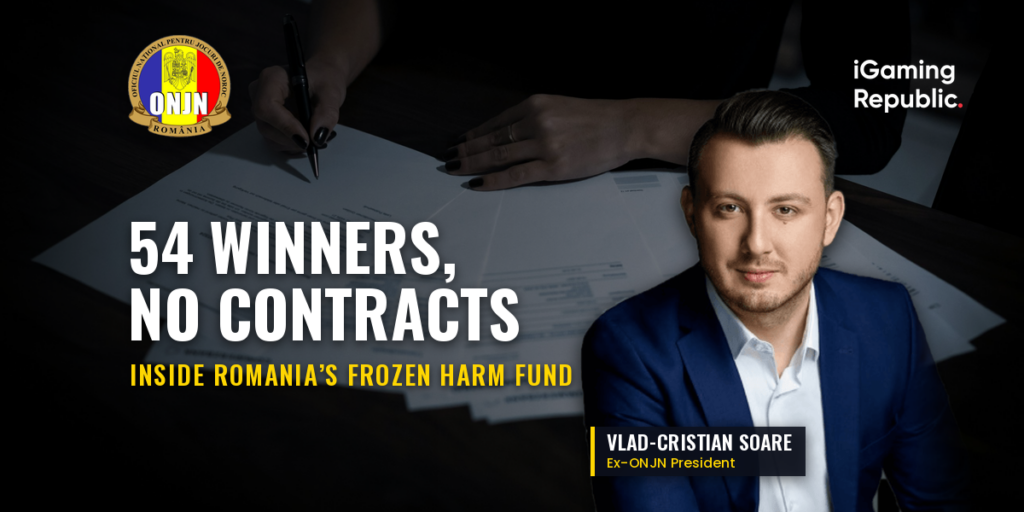
- Romania’s former regulator chief Vlad-Cristian Soare expects a review to kill his €5m harm-prevention programme.
- The regulator’s new leadership suspended the grants on 2 October over budget and legal concerns.
- Soare says 54 projects were selected in July and none has been contracted.
A €5m programme meant to fund gambling addiction prevention in Romania has stalled, and the man who created it says the regulator’s new leadership wants it cancelled.
Vlad-Cristian Soare, who ran Romania’s National Gambling Office (ONJN) until August, made the claim in an interview with Adevărul published on 15 October.
ONJN licenses and supervises gambling operators in Romania. It also collects revenue from the industry, part of which is set aside for responsible gambling work.
The programme, “Conștient și Liber” (Aware and Free), was ONJN’s first dedicated attempt to spend that money on prevention and treatment projects. Winners were chosen in July. According to Soare, not one has received a contract.
How the fund worked
ONJN announced the call on 17 April, with a total budget of RON 25,410,500, about €5m. The money came from the regulator’s own revenues, not from new taxes on operators.
Soare told Adevărul the regulator holds roughly €30m for this type of funding. He kept the first round smaller on purpose, because it was a test run.
The money was split into three pots:
- up to €300,000 for public authorities building treatment centres
- up to €100,000 for prevention and education projects
- up to €200,000 for research
Applicants had to cover 10% of costs themselves.
Strong demand, then a stop
Interest was high. Soare said 199 applications came in between 20 April and 11 May, and 180 passed the eligibility checks.
On 28 July, ONJN published the final results. According to Soare, 46 projects won full funding and eight won partial funding. Another 107 qualified but missed out because the money ran out.
Contracts were due to be signed between 29 and 31 July. That never happened. Soare said ONJN’s own responsible gambling team confirmed in September that no contract had been signed.
Why the money is frozen
In August, the government replaced Soare (more on that below). On 2 October, the new leadership at ONJN put the programme on hold.
It said there were problems with how the programme was budgeted. It also questioned whether the law allowed ONJN to spend its own revenues this way. A working group was set up to review everything, from the legal basis to how winners were picked.
Soare disputes this. He said the money was included in Romania’s 2026 State Budget Law. He added that the Ministry of Finance sent a letter in April 2026 allocating RON 26,017,000 to the programme.
A paperwork problem
In Soare’s telling, the real issue was technical. The money was approved, but ONJN’s budget lacked the specific spending code needed to sign contracts and pay grantees.
He said a fix agreed with the Ministry of Finance was added to a draft government package of budget measures. It was later removed, and Parliament did not pass it as an amendment either.
Soare wants to know who dropped the fix and why. He was careful not to claim political interference. He said only that people deserve an explanation when an official solution disappears and social projects lose out as a result.
Who is doing the review
Soare’s biggest objection is to the review itself. He said the working group sits outside the ONJN department that ran the programme.
He also alleged that its members include staff whose contracts he declined to renew, referred for disciplinary action or criticised for poor performance.
Vlad-Cristian Soare, former president of ONJN, said:
“Therefore, I expect the report to be a negative one, ostensibly citing dysfunctions, but in reality aimed at cancelling the procedure.”
How winners were chosen
Soare argues the programme was built to be fair. When ONJN staff said the law did not allow this kind of funding, he asked the Legislative Council, the body that advises on legal drafting, for an opinion. According to Soare, it confirmed the programme could go ahead.
The rules then went out for public consultation and were published in Romania’s Official Gazette on 31 December 2025.
To keep decisions away from ONJN management, applications were handled by state research funding agency UEFISCDI, under an agreement signed on 8 December 2025. Independent experts from a government database scored the bids.
Questions over the winners
Not everyone is convinced. Adevărul raised questions with Soare about alleged links between some winning organisations and the gambling industry. It also asked why the results listed projects by code and title, not by applicant name.
Soare said the codes were meant to stop ONJN staff from knowing whose project was whose, leaving the scoring to outside experts. He added that a partner helping to pay the 10% share does not become a beneficiary.
Soare said:
“Whoever claims the selection was flawed must point to the project, the criterion and the evidence.”
A regulator under pressure
The dispute comes at a difficult time for ONJN. Caretaker prime minister Ilie Bolojan removed Soare on 21 August and appointed Valentin-Ioan Tomescu, a former head of ONJN’s control department. The government has not explained the change.
A month earlier, anti-corruption prosecutors searched ONJN’s Bucharest headquarters in a second bribery probe this year.
Soare himself took over in April 2025, after his predecessor Gheorghe-Gabriel Gheorghe resigned when audits exposed a large gap in gambling tax collection.
Soare’s wider case
Soare believes the programme is caught up in a bigger fight over his record. During his 16 months in charge, he introduced QR codes, location tracking and a public register for gaming machines. He also filed criminal complaints over suspected tax manipulation by online operators.
He has previously explained in detail how illegal operators disguise gambling payments.
He also criticised the new leadership for questioning the figures in ONJN’s 2025 activity report. Those figures included around 1,300 blocked illegal sites and nearly RON 10m in fines. Soare said every number came from ONJN’s own departments.
Unfinished business
He said he inherited around 30,000 unprocessed self-exclusion requests from players asking to be barred from gambling. Lists of those players were circulating in the market as Excel spreadsheets.
His draft emergency ordinance for a single national self-exclusion system had all required approvals, he said, but was never adopted.
He also refused to grant operating licences he considered unlawful. He said this tougher approach shrank the market by more than 70%.
Soare said:
“The fact that a law is imperfect does not give the head of an institution the right to break it.”
What Soare would change
Soare admitted the first round had flaws. With only three funding pots, many strong projects competed for the same money and some good ones missed out.
He said a second round was already drafted. It would have created separate pots for culture, technology, sport, addiction treatment, intervention, education and advertising.
Soare said:
“No family receives help just because a ranking has been published. Help begins when projects can be contracted and implemented.”
What happens next
ONJN has not said when the working group will report. If it recommends cancellation, none of the selected projects would receive money from the first round.
If it recommends a fix, the missing spending code becomes the key question. That would put the decision with the Ministry of Finance and Parliament, and show whether Romania’s first regulator-funded harm-prevention scheme survives its change of leadership.
Note: All quotes from Vlad-Cristian Soare have been translated from Romanian.
About the author
Bianca Máthe
Bianca Máthe is Publisher of iGaming Republic. She spent close to a decade on the supplier side of iGaming, working across the sector's core verticals: platform and player-engagement technology and crypto payments. That mix gave her a working knowledge of how operators, suppliers and payment providers actually run. In 2025 she started a media project, bringing that operational grounding to her editorial work. Her output includes interviews with high-profile iGaming executives, original reports, and in-depth features covering licensing, M&A, and the operators and suppliers shaping the sector. Based in Malta, she spends much of her time getting closer to emerging sectors like prediction markets, tracking how they're developing before the rest of the industry catches up.
Do you have a story worth sharing?
Send it over to our editors!