Colombian gaming body calls for Polymarket ban over electoral betting

- Fecoljuegos demands immediate blocking of Polymarket for operating without licence and offering political betting markets
- Platform has recorded USD 129,517 in betting volume on Colombia’s 2026 presidential elections
- Colombian regulator Coljuegos subsequently banned the cryptocurrency-based prediction market
The Colombian Federation of Games of Luck and Chance (Fecoljuegos) has demanded authorities immediately block cryptocurrency-based prediction platform Polymarket for operating without a licence and facilitating electoral betting. The gaming trade body warned that the platform poses risks to democratic processes and regulatory integrity in the South American nation.
Polymarket has accumulated USD 129,517 in betting volume on Colombia’s 2026 presidential elections, scheduled for 31 May 2026, with potential second-round voting on 21 June 2026.
The platform allows users to wager on various presidential candidates, with Abelardo de la Espriella currently leading at 38% odds, followed by independent candidate Vicky Dávila at 15%, as of publication date.
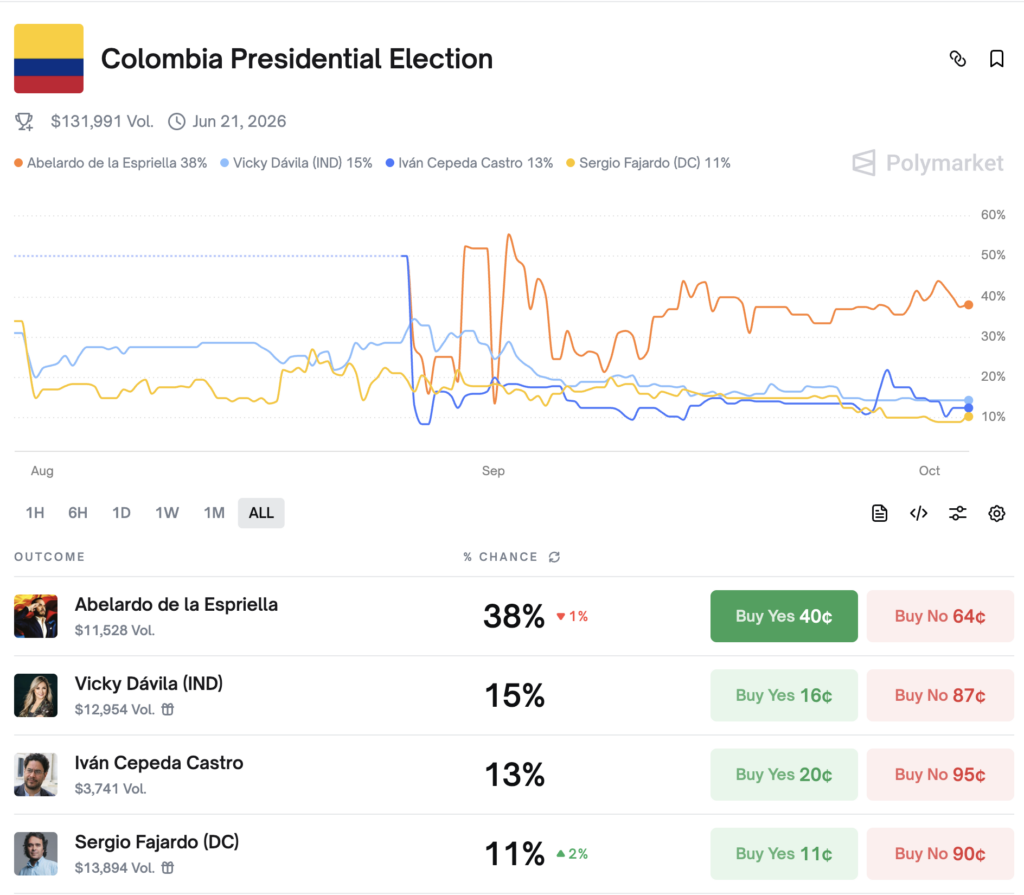
Polymarket – Colombia Presidential Election market
Democratic interference
Evert Montero Cárdenas, president of Fecoljuegos, expressed concerns about potential electoral manipulation.
“Our greatest concern is that betting on electoral events or electoral activities is being allowed,” said Montero Cárdenas. “And I think this is a call we need to make to review it and take decisive action against Polymarket. Because ultimately, this could interfere with the free development of these electoral events that are about to take place in the country.”
The federation warned that such platforms could facilitate misinformation and undermine the democratic process. Montero Cárdenas added that these electoral events “could be manipulated or used to distort the reality of electoral activity”.
No legal oversight
Polymarket functions without local regulatory approval, bypassing age verification and responsible gaming policies required under Colombian law. The platform’s use of cryptocurrencies raises additional concerns about financial traceability and anonymous betting, which hinder regulatory oversight.
Fecoljuegos emphasised that licensed operators in Colombia contribute significantly to public welfare, including healthcare funding through mandatory contributions. The trade body represents 76% of authorised online platforms in the country, with members present in over 200 Colombian municipalities.
More international restrictions
Following Fecoljuegos’ call for action, Colombian gambling regulator Coljuegos officially banned Polymarket from operating in the country. Marco Emilio Hincapié, president of Coljuegos, declared that prediction markets constitute illegal gambling despite platform supporters’ claims that such activity represents trading or forecasting.
The ban joins similar restrictions imposed by multiple jurisdictions, including Belgium, France, Switzerland, Singapore, Taiwan and Poland. Belgium blocked Polymarket in January 2025 following warnings from the Belgian Gaming Commission for non-compliance with national gambling laws.
Colombia’s action reflects broader regulatory scrutiny of prediction markets that blur traditional boundaries between financial trading and gambling. Coljuegos has blocked more than 28,000 unlicensed websites to date, with plans to add another 3,000 by year-end.
The regulator noted that 14 licensed online gambling companies currently operate legally in Colombia, contributing COP257 billion (€56.5 million) to subsidised healthcare and nearly COP783 billion (€172.3 million) in value-added tax revenue this year.
Do you have a story worth sharing?
Send it over to our editors!