Charlotta Shelbourg, LeoVegas: Invisible KYC doesn’t mean no KYC

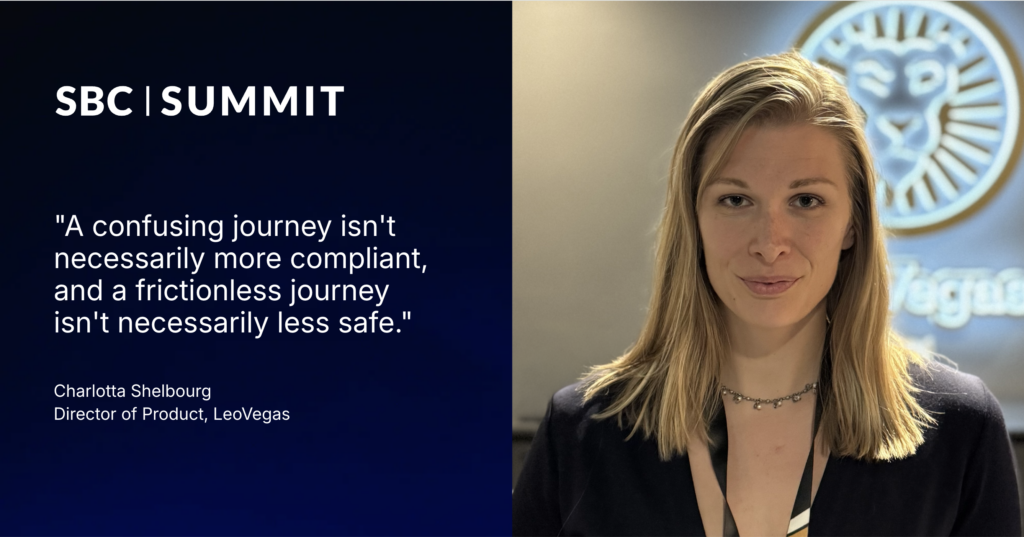
Charlotta Shelbourg, Director of Product at LeoVegas, explains why invisible KYC is less about stripping out checks and more about relocating them, and how onboarding friction and regulatory pressure can reinforce each other instead of pulling in opposite directions.
Onboarding friction and regulatory pressure keep pulling operators in opposite directions: cut the checks and players convert faster, add more and compliance gets easier to defend.
“Invisible KYC” has become the industry’s shorthand for escaping that trade-off altogether, but there’s a real gap between the concept as a talking point and what’s actually deployable market by market.
Charlotta Shelbourg is Director of Product at LeoVegas, where onboarding design sits directly against that tension. She brings a product lead’s view to a debate that usually stays at the level of vendor pitches and panel titles.
Shelbourg will be speaking on the panel “RegTech: Is ‘invisible KYC’ actually achievable or just another industry fantasy?” at SBC Summit on Wednesday 30 September, 11:00–11:40 local time, alongside Giorgi Tsamalaidze (Random Systems Georgia) and Matteo Iannucci (GeoComply), moderated by Ana Barbara Teixeira (AMIG).
Ahead of that session, she spoke to iGaming Republic about what invisible KYC actually means in practice, where automation should stop, and whether product teams can really design for players and regulators at once.
This Q&A breaks down:
- What “invisible KYC” actually means once you strip away the industry hype
- Where automation should hand off to a human reviewer, and why
- Whether product teams can genuinely design for the player and the regulator at the same time
Let’s dive in!
iGaming Republic: “Invisible KYC” sounds like the industry’s dream fix for onboarding friction. How close are we actually to delivering that, versus just talking about it?
Charlotta Shelbourg: I think we’re closer than we sometimes make it sound. A lot of KYC can, and already does, happen in the background today, although of course it depends heavily on the market and the regulation.
For me, invisible KYC doesn’t mean “no KYC”. It means that the player shouldn’t have to actively do something for the KYC to happen. And I think that’s possible much more often than we realise.
Today, there are so many different data points available throughout the customer journey: identity data, fraud signals, device information, and payment data. Not just the traditional KYC methods. By using those signals together, invisible KYC is already becoming a reality in many markets.
The bigger challenge now is consistency. Regulation, available data sources and identity infrastructure still vary significantly between markets and I don’t think there will be one global solution. We’ll get there market by market, localisation will be key.
“Invisible KYC doesn’t mean ‘no KYC’. It means that the player shouldn’t have to actively do something for the KYC to happen.”
Charlotta Shelbourg, Director of Product at LeoVegas
iGR: Operators lose players at onboarding just as regulators demand more checks. How do you reconcile those two pressures when designing the actual flow?
CS: I don’t necessarily see those as opposing goals. A good onboarding experience isn’t about having fewer checks; it’s about making the necessary checks as relevant and effortless as possible.
There’s also an interesting shift when players already expect that certain checks need to happen. At that point, the question becomes less about removing the obstacle and more about designing the best possible journey through it. And I think getting that right can actually become part of your retention strategy.
One very tangible thing operators can do, is to make better use of information already at hand. Even if it was originally collected for another purpose, where regulation allows us to reuse it, we should. This allows us to avoid asking the same question twice. Friction should only be introduced when there is a genuine reason for it.
And in the cases friction is necessary, explain why it’s introduced and make sure to do so at the right moment. Players are much more accepting of an extra step when they understand what information we’re asking for and why we need it.
iGaming Republic readers can save 30% on VIP, Conference, Networking and Business passes using code IGRPARTNERVIP at checkout.
iGR: Where should the system pause automation and hand a case over to a human reviewer?
CS: When the system is no longer confident enough to make the right decision quickly.
Automation is fantastic for clear, repeatable cases. But when information conflicts, or when a decision could have a significant impact on the customer, for example blocking an account, I think human judgement still has an important role.
The goal shouldn’t be to automate 100 percent of cases. It should be to automate the obvious ones, so that our people can spend their time on the cases that genuinely require judgement.
iGR: As fraud becomes more sophisticated, could invisible KYC mean more monitoring after onboarding rather than fewer checks at registration?
CS: Absolutely. I actually think that’s an important part of where the industry needs to go.
Identity and risk aren’t things you establish once at registration and then forget about. Behaviour changes, payment patterns change, and devices change needs to be monitored. Cause we need to continuously understand whether the person using the account is still the person we originally verified.
If we can establish enough confidence to let a legitimate player onboard smoothly and then continuously assess risk in the background, we can create both a better player experience and stronger protection.
So invisible KYC may ultimately be less about removing checks and more about moving the right checks to the right moment in the customer journey.
“Invisible KYC may ultimately be less about removing checks and more about moving the right checks to the right moment in the customer journey.”
Charlotta Shelbourg, Director of Product at LeoVegas
iGR: The panel title asks: are we designing for the player or the regulator? What’s your honest answer, and can product teams really serve both?
CS: We have to design for both, but I will always start with the player.
Regulation gives us the boundaries and requirements we need to operate within. Product’s job is to take those requirements and turn them into an experience that still feels intuitive, trustworthy and enjoyable for the player.
And I genuinely think the best solutions serve both. A confusing journey isn’t necessarily more compliant, and a frictionless journey isn’t necessarily less safe.
That’s really the interesting product challenge: finding the experience where player needs and regulatory requirements reinforce each other rather than compete.
“A confusing journey isn’t necessarily more compliant, and a frictionless journey isn’t necessarily less safe.”
Charlotta Shelbourg, Director of Product at LeoVegas
iGR: Looking beyond your panel, what are you most looking forward to at the SBC Summit this year?
CS: For me, it’s the conversations and the people you meet in and around the event.
Our industry is changing incredibly quickly: AI, regulation, personalisation, payments, identity… The list goes on. Events like SBC are one of the few opportunities where you have operators, suppliers and regulators in the same place.
I’m looking forward to hearing what other people are celebrating, where they’re struggling, and hopefully I’ll come home with a few interesting ideas that can challenge what we currently think.
iGaming Republic readers can save 30% on VIP, Conference, Networking and Business passes using code IGRPARTNERVIP at checkout.
About the author
Bianca Máthe
Bianca Máthe is Publisher of iGaming Republic. She spent close to a decade on the supplier side of iGaming, working across the sector's core verticals: platform and player-engagement technology and crypto payments. That mix gave her a working knowledge of how operators, suppliers and payment providers actually run. In 2025 she started a media project, bringing that operational grounding to her editorial work. Her output includes interviews with high-profile iGaming executives, original reports, and in-depth features covering licensing, M&A, and the operators and suppliers shaping the sector. Based in Malta, she spends much of her time getting closer to emerging sectors like prediction markets, tracking how they're developing before the rest of the industry catches up.
Do you have a story worth sharing?
Send it over to our editors!