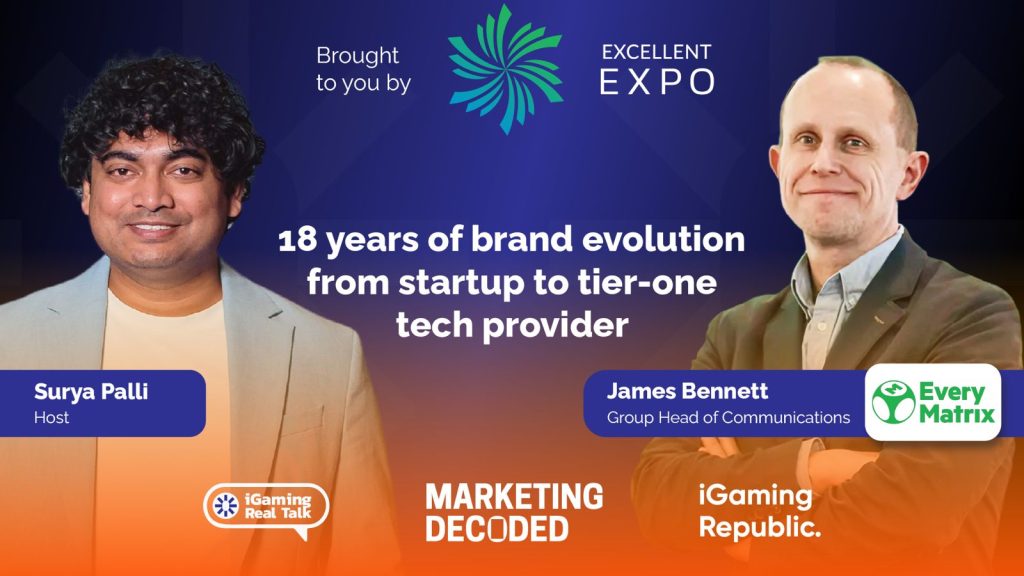
EveryMatrix x Marketing Decoded: 18 years of brand evolution from startup to tier-one tech provider

- From product lines to unified brand positioning
- Targeting tier-one while staying humble
- Refusing to play the buzzword game
- "Everything is Possible": philosophy meets positioning
- The 30-minute launch myth
- From spray and pray to content-driven lead generation
- When deals take years to sign
- Advice for B2B startups: don't fake it
- Marketing Decoded debuts at ICE Barcelona 2026, featuring seven CMOs and marketing leaders from major B2B iGaming providers.
- In this episode, James Bennett, Group Head of Communications at EveryMatrix, discusses brand consolidation, tier-one positioning, and why “not everything needs a name.”
- Series presented by Excellent Expo, produced by iGaming Real Talk and iGaming Republic, focusing on actionable marketing insights.
A new interview series spotlighting iGaming’s marketing leaders has launched from ICE Barcelona 2026. Marketing Decoded brings together seven Chief Marketing Officers and heads of marketing from leading B2B providers to share the strategies behind their brands’ success.
This episode features James Bennett, Group Head of Communications at EveryMatrix, who reveals how an 18-year-old company evolved from promoting individual product lines to unified brand positioning, why simplicity beats buzzwords, and how data becomes a competitive moat that competitors cannot replicate.
EveryMatrix is a turnkey iGaming software provider serving operators, lotteries, and platforms worldwide. Founded 18 years ago in 2008, the company has built a reputation as the industry’s educational resource, combining deep technical expertise with clear, accessible communication that helps newcomers and iGaming veterans to understand the complex iGaming ecosystem.
From product lines to unified brand positioning
EveryMatrix has undergone significant brand consolidation over the past three years. The company previously marketed individual business units like OddsMatrix and PartnerMatrix as separate brands. Now, everything sits under one unified EveryMatrix umbrella.
“The branding was very much about branding the different business units. Now we’ve actually taken that under the hood of EveryMatrix, under the umbrella of the business,” James explained during the interview.
This shift reflects a strategic evolution in how the company positions itself. Rather than selling individual products, EveryMatrix now leads with its turnkey capabilities, the ability to run an entire operation from the ground up.
“We’re evolving more into pushing the turnkey side of our business, the turnkey software and turnkey technology. We can effectively run an entire operation, an entire business,” he added.
The company currently works with seven lotteries, running several of them completely. This positions EveryMatrix not as a collection of tools, but as a comprehensive technology partner for tier-one operators.
Targeting tier-one while staying humble
EveryMatrix has deliberately shifted its focus from tier-three and tier-two operators to tier-one businesses with big ambitions in regulated markets. James defines tier-one as brands in the top five positioning in any global regulated market.
“The business has gone from startup to tier three, tier two. And now we’re really focusing on tier one businesses. We’re looking to work with and partner with tier one operators, tier one lotteries,” he said.
Despite this upward positioning, the company maintains what James calls a commitment to staying humble. At ICE Barcelona, EveryMatrix’s stand featured a massive screen, yet James was quick to put it in perspective.
“The stand is big, but it’s not by any means the biggest or anything like that. We spend within our limits and we kind of make sure that’s all we need,” he noted.
This approach extends to how the company thinks about events. After 18 years, top management knows the majority of people in the industry, making the audience smaller and more mature.
For James, ICE remains the non-negotiable yearly occasion to reconnect with the industry, saying that this is the one event they cannot miss. The company measures success through the number of meetings held and potential deals closed rather than pure visibility metrics.
Refusing to play the buzzword game
One of EveryMatrix’s most distinctive positions is its deliberate rejection of industry buzzwords and over-branding. The company has a wide range of products across all iGaming verticals, but James is adamant that not everything needs a branded name anymore.
“I don’t think everything needs a name. There’s a thing in the industry where literally, you know, I’m obsessed with upper casing and lower casing and things like that. Not everything needs a name,” he explained.
For James, clarity matters more than clever naming. Products should be described by what they do, not wrapped in marketing language that obscures their function.
“It solves bonus abuse or it helps solve bonus abuse. Engage Suite helps drive player engagement. We’re trying to keep it simple. You don’t need to be complex and you don’t need to flood the industry with a lot of buzzwords,” he said.
This philosophy stems from a genuine concern about industry accessibility. James believes that if a newcomer tried to decode the iGaming industry today, they would struggle because the language has become so convoluted.
“If a newcomer was to come to this industry and try and decode the industry, they wouldn’t be able to because it’s so complex. So we try and demystify it,” he noted.
This commitment to simplicity is exactly why EveryMatrix became the go-to educational resource for industry newcomers, clear blog articles that explain complex concepts without jargon or pretense.
“Everything is Possible”: philosophy meets positioning
EveryMatrix’s slogan, “Everything is Possible,” carries a distinctly optimistic, almost lifestyle-brand tone that feels more Nike than B2B software. James explains the philosophy behind it runs deeper than marketing copy.
The slogan reflects EveryMatrix’s commitment to bespoke solutions. It is not about selling off-the-shelf software and walking away. It is about building something that works for a specific operator, in a specific market, with specific regulatory requirements.
“It’s not just an off-the-shelf solution that we’re going to give you and it’s going to fail on day two. We have to try and make it work for a specific operator, a specific market, maybe a specific segment of players,” he said.
James is honest about the limits. Not everything is actually possible. But the philosophy pushes the team to approach customer challenges with a problem-solving mindset rather than simply pointing to existing features.
The 30-minute launch myth
When asked about competitors claiming operators can launch in 30 minutes, James did not hold back.
“If you were to ask our developers, they would probably try and hide under their desks. To me, it’s just a gimmick. I’m going to be cynical and say it’s just a marketing play,” he said.
EveryMatrix has learned through their 18 years of experience that integration, especially at scale, takes serious time and effort. For tier-one operators with complex requirements across multiple regulated markets, speed cannot come at the expense of customization or stability.
“We’ve learned the hard way that integration can be very tough, especially when it comes to large scale. Maybe if it’s a small company or small problem they might have, maybe they can do it in 30 minutes. But you can’t do that on a big scale,” James explained.
This stance reinforces the company’s positioning: EveryMatrix is not competing on flashy promises or chasing well-funded startups with a 3-year life cycle. It is about competing on delivering solutions to the biggest names in the industry and building relationships so good that they actually matter when the stakes are high.
From spray and pray to content-driven lead generation
EveryMatrix has shifted its marketing approach from broad brand awareness campaigns to targeted, content-driven lead generation. The company no longer needs to introduce itself to the market. After 18 years, awareness is not the challenge.
“We have done brand building in the past. Now we’re focusing more on trying to convert those into generating leads. We’re very focused on content-driven campaigns. We don’t do spray and pray anymore,” James said.
One standout example is Slot Trumps, a data-driven content campaign that analyzed game performance across different markets. Using EveryMatrix’s own platform data, the campaign provided operators with insights they could not get anywhere else.
“We looked at all the different markets and how, using our own data, we could create content to educate the industry and provide them with something they’d never seen before,” James explained.
The campaign revealed which games performed best in specific markets, what the most popular themes were, average deposit sizes, and other metrics that help operators make informed decisions when launching in new territories.
“We’re not just talking about our games, but our competitors’ games, our partners’ games. We can say what the most popular game is, what the most popular deposit is, the most popular themes. If you’re launching into a new market like Brazil, we’re just giving them a little bit of insight,” he added.
Getting buy-in from the business to share this data was not easy, but it became a key differentiator. Very few companies have decades of platform data, and even fewer are willing to surface it publicly in a way that helps the entire industry.
When deals take years to sign
B2B iGaming sales cycles are notoriously long, but James shared a reality that many marketers struggle to communicate to leadership: some deals take not just months, but years.
“Talking to some of the lottery colleagues, it can take years and years and years. If we’re looking at lotteries in Africa, for example, you can even go decades without actually signing a contract and then eventually it might pay off,” he revealed.
This timeline fundamentally changes how EveryMatrix thinks about marketing ROI. Traditional lead generation metrics do not capture the reality of relationship-driven sales in regulated markets where procurement processes move slowly and trust is built over years, not quarters.
For casino and sports betting clients, timelines can be shorter. EveryMatrix has closed deals on the stand at ICE within two months. But for lotteries and tier-one operators entering new markets, patience is not optional, it is the business model.
Advice for B2B startups: don’t fake it
When asked what advice he would give to startups trying to compete in the crowded B2B iGaming space, James was direct.
“The advice is to be selective, to really focus and narrow in on your audience and just focus on one or two things. Get a few clients, do it well. That’s the hard thing,” he said.
He specifically cautioned against trying to compete at every event, particularly ICE, when resources are limited.
“Don’t try and compete with everyone at ICE. Don’t do anything at ICE necessarily. Do a little bit before, do a little bit afterwards. And don’t try to be bigger than you are. I see a lot of brands trying to take the approach of fake it till you make it,” he advised.
Instead, James recommended investing in marketing to build awareness, but doing so strategically. Use data if you have it. Leverage visuals, since iGaming is an inherently visual business. Focus on proving the model with a handful of clients rather than trying to be everywhere at once.
“They’re very reluctant to invest in marketing upfront before having clients because they want to prove the model. But they have to invest in marketing. They have to do something to build up some kind of awareness,” he said.
Marketing Decoded is presented by Excellent Expo and produced by iGaming Real Talk in collaboration with iGaming Republic. The complete series features six additional episodes with marketing leaders from: Elen Atanesyan (18Peaches), Märit von Stedingk (Alea), Yaroslava Romaniv (GR8 Tech), Valentina Bagniya (SOFTSWISS), Tereza Melicharkova (Elantil), and Irina Veselkova (Endorphina).
Watch the previous episodes now:
About the author
Bianca Máthe
Bianca Máthe is Publisher of iGaming Republic. She spent close to a decade on the supplier side of iGaming, working across the sector's core verticals: platform and player-engagement technology and crypto payments. That mix gave her a working knowledge of how operators, suppliers and payment providers actually run. In 2025 she started a media project, bringing that operational grounding to her editorial work. Her output includes interviews with high-profile iGaming executives, original reports, and in-depth features covering licensing, M&A, and the operators and suppliers shaping the sector. Based in Malta, she spends much of her time getting closer to emerging sectors like prediction markets, tracking how they're developing before the rest of the industry catches up.
Do you have a story worth sharing?
Send it over to our editors!